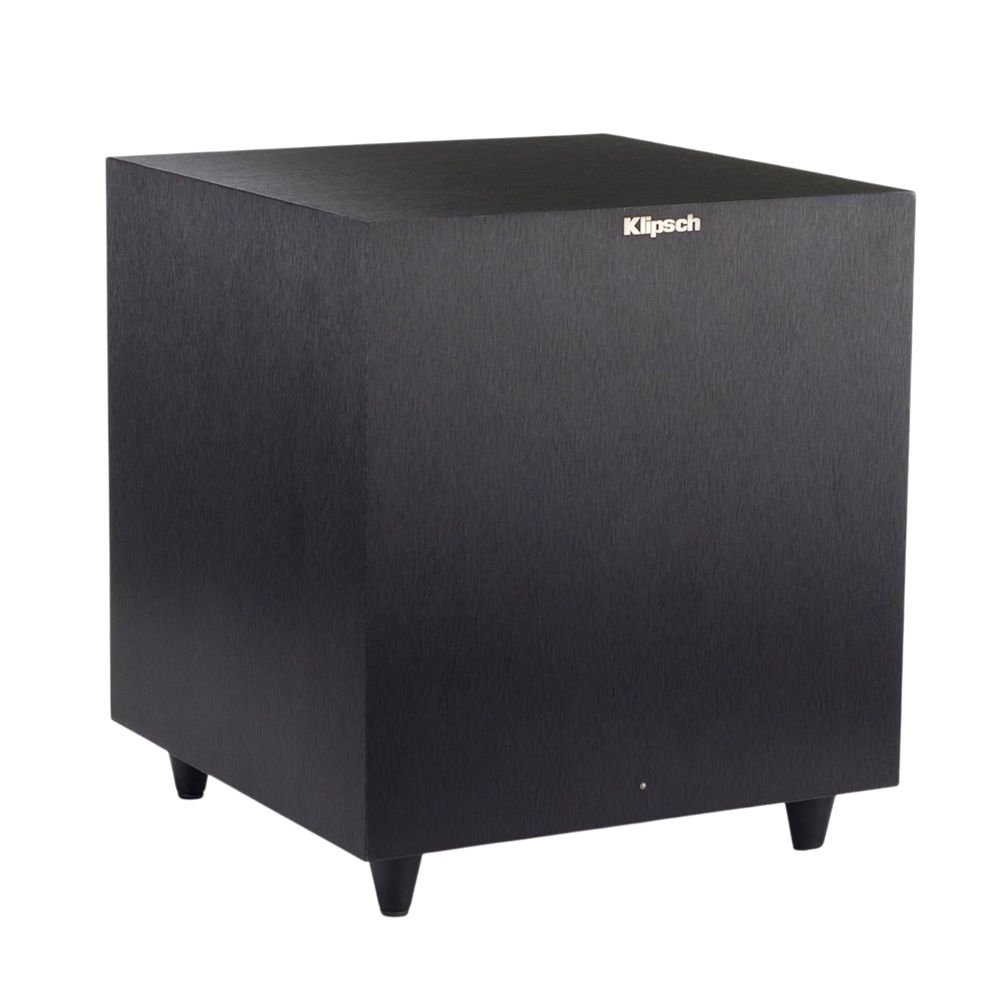
The Klipsch Reference R-8SW is the subwoofer to buy when floor space is the main constraint. It is Klipsch’s smallest sub, it plugs into any AV receiver’s subwoofer output, and its down-firing 8-inch woofer keeps the look discreet beside a TV stand or desk.
Skip it for a big living room or if you want deep, loud movie bass. Klipsch rates it to 38 Hz and 108 dB, which is a step below the 10-inch R-100SW, and its amplifier is rated at 50 watts continuous. It also cannot connect to an amplifier that only has speaker terminals.
ArmorSound did not test the R-8SW. This research review is built from Klipsch’s spec sheet and owner’s manual, setup guidance from Audioholics and Sound & Vision, and the published specs of the subs you are likely comparing it with.
A tidy small-room sub that trades depth for size
The R-8SW is Klipsch’s smallest subwoofer, rated to 38 Hz and 108 dB, and it plugs into any receiver’s sub output. Buy it for bedrooms, apartments and tight spots; get a 10-inch sub for movie rumble in a living room.
- Bedrooms, dens and apartments
- Receivers with a Sub Out or LFE jack
- Tight spots beside a TV stand
- Large or open-plan living rooms
- Amps with only speaker terminals
- Loud, bass-heavy movie nights
Where to buy
 Our verdict
Klipsch Reference R-8SW
Best for: Small rooms and compact setups
- Driver
- 8-inch down-firing IMG woofer
- Amplifier
- 50W continuous / 150W peak
- Frequency response
- 38–120 Hz ±3 dB
- Size (H x W x D)
- 13.25 x 11.75 x 11.75 in
- Weight
- 15 lb
- Klipsch’s most compact sub at 15 lb
- Line/LFE RCA input works with any receiver sub out
- Down-firing driver keeps the cone out of sight
- Low-pass, phase and auto power controls
- Rated only to 38 Hz
- Modest 50W continuous amplifier
- No speaker-level inputs
Watch for: It is rated to 38 Hz and 108 dB, so it suits small rooms and will run out of headroom in a big, open living space.
Check price on Amazon →What are the Klipsch R-8SW key specs?
| Spec | Klipsch Reference R-8SW |
|---|---|
| Driver | 8-inch (20.3 cm) high-excursion IMG woofer, down-firing |
| Amplifier | All-digital, 50W continuous / 150W peak |
| Frequency response | 38–120 Hz ±3 dB |
| Maximum output | 108 dB |
| Enclosure | MDF, bass reflex via down-firing tube port |
| Inputs | Line-level/LFE RCA jacks |
| Controls | Volume, low-pass, 0/180 phase switch, auto power |
| Size (H x W x D) | 13.25 x 11.75 x 11.75 in |
| Weight | 15 lb (6.8 kg) |
| Finish | Brushed black polymer veneer |
All of these numbers come from Klipsch. We could not find an independent lab measurement of the R-8SW from a major publication, so read the 38 Hz and 108 dB figures as manufacturer ratings. Klipsch lists no remote control; every adjustment lives on the back panel.
What can a down-firing 8-inch sub do, and what are its limits?
Klipsch pitches the R-8SW for smaller rooms, and its numbers back that up. Next to the 10-inch R-100SW (32 Hz, 112 dB, 150W continuous), the R-8SW gives up 6 Hz of rated extension, 4 dB of rated output and two-thirds of the continuous amplifier power.
On paper, that makes it a sub for adding low-end weight to small speakers in small rooms, with less headroom for loud, low movie effects in a large space. For scale, each 3 dB of extra output takes roughly twice the amplifier power, so a 4 dB gap is a real difference.
The cabinet design is the R-8SW’s real selling point. Both the woofer and the tube port fire downward, so nothing pokes out of the front, and the box is only 11.75 inches deep. Klipsch says the down-firing layout adds placement flexibility. Give it a firm, level surface and keep the gap under the cabinet clear, since that gap is where all of its output leaves the box.
Can the R-8SW connect to a receiver or a soundbar?
The R-8SW has line-level/LFE RCA jacks. Klipsch’s manual covers two ways in:
- From a receiver’s Sub Out, SW Out or Subwoofer Pre Out into the sub’s LEFT/LFE input with one subwoofer cable. Klipsch says this handles music and surround movies.
- From a receiver’s left and right pre-amp outputs into the sub’s L/LFE and R inputs, if there is no dedicated sub output.
There are no speaker-level inputs, so a stereo amp with only speaker terminals cannot drive it. The Polk Audio PSW10 is the obvious workaround: Polk lists spring-terminal speaker inputs as well as RCA.
Most soundbars with their own wireless subs only accept their own brand’s module, so the R-8SW will not pair with them; our Bose Bass Module 700 review and Sonos Sub 4 review explain those closed systems. A Sonos Amp is an exception: Sonos lists an auto-detecting RCA subwoofer output with a 50–110 Hz crossover, so an Amp driving passive bookshelf speakers can use the R-8SW. If your speakers are powered desktop models, our Audioengine S8 review covers a compact sub built for that kind of system.
What crossover setting should I use with small speakers?
People usually pair an 8-inch sub with small bookshelf or satellite speakers, so the crossover matters more here than with big floorstanders.
- With an AV receiver: set the speakers to Small and start at 80 Hz, the starting point Audioholics recommends for most systems. Audioholics adds that if your speakers are rated flat to about 60 Hz, 80–90 Hz is a sensible setting. Then turn the R-8SW’s low-pass knob fully clockwise (160 Hz, per Klipsch) so the receiver handles the filtering.
- Without receiver bass management: Klipsch suggests 90–150 Hz for small bookshelf or satellite speakers, going higher as the speakers get smaller, and 50–90 Hz for floorstanders.
- Level and phase: set the receiver’s sub level to its halfway or 0 dB point, raise the R-8SW’s gain until it matches the main speakers, then flip the phase switch between 0 and 180 and keep whichever gives more bass at your seat.
Watch the top end. The R-8SW is rated up to 120 Hz, and Sound & Vision notes that bass below the typical 60–100 Hz crossover range is non-directional. Push the crossover well past that and the sub starts carrying sound you can localize.
In Auto mode the sub wakes on signal and drops to standby after 15–20 minutes without one, per Klipsch’s manual.
Where should I put the R-8SW?
Klipsch’s manual recommends a corner on the same wall as the front speakers. Corners raise bass output; the middle of a wall or a spot out in the room lowers it. In a small room that extra corner gain can help an 8-inch driver, but it can also exaggerate a boomy note, so be ready to pull it a little way out.
For a better result, try the subwoofer crawl that Sound & Vision describes. Put the sub on your seat, play a bass-heavy track or a slow sweep, and move around the floor with your ears at the height of the sub’s driver. Wherever the bass sounds deepest and smoothest is where the sub should go.
Sound & Vision also notes that one subwoofer can only be optimized for one seat. Two small subs on opposite walls can give more even bass across a sofa than one bigger box, which makes a pair of R-8SWs a reasonable plan in a room where floor space is scattered. Our complete subwoofer guide walks through that setup.
R-8SW vs R-100SW: when is 8 inches enough?
This is the real buying decision, and the spec sheets make it easy to frame.
| Spec | R-8SW | R-100SW |
|---|---|---|
| Driver | 8-inch, down-firing | 10-inch, front-firing |
| Amplifier (cont./peak) | 50W / 150W | 150W / 300W |
| Rated response | 38–120 Hz ±3 dB | 32–120 Hz ±3 dB |
| Max output | 108 dB | 112 dB |
| Size (H x W x D) | 13.25 x 11.75 x 11.75 in | 14.5 x 12.5 x 16.4 in |
| Weight | 15 lb | 24 lb |
The R-100SW needs about 4.6 more inches of depth and weighs 9 lb more. In exchange you get deeper rated extension, more output and three times the continuous amplifier power. If you can fit it, the bigger box is the better subwoofer; our Klipsch R-100SW review covers it, including its newer R-101SW replacement.
Who should buy the R-8SW, and who should skip it?
Buy the R-8SW if:
- You have a small room, a bedroom setup or a desk system.
- Your receiver has a Sub Out, LFE or pre-out jack.
- You need a sub that fits a tight gap and hides its driver.
- You want a cheap first sub to fill out small bookshelf speakers.
Skip it if:
- You are filling a large or open-plan living room.
- Your amplifier only has speaker terminals.
- You use a Bose or Sonos soundbar that only pairs with its own sub.
- You mostly watch effects-heavy movies at high volume.
What alternatives to the Klipsch R-8SW should I consider?
| Model | Driver | Rated low end | Connection | Weight |
|---|---|---|---|---|
| Klipsch R-8SW | 8-inch, down-firing, ported | 38 Hz (±3 dB) | Line/LFE RCA | 15 lb |
| Klipsch R-100SW | 10-inch, front-firing, ported | 32 Hz (±3 dB) | Line/LFE RCA | 24 lb |
| Klipsch R-101SW | 10-inch, front-firing, ported | 29.5 Hz | Line/LFE RCA | 31 lb |
| Polk Audio PSW10 | 10-inch, front-firing, ported | 40 Hz (−3 dB) | Line RCA + speaker-level | 26 lb |
| Sonos Sub Mini | Dual 6-inch, sealed | As low as 25 Hz | Wireless, Sonos only | 14 lb |
Klipsch R-100SW. The 10-inch step up from the same family, with three times the continuous power and a 32 Hz rating. Klipsch now points buyers from it to the newer R-101SW.
Klipsch R-101SW. The current 10-inch Reference sub, rated to 29.5 Hz and 115 dB. It is far bigger (19.7 inches deep, 31 lb), so it suits living rooms rather than the small spaces the R-8SW targets.
Polk Audio PSW10. A 10-inch budget sub that adds speaker-level inputs, which makes it the pick for older stereo amps with no sub output. Polk rates it to 40 Hz at −3 dB. Read our Polk PSW10 review.
Sonos Sub Mini. If your “system” is a Sonos Ray, Beam or Era 100, a wired Klipsch will not connect. Sonos’s compact wireless sub uses two inward-facing 6-inch woofers in a sealed cabinet and weighs 14 lb. See our Sonos Sub Mini review, or browse more compact subwoofers.
Frequently asked questions
Is the Klipsch R-8SW front-firing or down-firing?
Down-firing. Klipsch’s spec sheet lists an 8-inch high-excursion IMG woofer that fires at the floor, plus a down-firing tube port. Keep the space under the cabinet clear and set it on a firm, level surface so the driver and port can breathe.
Does the Klipsch R-8SW come with a remote?
Klipsch does not list a remote. The controls are on the back panel: volume, a low-pass crossover knob, a 0/180 phase switch and an auto power setting. Once you connect it to a receiver, you normally adjust the sub level and crossover from the receiver’s setup menu and its own remote.
Can the R-8SW work with a soundbar?
Only with a soundbar that has a wired subwoofer output, because the R-8SW accepts line-level/LFE RCA signals only. Soundbars from brands such as Bose and Sonos pair only with their own wireless subs. The Sonos Amp is an exception in that family, since Sonos lists an RCA subwoofer output on it.
What size room is the R-8SW good for?
Klipsch describes it as suited to smaller rooms, and the specs agree: 38 Hz extension, 108 dB maximum output and a 50W continuous amplifier. It fits bedrooms, dens, apartments and desk setups. In a large or open-plan living room, a 10-inch model such as the R-100SW or R-101SW has more headroom.
Can I use two R-8SW subwoofers?
Yes, if your receiver can feed two subs. Sound & Vision cites Harman research showing that two subs on opposite walls give more even bass across several seats than one. The goal is consistency from seat to seat rather than more volume, so a pair of small subs can beat one larger sub in a multi-seat room.
Sources
- Klipsch: R-8SW product page
- Klipsch: R-8SW spec sheet (PDF)
- Klipsch: Reference subwoofers (R-8SW/R-10SW/R-12SW) owner’s manual (PDF)
- Klipsch: R-100SW spec sheet (PDF)
- Klipsch: Reference R-101SW spec sheet (PDF)
- Polk Audio: PSW10 product page and specs
- Sonos: Sub Mini tech specs
- Sonos: Amp tech specs (subwoofer output)
- Audioholics: AV receiver bass management basics
- Sound & Vision: Subwoofer setup in 3 steps
What do the R-8SW's numbers mean for a small room?
Klipsch's ratings and published setup advice show where this sub fits. These are manufacturer figures, not independent lab measurements.
- Klipsch rates the R-8SW down to 38 Hz, 6 Hz short of the R-100SW, so expect less deep rumble.
- Maximum output is 108 dB, 4 dB below the R-100SW, which leaves less headroom in a large room.
- Audioholics recommends 80 Hz as the starting crossover for most systems. (audioholics.com)
- Per Sound & Vision, bass below 60 to 100 Hz is non-directional, so a far higher crossover reveals the sub. (soundandvision.com)
- In Auto mode the sub drops to standby after 15 to 20 minutes without a signal. (d2um2qdswy1tb0.cloudfront.net)