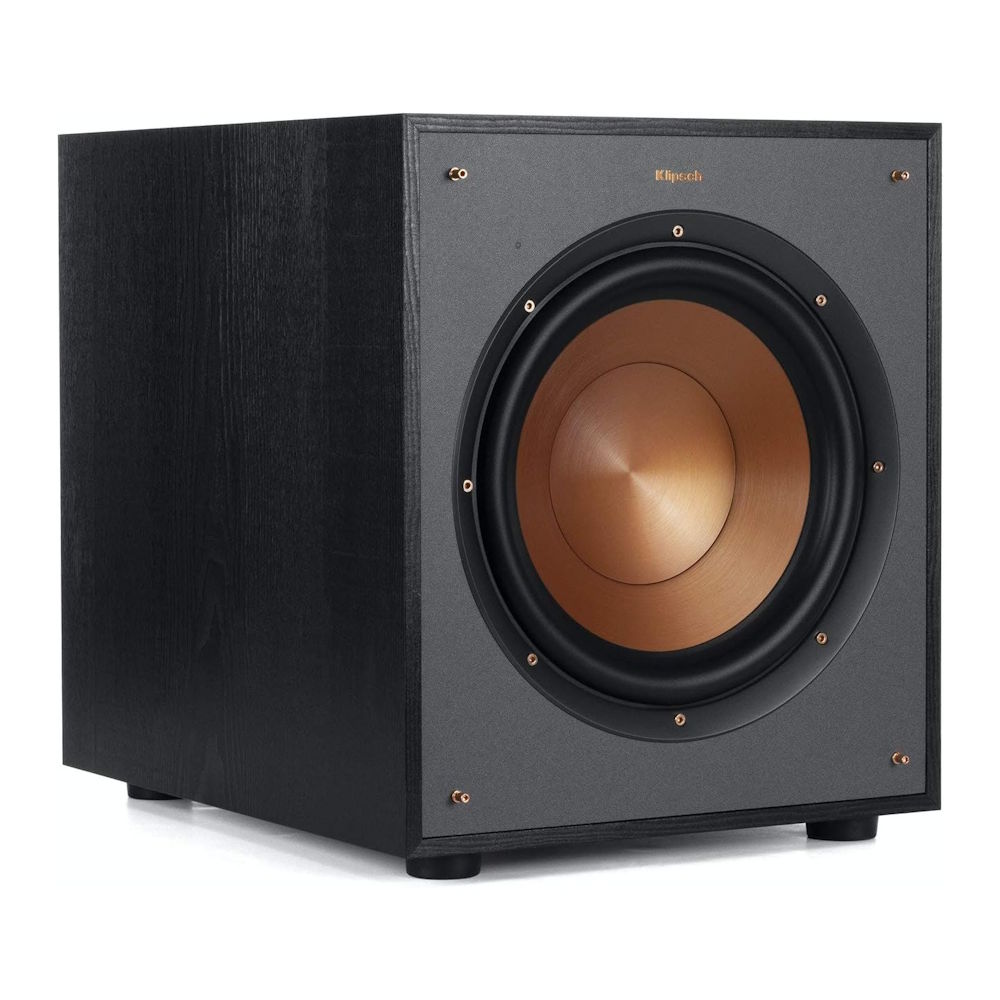
The Klipsch R-100SW is a 10-inch powered subwoofer for people with an AV receiver who want proper bass under movies and music without spending much. It connects with one RCA cable, Klipsch rates it down to 32 Hz, and the back panel has exactly the three controls you need.
Skip it if your amplifier has no subwoofer output, or if you want app control and room correction built into the sub. Also check the price of its replacement first: Klipsch’s own R-100SW page now carries a banner pointing shoppers to the newer Reference R-101SW.
ArmorSound did not test the R-100SW. This research review draws on Klipsch’s spec sheet and owner’s manual, setup guidance from Audioholics and Sound & Vision, and the published specs of its closest rivals.
An easy receiver upgrade, now outgoing, so buy it discounted
The R-100SW adds real low end to any AV receiver with a sub output, and Klipsch rates it down to 32 Hz. Klipsch now steers shoppers to the R-101SW, so the older model only makes sense at a clear discount or in a tight space.
- AV receivers with a Sub Out or LFE jack
- Small and mid-size living rooms
- Klipsch Reference speaker systems
- Your amp only has speaker terminals
- You want app control or room EQ in the sub
- The R-101SW costs about the same
Where to buy
 Our verdict
Klipsch R-100SW
Best for: Budget receiver-based home theaters
- Driver
- 10-inch front-firing IMG woofer
- Amplifier
- 150W continuous / 300W peak
- Frequency response
- 32–120 Hz ±3 dB
- Inputs
- Line-level/LFE RCA
- Weight
- 24 lb
- Rated down to 32 Hz with 112 dB max output
- One RCA cable connects it to any receiver sub out
- Volume, low-pass and phase controls on the back
- Auto power-on with standby after idle
- No speaker-level inputs for older stereo amps
- No app, EQ or room correction
- Klipsch now promotes the newer R-101SW
Watch for: It only accepts line-level RCA, so an amplifier without a Sub Out or pre-outs has no way to feed it.
Check price on Amazon →What are the Klipsch R-100SW key specs?
| Spec | Klipsch R-100SW |
|---|---|
| Driver | 10-inch high-excursion spun-copper IMG woofer, front-firing |
| Amplifier | All-digital, 150W continuous / 300W peak |
| Frequency response | 32–120 Hz ±3 dB |
| Maximum output | 112 dB |
| Enclosure | MDF, bass reflex via rear-firing port |
| Inputs | Line-level/LFE RCA jacks |
| Controls | Volume, low-pass crossover, 0/180 phase, auto power-on |
| Size (H x W x D) | 14.5 x 12.5 x 16.4 in |
| Weight | 24 lb (10.9 kg) |
Every figure above comes from Klipsch’s spec sheet. We could not find a lab measurement of the R-100SW from a major review publication, so read 32 Hz and 112 dB as manufacturer ratings. A previous version of this page listed 26 lb; Klipsch’s sheet says 24 lb.
How deep does the Klipsch R-100SW bass go?
The R-100SW pairs a 10-inch woofer with a rear-firing port in an MDF box. Klipsch rates it at 32–120 Hz within ±3 dB, which marks where output starts to fall away. Below 32 Hz it gets quieter fast.
The useful comparison is the rest of Klipsch’s range. The smaller R-8SW is rated to 38 Hz and 108 dB, the newer R-101SW to 29.5 Hz and 115 dB, and the 12-inch R-121SW to 28 Hz and 118 dB. The R-100SW sits in the middle: deeper and louder on paper than the 8-inch model, shallower than the newer 10-inch and 12-inch boxes.
Its amplifier is rated at 150 watts continuous and 300 watts peak. Do not shop on watts alone; the extension and maximum-output ratings tell you more about what the box can do in a room.
Because the port fires out the back, leave some breathing room between the cabinet and the wall rather than pushing it flush.
What can the Klipsch R-100SW connect to?
The R-100SW has line-level/LFE RCA jacks and nothing else. Klipsch’s manual describes two hookups:
- Receiver with a sub output. Run one subwoofer cable from the jack labeled Sub Out, SW Out or Subwoofer Pre Out to the sub’s LEFT/LFE input. Klipsch says this handles both music and surround movies.
- Receiver without a sub output. Connect the receiver’s left and right pre-amp outputs to the sub’s L/LFE and R inputs.
There are no speaker-level (spring-clip) inputs on the spec sheet. A vintage stereo receiver with only speaker terminals cannot feed it. If that is your setup, the Polk Audio PSW10 lists spring-terminal speaker inputs alongside its RCA jacks; our Polk PSW10 review covers it.
Soundbars are hit and miss. Most soundbars built around their own wireless subs only accept their own brand’s module, which is why our Bose Bass Module 700 review and Sonos Sub 4 review spend so much time on compatibility. Only a bar with a wired subwoofer output can drive the R-100SW.
One Sonos exception is worth knowing: the Sonos Amp has an auto-detecting RCA subwoofer output with an adjustable 50–110 Hz crossover, according to Sonos’s tech specs. A Sonos Amp running passive speakers can use the R-100SW instead of a Sonos Sub.
What crossover, phase and level settings should the R-100SW use?
Most of the R-100SW’s sound depends on three settings. Klipsch’s manual and Audioholics agree on the order of operations.
- Crossover. If your receiver handles bass management, set the speakers to Small and start the crossover at 80 Hz, the THX-derived starting point Audioholics recommends for most systems. Then turn the R-100SW’s low-pass knob fully clockwise (160 Hz, per Klipsch) so the receiver’s filter does the work.
- No receiver crossover: set it on the sub. Klipsch suggests 50–90 Hz with floorstanding speakers and 90–150 Hz with small bookshelf or satellite speakers, going higher as the speakers get smaller.
- Level. Klipsch says to set the receiver’s subwoofer level to the halfway or 0 dB point, then raise the sub’s own gain until its output matches your main speakers.
- Phase. Flip between 0 and 180 degrees from your seat and keep whichever position gives more bass.
If your receiver has a separate LFE crossover setting, Audioholics suggests 120 Hz, the top of the LFE channel’s range. The manual also describes an Off/Auto/On switch: in Auto, the sub wakes on signal and drops to standby after 15–20 minutes of silence.
Where should I put the R-100SW in my room?
Klipsch recommends a corner on the same wall as your front speakers. Corner placement raises bass output, and moving the sub to the middle of a wall or out into the room lowers it. Treat that as a starting point, because your room’s dimensions decide where bass peaks and dips.
The fastest way to find a good spot is the subwoofer crawl that Sound & Vision describes:
- Put the sub on your main seat, raised toward ear height.
- Play a bass-heavy track or a slow low-frequency sweep.
- Get down on the floor and move around the room with your ears where the sub’s driver will sit.
- Mark the spot where bass sounds deepest and smoothest, then move the sub there.
Sound & Vision points out that a single subwoofer can only be optimized for one seat. For a sofa full of people, two subs on opposite walls give more even bass from seat to seat, and Sound & Vision stresses that uniformity is the reason to add the second one. Our complete subwoofer guide covers multi-sub setups in more depth.
Should I buy the R-100SW or the R-101SW?
Klipsch’s R-100SW product page now reads “Shop the New Reference R-101SW.” Treat the R-100SW as the outgoing model. Here is what the newer box changes, per Klipsch’s spec sheets:
- Driver: a 10-inch spun-copper woofer made from thermoformed crystalline polymer (TCP) instead of IMG.
- Same amplifier rating: 150W continuous, 300W peak.
- Deeper and louder on paper: a 29.5–120 Hz range and 115 dB maximum output, against 32 Hz and 112 dB.
- Bigger box: 14.6 x 14.0 x 19.7 inches and 31 lb, against 14.5 x 12.5 x 16.4 inches and 24 lb.
The R-101SW is 3.3 inches deeper and 7 lb heavier. If it fits your space and costs about the same, it is the better buy. The R-100SW still makes sense when it is clearly cheaper or when a shallow cabinet matters.
What do Klipsch R-100SW owners say?
Spec sheets and lab reviews only go so far. Here is what owners say after living with it, drawn from their own posts on Reddit and X.
- Great for a desk setup. An owner who bought one on sale at Costco for $100 uses it in a desk setup and loves it. (r/hometheater)
- Outclassed in a home theater. One buyer returned theirs after three days, saying an older Klipsch soundbar subwoofer outperformed it, and moved to an SVS PB-1000. (r/hometheater)
- Budget rivals to compare. Home theater regulars repeatedly point R-100SW shoppers toward subs like the RSL Speedwoofer 10e or a used Klipsch R-110SW for a big step up. (r/hometheater)
Owners see the R-100SW as a fine sale-priced sub for desks and small rooms. Movie fans with bigger rooms tend to move up.
Who should buy or skip the Klipsch R-100SW?
Buy the R-100SW if:
- Your AV receiver or preamp has a Sub Out, LFE or pre-out jack.
- You want a sub you set once with three knobs, with no app.
- You found it well below the R-101SW’s price.
- You run Klipsch Reference speakers and want the matching copper look.
Skip it if:
- Your amplifier only has speaker terminals. Look at the Polk PSW10.
- Your soundbar uses its own wireless sub ecosystem, such as Bose or Sonos.
- You want room correction or parametric EQ inside the subwoofer.
- You have a large room and want deep, loud movie bass. Step up to the 12-inch R-121SW.
What should I buy instead of the Klipsch R-100SW?
| Model | Driver | Amp (cont./peak) | Rated low end | Inputs | Weight |
|---|---|---|---|---|---|
| Klipsch R-100SW | 10-inch, front-firing | 150W / 300W | 32 Hz (±3 dB) | Line/LFE RCA | 24 lb |
| Klipsch R-101SW | 10-inch, front-firing | 150W / 300W | 29.5 Hz | Line/LFE RCA | 31 lb |
| Klipsch R-121SW | 12-inch, front-firing | 200W / 400W | 28 Hz | Line/LFE RCA | 35 lb |
| Klipsch R-8SW | 8-inch, down-firing | 50W / 150W | 38 Hz (±3 dB) | Line/LFE RCA | 15 lb |
| Polk Audio PSW10 | 10-inch, front-firing | 100W peak | 40 Hz (−3 dB) | Line RCA + speaker-level | 26 lb |
Klipsch R-101SW. The direct replacement, with the same amplifier rating, deeper rated extension and 3 dB more rated output. Buy it unless the R-100SW is meaningfully cheaper or the extra depth will not fit.
Klipsch R-121SW. The 12-inch step up, rated to 28 Hz and 118 dB with a 200W/400W amp. It is the one to get for a bigger living room or for people who mostly watch action movies.
Klipsch R-8SW. Klipsch’s smallest sub, rated to 38 Hz, with a down-firing driver. It suits bedrooms and apartments where floor space matters more than depth. See our Klipsch R-8SW review.
Polk Audio PSW10. A cheaper 10-inch sub rated to 40 Hz. Its spring-clip speaker inputs make it the easy choice for older stereo receivers with no sub output. For more options in this tier, see our best powered subwoofers under $300.
Frequently asked questions
Is the Klipsch R-100SW discontinued?
Klipsch still has an R-100SW product page, but it now carries a banner pointing shoppers to the new Reference R-101SW, so treat the R-100SW as the outgoing model. It remains a sound buy at a discount, but if both cost about the same, the R-101SW has a deeper rated range and higher maximum output.
Can I connect the Klipsch R-100SW to a soundbar?
Only if the soundbar has a wired subwoofer output. The R-100SW accepts line-level/LFE RCA signals only, and most soundbars that sell their own wireless subwoofers, including Bose and Sonos models, do not pair with third-party subs. A Sonos Amp is the exception in that family, since it has an RCA subwoofer output.
What crossover should I use with the R-100SW?
With an AV receiver, set your speakers to Small, start at 80 Hz as Audioholics recommends, and turn the sub’s low-pass knob fully clockwise. Without receiver bass management, Klipsch suggests 50–90 Hz for floorstanding speakers and 90–150 Hz for small bookshelf or satellite speakers, adjusting until the hand-off sounds even.
Does the R-100SW have speaker-level inputs?
No. Klipsch’s spec sheet lists only line-level/LFE RCA jacks. You need a receiver or preamp with a subwoofer output or left and right pre-outs. If your amplifier only has speaker terminals, choose a sub with high-level inputs, such as the Polk PSW10, which lists spring-terminal speaker inputs.
Should I get the R-100SW or the smaller R-8SW?
Get the R-100SW if you have the floor space. Klipsch rates it to 32 Hz and 112 dB, against 38 Hz and 108 dB for the 8-inch R-8SW, and its amplifier is rated at three times the continuous power. The R-8SW only makes sense when a smaller, 15-pound cabinet matters more than depth.
Sources
- Klipsch: R-100SW product page
- Klipsch: R-100SW spec sheet (PDF)
- Klipsch: Reference Subwoofers owner’s manual (PDF)
- Klipsch: Reference R-101SW spec sheet (PDF)
- Klipsch: Reference R-121SW spec sheet (PDF)
- Klipsch: R-8SW spec sheet (PDF)
- Polk Audio: PSW10 product page and specs
- Sonos: Amp tech specs (subwoofer output)
- Audioholics: AV receiver bass management basics
- Sound & Vision: Subwoofer setup in 3 steps
What do the R-100SW numbers mean for your room?
Klipsch publishes the R-100SW ratings, and setup guides from Audioholics and Sound & Vision fill in the rest. These are manufacturer ratings, not lab results.
- Klipsch rates the R-100SW down to 32 Hz, so bass gets quieter fast below that point. (d2um2qdswy1tb0.cloudfront.net)
- The R-101SW is rated to 29.5 Hz and 115 dB, so it digs deeper and plays louder on paper. (d2um2qdswy1tb0.cloudfront.net)
- Audioholics recommends starting the receiver crossover at 80 Hz, a starting point that suits most systems. (audioholics.com)
- In Auto mode, the sub drops to standby after 15 to 20 minutes of silence. (d2um2qdswy1tb0.cloudfront.net)
- The Sonos Amp has an RCA sub output with a 50 to 110 Hz crossover, so it can drive the R-100SW. (sonos.com)