The Audioengine S8 Powered Subwoofer is a compact 8-inch sub built to sit beside powered bookshelf and desktop speakers, and that is where it makes the most sense. It takes RCA or 3.5mm input, so it plugs into Audioengine’s own A2+, A5+ and HD6 as well as most speakers with a sub or line output.
Skip it if you want room-shaking movie bass from an AV receiver: a 10-inch receiver sub such as the Klipsch R-100SW is rated for more output. The most detailed independent review we found, from What Hi-Fi?, called its bass loud but a little flabby.
ArmorSound did not test the S8. This research review is built from Audioengine’s spec sheet, setup guide and FAQ, What Hi-Fi?’s review, the published specs of rival subs and speakers, and Sound & Vision’s setup advice.
A tidy match for powered speakers, not a movie-room sub
The S8 takes RCA or 3.5mm input, so it pairs with Audioengine, Klipsch The Fives, Onkyo GX-10DB and most powered speakers with a sub or line out. What Hi-Fi? heard loose bass when pushed, and a 10-inch receiver sub is the better buy for home theater.
- Audioengine A2+, A5+ and HD6 owners
- Powered speakers with a sub or line out
- Desks and small living rooms
- You want loud movie bass in a big room
- Your amp only has speaker terminals
- You want app control or room EQ
Where to buy
 Our verdict
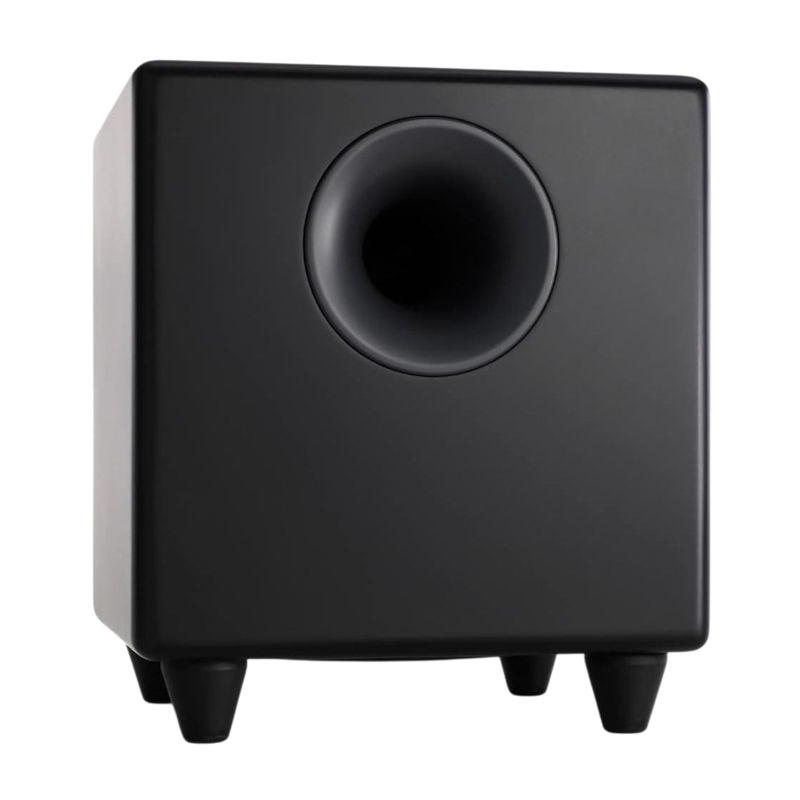
Audioengine S8
Best for: Powered bookshelf and desktop speakers
- Driver
- 8-inch down-firing woofer
- Amplifier
- Class D, 140W RMS / 250W peak
- Rated response
- 27–180 Hz ±1.5 dB
- Inputs
- RCA L/R, 3.5mm mini-jack
- Size / weight
- 11.25-inch cube, 23.6 lb
- RCA and 3.5mm inputs suit most powered speakers
- Variable 50–130 Hz crossover and phase switch
- Compact 11.25-inch cube with isolation feet
- Optional W3 adapter makes it wireless
- What Hi-Fi? heard flabby bass and cabinet rattle when pushed
- No speaker-level inputs, app or room EQ
- Audioengine’s own pages disagree on RMS power and enclosure type
Watch for: It has no speaker-level inputs, so an amplifier without a sub, pre-out or line output has no way to feed it.
Check price on Amazon →What are the Audioengine S8 key specs?
| Spec | Audioengine S8 |
|---|---|
| Driver | 8-inch long-throw, down-firing woofer |
| Amplifier | Class D, 140W RMS / 250W peak (AES) |
| Rated response | 27–180 Hz ±1.5 dB |
| Crossover | Variable, 50–130 Hz |
| Phase | 0 / 180 degrees switch |
| Inputs | RCA L/R (also used as LFE input), 3.5mm stereo mini-jack |
| Outputs | None |
| Standby power | Under 1W, with auto-sleep |
| Size (H x W x D) | 11.25 x 11.25 x 11.25 in |
| Weight | 23.6 lb (10.7 kg) |
| Finishes | Matte Black, Hi-Gloss Piano White |
Figures come from Audioengine’s tech-specs page. Two details are inconsistent on Audioengine’s own site: its product page has listed 125W RMS while the spec table says 140W RMS, and the spec table calls the cabinet front-ported while the S8 Wireless page describes a sealed enclosure. What Hi-Fi? described a front-ported box. A previous version of this page listed the cube at 11.26 inches and mentioned a steel-reinforced frame; Audioengine lists 11.25 inches and a 15.6mm MDF cabinet, and we found no source for the steel frame.
What do the specs and reviews say about the Audioengine S8 bass?
Audioengine rates the S8 at 27–180 Hz within ±1.5 dB. That is a tighter tolerance than the ±3 dB Klipsch uses for its subs, so the numbers are not directly comparable: a ±3 dB rating on the S8 would likely read a little deeper.
What Hi-Fi?’s review found plenty of weight and reasonable depth, with build quality it called high. It also heard “a definite flabbiness to bass notes,” a lack of tonal definition and a cabinet prone to rattling when pushed, and concluded there were better options at the price. That review covers an earlier S8 that had a built-in AC outlet for a wireless adapter; the current rear panel lists a USB charging port instead. We found no lab measurement of the current model from a major publication.
Audioengine itself pitches the S8 for living rooms, family rooms and home theaters, and steers people with close neighbors or a desktop setup toward the smaller 6-inch S6. Read that as a small-to-medium-room sub. In a large open-plan space, a 10-inch box such as the Klipsch R-100SW has more rated output to work with.
Which speakers does the Audioengine S8 pair with?
The S8 has two line-level inputs: stereo RCA (Input A) and a 3.5mm mini-jack (Input B). There are no speaker-level terminals, so it needs a source with a line-level output. Audioengine’s quick-setup notes say a single RCA sub or LFE output should go to the S8’s left RCA input.
| Speaker or source | Output to use | Notes |
|---|---|---|
| Audioengine A2+ / A5+ | Variable RCA out (left speaker) | Audioengine’s own recommended pairing |
| Audioengine HD6 | RCA variable line-out | Stereo out into the S8’s RCA L/R |
| Klipsch The Fives | Mono RCA sub out | Into the S8’s left RCA input |
| Onkyo GX-10DB | Mono RCA sub pre-out | A good size match on a desk |
| KEF LSX II | Mono RCA sub out | KEF’s app adds a 50–120 Hz high-pass for the speakers |
| AV receiver | Sub Out / LFE | Works, but 10-inch receiver subs are rated for more output |
A variable output follows the speakers’ volume control, so the S8 gets louder and quieter with your main speakers instead of needing its own adjustment every time.
The KEF pairing is the cleanest. According to KEF’s manual, the LSX II app can roll off the speakers’ own bass below a set point (50–120 Hz) and set the sub’s low-pass anywhere from 40 to 250 Hz. Most other powered speakers keep playing full range when a sub is connected, which puts all the blending work on the S8’s crossover knob.
It will not work with soundbars that only pair with their own brand’s wireless sub. Our Sonos Sub 4 review and Bose Bass Module 700 review explain those closed systems. A stereo amplifier with only speaker terminals is also out; the Polk PSW10 has spring-clip speaker-level inputs for that job.
What crossover, phase and level settings should I use on the S8?
Most of the S8’s sound depends on three controls on the back panel.
- Crossover with powered speakers. Set the S8’s crossover near the point where your speakers run out of bass. Audioengine rates the HD6 to 50 Hz and the A2+ to 65 Hz, and Onkyo rates the GX-10DB to 70 Hz, so 50–60 Hz is a sensible start with the HD6 and roughly 70–80 Hz with the smaller desktop pairs. Adjust by ear from there.
- Crossover with a receiver or KEF LSX II. Let the source filter the bass and turn the S8’s crossover to its 130 Hz maximum so two filters do not stack.
- Phase. Sit in your usual spot, play something with a steady bass line, and flip between 0 and 180 degrees. Keep the setting that sounds fuller around the hand-off.
- Level. Start low and raise the S8’s volume until bass sounds even with the speakers, not until you notice the sub on its own.
One quirk from Audioengine’s troubleshooting notes: the S8 needs a minimum signal level to wake from standby. If it stays asleep at low volume, turn up the source or speakers a little and lower the S8’s own gain to compensate.
Should I place the S8 under a desk or in a living room?
Audioengine’s own tip is to put the S8 under a desk, or against a wall in a larger room. The woofer fires down into the floor, and the sub ships with Audioengine’s Isolation Elastomer Feet to reduce vibration. On a desk setup, under the desk near the front edge keeps the sub close to the speakers and out of your way.
In a living room, start with the spot Sound & Vision recommends finding by “subwoofer crawl”:
- Put the S8 at your listening seat, raised toward ear height.
- Play a slow low-frequency sweep or a bass-heavy track.
- Move around the room with your ears at the height the woofer will sit, and note where the bass sounds smoothest.
- Move the sub to that spot.
Sound & Vision notes that one sub can only be optimized for one seat, and that bass below the usual 60–100 Hz crossover range is non-directional. That second point is why the S8 can sit off to one side without pulling the stereo image toward it.
If cables are the problem, Audioengine sells the S8 Wireless bundle, which includes its W3 adapter. Audioengine rates the W3 at up to 100 feet of range with under 20ms of latency and 16-bit/48kHz input. The W3 receiver runs on 5V USB power, and the S8’s rear panel has a USB charging port.
Who should buy the Audioengine S8, and who should skip it?
Buy the S8 if:
- You own Audioengine A2+, A5+ or HD6 speakers and want the matching finish.
- Your powered speakers have a sub, line or variable output and you want a compact sub.
- You want a sub that fits under a desk or in an apartment living room.
- You may want to go wireless later with the W3 adapter.
Skip it if:
- You mainly watch movies through an AV receiver in a big room.
- Your amplifier only has speaker terminals.
- You want app control, room correction or EQ inside the sub.
- Your system is a Sonos or Bose soundbar with its own sub ecosystem.
What are the alternatives to the Audioengine S8?
| Model | Driver | Amp (RMS/peak) | Rated low end | Inputs | Weight |
|---|---|---|---|---|---|
| Audioengine S8 | 8-inch, down-firing | 140W / 250W | 27 Hz (±1.5 dB) | RCA L/R, 3.5mm | 23.6 lb |
| Audioengine S6 | 6-inch, front-firing, sealed | 125W / 210W | 33 Hz (±1.5 dB) | RCA L/R, 3.5mm | 15.4 lb |
| Klipsch R-8SW | 8-inch, down-firing | 50W / 150W | 38 Hz (±3 dB) | Line/LFE RCA | 15 lb |
| Polk Audio PSW10 | 10-inch, front-firing | 100W peak | 40 Hz (−3 dB) | RCA L/R, speaker-level | 26 lb |
| Klipsch R-100SW | 10-inch, front-firing | 150W / 300W | 32 Hz (±3 dB) | Line/LFE RCA | 24 lb |
Audioengine S6. The smaller sibling: a sealed 6-inch sub measuring 10 x 8.7 x 10 inches with a 40–130 Hz crossover. Audioengine recommends it for desktops and shared walls. Pick it over the S8 for a desk-only system.
Klipsch R-8SW. Another 8-inch down-firing sub, rated to 38 Hz and 108 dB. It has line/LFE RCA jacks but no 3.5mm input, and it suits a receiver-based bedroom or den system. See our Klipsch R-8SW review.
Polk Audio PSW10. A larger 10-inch budget sub. Its speaker-level inputs make it the easy choice for an older stereo amp with no sub output, though at 16 inches deep it is too big for most desks.
Klipsch R-100SW. The better buy for a receiver-based home theater, rated to 32 Hz and 112 dB with a 150W continuous amp. It accepts only line/LFE RCA input.
Frequently asked questions
Does the Audioengine S8 work with an AV receiver?
Yes. Run one RCA cable from the receiver’s Sub Out or LFE jack to the S8’s left RCA input, as Audioengine’s setup notes describe. Then turn the S8’s crossover to its 130 Hz maximum and let the receiver’s bass management handle the hand-off. It works, but for a movie-focused living room a 10-inch receiver sub is rated for more output.
Can the Audioengine S8 be made wireless?
Yes, with Audioengine’s W3 Wireless Audio Adapter, sold separately or bundled as the S8 Wireless. The sender plugs into your speakers’ output and the receiver into the S8. Audioengine rates the W3 at up to 100 feet with under 20ms of latency, which is low enough for TV and movies.
What crossover setting should I use with the S8?
With powered speakers that play full range, set the S8’s crossover near where the speakers roll off: around 50–60 Hz for the HD6, which Audioengine rates to 50 Hz, and 70–80 Hz for small desktop speakers rated to 65–70 Hz. With a receiver or KEF LSX II handling bass management, turn the S8’s knob to its 130 Hz maximum.
Can I connect a turntable to the Audioengine S8?
Not directly in any useful way. A turntable needs a phono preamp, and the S8 only reproduces bass. Connect the turntable to speakers or an amplifier with a phono input, such as Klipsch The Fives or the Onkyo GX-10DB, then feed the S8 from that system’s subwoofer output.
Should I buy the Audioengine S6 or S8?
Audioengine positions the S6 for desks and homes with shared walls, and the S8 for living rooms and larger spaces. The S8 has the bigger 8-inch woofer and a lower 27 Hz rating against 33 Hz for the S6. The S6 is smaller at 10 x 8.7 x 10 inches and 15.4 pounds against 23.6 pounds.
Sources
- Audioengine: S8 Powered Subwoofer product page
- Audioengine: S8 tech specs, setup and FAQ
- Audioengine: S6 tech specs
- Audioengine: W3 Wireless Audio Adapter tech specs
- What Hi-Fi?: Audioengine S8 review
- KEF: LSX II user manual (PDF)
- Klipsch: R-8SW spec sheet (PDF)
- Klipsch: R-100SW spec sheet (PDF)
- Polk Audio: PSW10 product page and specs
- Sound & Vision: Subwoofer setup in 3 steps
What do the numbers say about the Audioengine S8?
These figures come from maker spec sheets and product pages. They show where the S8 fits and where a rival fits better.
- Audioengine rates the S8 at 27 to 180 Hz within ±1.5 dB, so compare it carefully with ±3 dB ratings. (audioengine.com)
- Audioengine lists 125W RMS on its product page and 140W RMS in its spec table, so check both. (audioengine.com)
- The W3 adapter is rated up to 100 feet with under 20ms of latency, low enough for TV and movies. (audioengine.com)
- The S6 is rated to 33 Hz and weighs 15.4 lb, a better size for a desk-only system. (audioengine.com)
- The Klipsch R-100SW is rated to 32 Hz and 112 dB, more output for a receiver-based home theater. (d2um2qdswy1tb0.cloudfront.net)