The Marshall Stanmore III is a good living-room speaker if you can buy it at a real discount. It plays loud with deep bass, takes RCA and 3.5 mm sources, and runs from brass knobs without needing an app. If you are paying close to full price, buy the Stanmore IV instead. Marshall released it in July 2026, and it brings better bass control at high volume, LDAC and Auracast.
Skip both Stanmores if you need Wi-Fi streaming, a voice assistant or a battery. And if most of what you play is talk radio, podcasts or TV dialogue, know that the Stanmore III's midrange measures too quiet in its default tuning.
Marshall still lists the Stanmore III on its US home speaker page as a special offer next to the new model, so stock is out there. Below you get the spec sheet, the lab data, how it sits against the rest of Marshall's home range, and the mistakes buyers make with it.
Big, bassy Marshall sound that makes sense on discount
The Stanmore III fills a living room and adds RCA input, but its default tuning pushes the midrange back, and the Stanmore IV improves bass control and codecs for little more at list price.
- Medium living rooms
- Turntable owners with a phono preamp
- Rock, pop and electronic music played loud
- You mostly play podcasts or TV dialogue
- You want Wi-Fi, AirPlay or voice control
- The Stanmore IV is close in price
Where to buy
 Our verdict
Marshall Stanmore III
Best for: Living rooms at a discounted price
- Power
- Mains only
- Amplifiers
- 50 W + 2 x 15 W Class D
- Inputs
- Bluetooth 5.2, RCA, 3.5 mm
- Rated max volume
- 97 dB SPL at 1 m
- Weight
- 4.25 kg (9.37 lb)
- Deep bass extension
- RCA and 3.5 mm inputs
- Tactile volume, bass and treble knobs
- Can join a Heddon multi-room setup
- Recessed midrange in default tuning
- No Wi-Fi, microphone or voice assistant
- Superseded by the Stanmore IV
Watch for: Keep it off the back wall or run Placement Compensation, because the bass turns boomy near walls.
Check price on Amazon →What are the Marshall Stanmore III's key specs?
| Spec | Marshall Stanmore III |
|---|---|
| Type | Mains-powered two-way stereo Bluetooth home speaker |
| Amplifiers | One 50 W Class D for the woofer, two 15 W Class D for the tweeters |
| Rated frequency range | 45 to 20,000 Hz |
| Rated maximum volume | 97 dB SPL at 1 m |
| Bluetooth | 5.2, LE Audio-ready, 10 m rated range |
| Wired inputs | 3.5 mm and RCA |
| Wi-Fi, microphone, voice assistant | None |
| Dimensions | 350 x 203 x 188 mm (13.78 x 8.00 x 7.40 in) |
| Weight | 4.25 kg (9.37 lb) |
Figures come from Marshall's Stanmore III specification page, checked October 24, 2026. Marshall does not list driver sizes. Inside sit a single 5-inch bass driver and two dome tweeters on waveguides.
How does the Stanmore III sound?
The overall balance is pleasant, with deep low-end extension and bright, extended treble. It handles loud playback in open spaces well and still sounds full at quiet bedroom levels. The full lab test from December 2022 gave it an overall score of 134.
The weakness is the middle. In the default setting the midrange sits too low, and voices in podcasts and films come across as distant. Bass precision and punch also change a lot with volume, loud transients can make the bass pump and distort, and the first few volume steps jump steeply.
On loudness, the Stanmore III measured 94.3 dBA with pink noise at maximum volume, slightly below the 96.9 dBA of the older Stanmore II. That is still plenty for a medium living room.
With rock and electronic music it sounds rich and powerful, with a strong live feel. Push it near the top of the dial and the treble can turn harsh, and a single box gives you some sense of space rather than true stereo separation.
The practical takeaway is simple. If you play rock, pop and electronic music loud, the Stanmore III delivers. If clear dialogue matters most, lift the treble knob, run Placement Compensation, or look at the Stanmore IV.
Acton III, Stanmore III or Woburn III: which size fits your room?
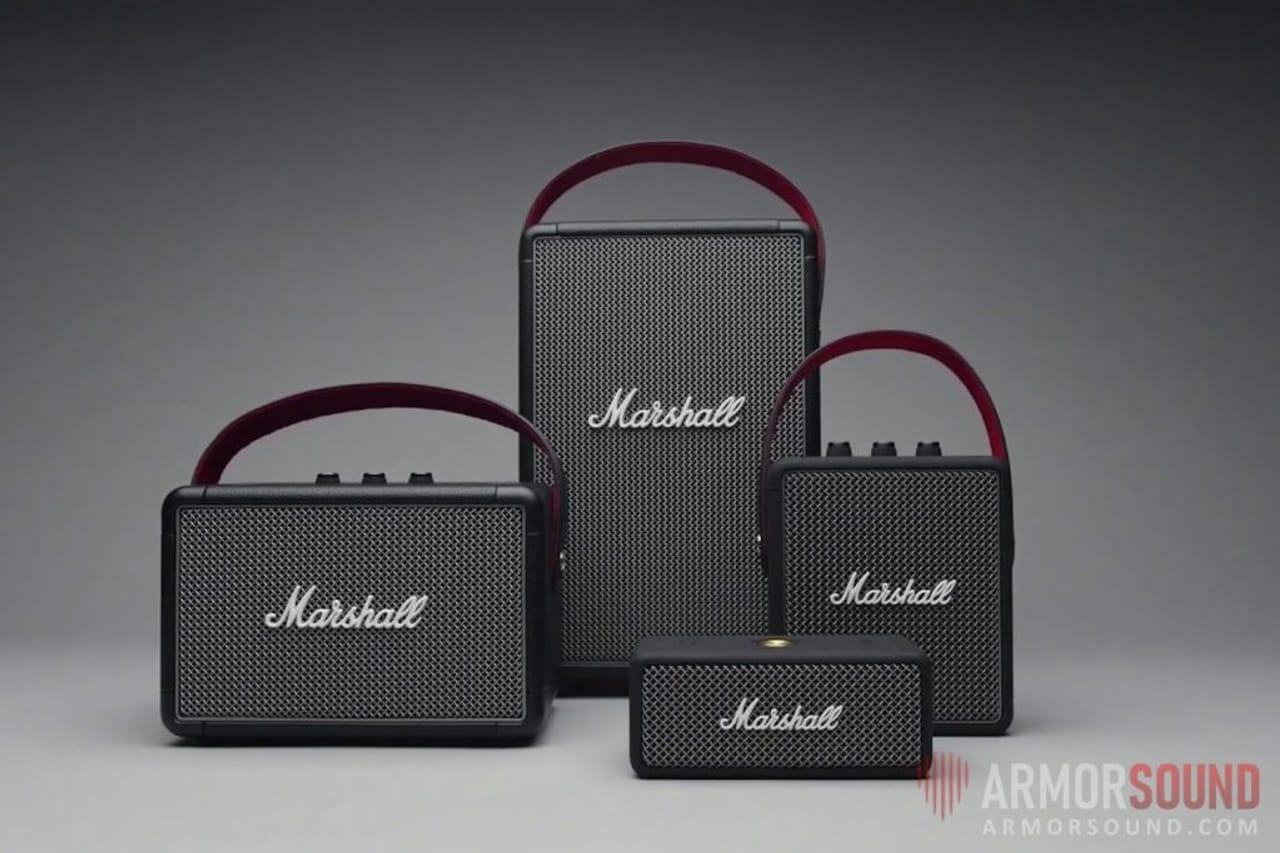
Marshall's Home Line III has three sizes, and the gaps between them are not even. All three amplifier stages add up as shown below. The jump from Acton to Stanmore adds 20 watts and a little more bass, while the jump from Stanmore to Woburn adds 70 watts, dedicated midrange drivers and HDMI.
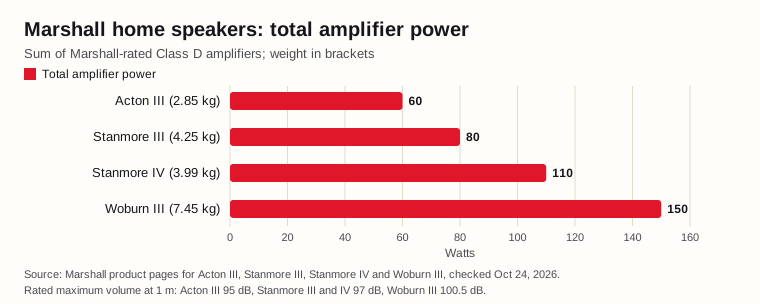
A commonly reported impression matches the numbers: the Acton III and Stanmore III sound closer than their sizes suggest, and the Woburn III sounds like a different class of speaker. So pick the Stanmore when you like its size or need its RCA inputs, not because you expect it to sound twice as big as the Acton.
| Spec (Marshall) | Acton III | Stanmore III | Woburn III |
|---|---|---|---|
| Amplifiers | 30 W + 2 x 15 W | 50 W + 2 x 15 W | 90 W + 2 x 15 W + 2 x 15 W |
| Rated maximum volume | 95 dB SPL at 1 m | 97 dB SPL at 1 m | 100.5 dB SPL at 1 m |
| Wired inputs | 3.5 mm | 3.5 mm, RCA | 3.5 mm, RCA, HDMI |
| Weight | 2.85 kg | 4.25 kg | 7.45 kg |
| Battery or water rating | None | None | None |
None of the three can pair with a second unit for left and right stereo, and none has a battery or water resistance. They are plug-in home speakers. Our Woburn III vs Stanmore III comparison goes deeper on the top two.
Where should you put it?
All of the sound comes out of the front of the cabinet, so aim it at where you sit. Tucking it into a corner facing the wrong way, or standing it sideways on a long shelf, wastes much of what it does well.
The Stanmore III is a bass-reflex design with its port on the back, and placement changes its sound a lot. Near a wall the bass stays boomy even after app calibration, especially with TV, and the low end tightens up with the speaker pulled away from the wall.
Marshall's app includes Placement Compensation. You tell it whether the speaker sits near a wall, in a corner or on an open shelf, and it trims the bass to match. Run it first, then fine-tune with the bass knob.
At 350 mm wide and 4.25 kg, it needs a sturdy shelf or sideboard rather than a narrow bookcase. It has no handle, battery or water rating, so it stays indoors and mostly stays put.
What inputs and connections does the Stanmore III have?
Bluetooth 5.2 covers wireless playback with a rated 10 m range. It holds two phones connected at once, which makes it easy for two people to take turns.
The wired options are why many people pick a Stanmore over the smaller Acton. There is a 3.5 mm jack on the top panel and a pair of RCA inputs at the bottom of the back panel, each selectable with the source button. A turntable needs a phono preamp, either built into the deck or as a separate box.
There is no Wi-Fi, AirPlay or Chromecast. You can add them with Marshall's Heddon hub, a separate Wi-Fi streamer that rebroadcasts over Auracast. Marshall's compatibility list includes the Stanmore III among speakers that join a Heddon broadcast with a button press once the firmware is current. That replaces the old answer on the product page, which still calls the speaker stand-alone.
For TV, there is no HDMI. Marshall reserves that for the Woburn III. Bluetooth latency also measures higher than on the Stanmore II, so for video a wired connection from the TV's analog output is the safer choice.
How do the Stanmore III controls and app work?
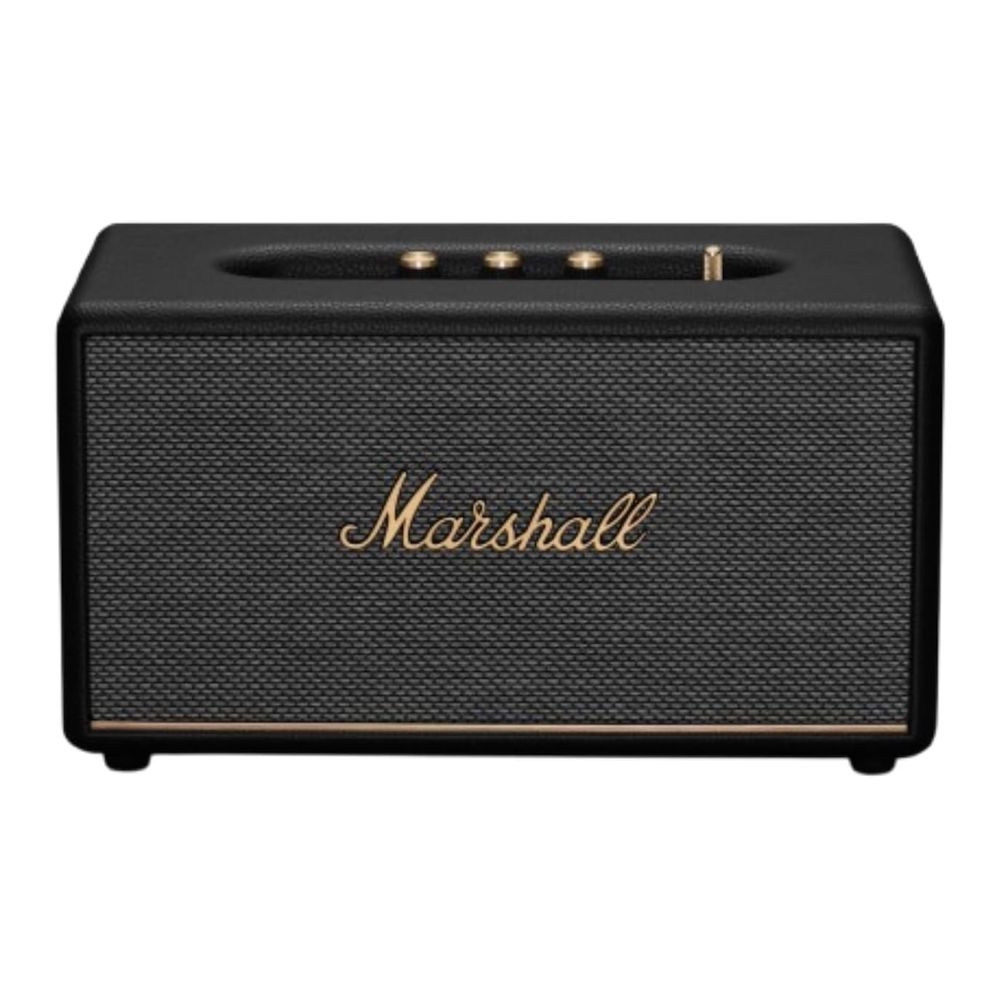
The brass top panel carries a source button, volume, bass and treble knobs, a combined play and skip control, and a toggle power switch. It is one of the most intuitive layouts in its class, and the knobs stay in sync with the app.
The Marshall Bluetooth app handles Placement Compensation, the bass and treble settings and over-the-air updates. It does not offer a multi-band EQ. Marshall's Dynamic Loudness adjusts tonal balance with volume. It works, but subtly, and it does not fully fix the thin midrange at normal listening levels.
Should you buy the Stanmore III or the Stanmore IV?
| Spec (Marshall) | Stanmore III | Stanmore IV |
|---|---|---|
| Amplifiers | 50 W + 2 x 15 W | 60 W + 2 x 25 W |
| Drivers | Woofer + 2 tweeters | 5-inch woofer + 2 x 0.75-inch tweeters |
| Rated frequency range | 45 to 20,000 Hz | 36 to 38,000 Hz |
| Rated maximum volume | 97 dB SPL at 1 m | 97 dB SPL at 1 m |
| Bluetooth | 5.2, LE Audio-ready | 5.3 with Auracast |
| Codecs listed | None listed | SBC, AAC, LDAC, LC3 |
| Wired inputs | 3.5 mm, RCA | 3.5 mm, RCA |
| Weight | 4.25 kg | 3.99 kg |
The Stanmore IV gets upgraded tweeters and waveguides, a redesigned bass port that makes wall placement easier, a customizable M-button and the newer Marshall app. It surpasses the III with a wider soundstage, more refined bass and better control at the top of the volume range.
Two complaints carry over: no Wi-Fi and no voice assistant. The Stanmore III launched at $379 in the US, and the Stanmore IV launched at $399.99, so the newer model costs little more at list price. Clearance pricing on the III is what changes the math.
What do Stanmore III owners report?
Owners who have lived with it rate the Stanmore III highly for music in living rooms. One who paid $299 on sale at Best Buy rates it 8.5 out of 10, calls the sound awesome even though the deepest bass falls away, and finds it built to last. Another who chose it over the Acton III finds it loud and bassy, great for music but not their pick for movies.
The most common gripe is about moving it. One owner wishes it had a handle, since it has no battery and they still carry it between rooms. Treat it as a plug-in home speaker, not a portable one and not a soundbar replacement.
What buying mistakes should you avoid with the Stanmore III?
The biggest mistake is paying close to list price. At full price the Stanmore IV is the better speaker for about the same money, so the III only makes sense on clearance.
The second is buying it as a TV speaker. With no HDMI, a recessed midrange and higher Bluetooth latency, it does dialogue worse than a soundbar at the same price. If TV is the main job, the Woburn III's HDMI input or a soundbar serves you better.
The third is expecting stereo from a pair. Two Stanmore IIIs cannot split left and right channels, so buying a second one gives you multi-room sync through a Heddon hub, not a stereo pair.
And plan for a phono preamp if you want to play records. The RCA input is line level, so a turntable without a built-in preamp will sound faint and thin.
Who should buy the Stanmore III, and who should skip it?
Buy the Stanmore III if you want a big, bass-forward Marshall for a medium living room and you can get it at a clear discount. It suits people who plan to plug in a turntable with a preamp, a CD player or a TV through RCA or 3.5 mm, and who like knobs and a power switch more than apps and voice commands.
Skip it if the Stanmore IV costs only a little more where you shop, or if you mainly listen to podcasts and dialogue. Skip it too if you want Wi-Fi, AirPlay, Alexa or Google Assistant built in, or if you plan to move it outdoors or between rooms often.
What are the alternatives to the Marshall Stanmore III?
| Speaker | Wired inputs | Weight | Why pick it |
|---|---|---|---|
| Marshall Stanmore III | 3.5 mm, RCA | 4.25 kg | Big sound at clearance prices |
| Marshall Stanmore IV | 3.5 mm, RCA | 3.99 kg | LDAC, Auracast, better high-volume control |
| Marshall Woburn III | 3.5 mm, RCA, HDMI | 7.45 kg | Three-way design and HDMI for a TV |
| Klipsch The Three Plus | RCA, USB-C, optical | 4.8 kg | Digital optical input for TVs |
The Marshall Stanmore IV is the default choice at full price. It has the same footprint and inputs, more amplifier power, LDAC for Android phones and a built-in Auracast receiver that joins a Heddon hub or a broadcast from a compatible phone.
The Marshall Woburn III is still Marshall's largest home speaker, with a 90 W woofer amplifier, dedicated midrange drivers and an HDMI input. It is far bigger and heavier. The Woburn III review covers it in depth.
The Klipsch The Three Plus brings RCA, USB-C and digital optical inputs, which helps if your TV only has optical out. Read our Klipsch The Three Plus review.
If your room is smaller, the Marshall Acton III review covers the compact sibling, and our best Marshall speakers guide compares the whole range, including the portable models.
Frequently asked questions
Is the Marshall Stanmore III discontinued?
It has been superseded. Marshall released the Stanmore IV in July 2026, roughly four years after the Stanmore III. Marshall's US store still sells the Stanmore III as a special offer, so new stock remains for now. Marshall promises at least two years of firmware support counted from the date it last sells a product.
Does the Stanmore III have Wi-Fi, AirPlay or a voice assistant?
No. Marshall lists no Wi-Fi, no microphone and no voice control. It streams over Bluetooth 5.2 or plays wired sources. To add AirPlay, Google Cast, Spotify Connect or Tidal Connect, you need Marshall's separate Heddon hub, which streams over Wi-Fi and rebroadcasts to the Stanmore III over Auracast after a firmware update.
Can I connect a record player to the Stanmore III?
Yes, through the RCA inputs on the back. The speaker has no phono stage, so your turntable needs a built-in preamp or a separate one, the same requirement Marshall lists for the Stanmore IV's RCA input. Once connected, select the RCA source with the button on the top panel. A 3.5 mm input is also available for a second source.
Can the Stanmore III connect to a TV?
Yes, but not over HDMI. Use the TV's analog audio output into the RCA or 3.5 mm input, or pair over Bluetooth. Marshall's own FAQ names the Woburn III as the only model in this range with HDMI. Bluetooth latency is higher than on its predecessor, so wired is the better choice for video.
Can two Stanmore III speakers be paired in stereo?
Not as a left and right pair. Marshall's product page describes it as a stand-alone speaker. With a Heddon hub and current firmware, several Stanmore III speakers can play the same music in sync across rooms, but that setup does not split left and right channels between two boxes.
Is the Stanmore III much louder than the Acton III?
A little. Marshall rates the Stanmore III at 97 dB and the Acton III at 95 dB at 1 m, with 80 W against 60 W of total amplifier power. The difference is real but modest. Choose the Stanmore for its RCA inputs and bigger bass, and step up to the Woburn III if you want a clearly bigger sound.
Can you use the Stanmore III outdoors?
Only briefly and in dry weather. It runs on mains power, has no battery and carries no water or dust rating, so it belongs indoors. For a patio, a battery speaker with an IP rating is the safer buy.
Sources
- Marshall: Stanmore III product page and specifications
- Marshall: Stanmore IV product page and specifications
- Marshall: US home speaker range (current listings)
- Marshall support: Heddon compatible speakers
- Marshall: Heddon streaming hub product page
- DXOMARK: Marshall Stanmore III speaker test (December 2022)
- STEREO GUIDE: Marshall Stanmore 3 review (November 2022)
- TechRadar: Marshall Stanmore IV review (July 2026)
- What Hi-Fi?: Marshall Homeline III launch report (June 2022)
How loud, big and pricey is the Stanmore III?
Price decides this purchase more than sound does. These figures show where the Stanmore III stands against its successor.
- Marshall rates the Stanmore III at 97 dB SPL at 1 m, the same as the Stanmore IV. (marshall.com)
- A published lab test measured 94.3 dBA with pink noise at maximum volume, plenty for a medium living room.
- It weighs 4.25 kg and is 350 mm wide, so it needs a sturdy shelf or sideboard. (marshall.com)