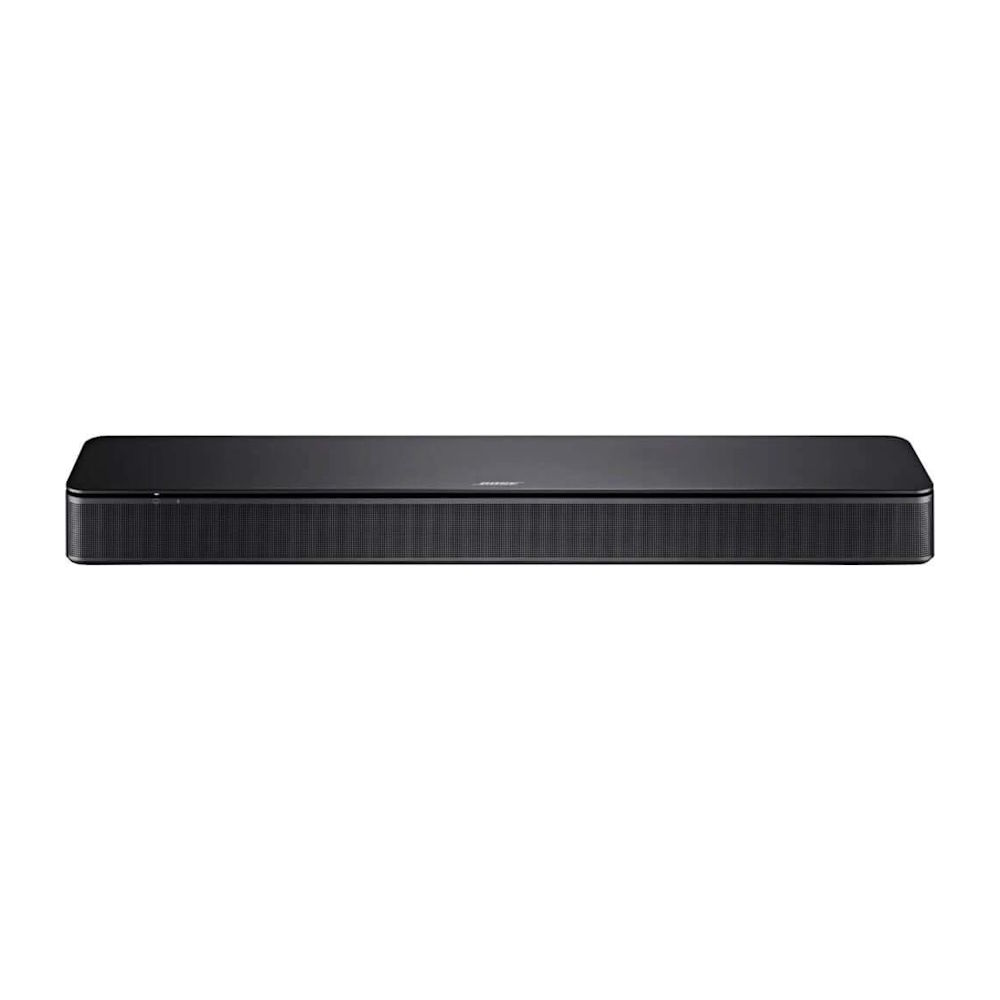
The Bose TV Speaker is a small 2.0-channel soundbar for people whose main complaint is that they cannot make out what anyone on TV is saying. RTINGS found its default sound balanced, with clear voices, and Bose’s Dialogue mode pushes speech further forward. Setup is one cable, and there is no app to learn.
Skip it if you want Dolby Atmos, surround effects or bass you can feel. RTINGS says it struggles with deep rumble on its own, and the only way to add a sub is a Bose bass module by cable. Bose also now sells a TV Speaker (2nd Gen) that it calls the successor, so the original makes the most sense at a discount.
ArmorSound did not test the TV Speaker. This review is built from RTINGS’ lab review, Bose’s product pages, FAQs and owner’s guides for both generations, What Hi-Fi?’s Bose buying advice, and the published specs of its main rivals.
A no-fuss dialogue fixer for bedrooms and small rooms
The Bose TV Speaker makes voices easier to follow than most built-in TV speakers, with one cable and no app. It has no Dolby Atmos, no EQ and little deep bass on its own, and Bose now sells a 2nd Gen successor, so buy the original only at a discount.
- Bedrooms, dens and smaller TVs
- Viewers who struggle to hear dialogue
- People who want one cable and no app
- You want Dolby Atmos or surround
- You want deep bass without adding a sub
- You stream music over Wi-Fi
Where to buy
 Our verdict
Bose TV Speaker
Best for: Clearer TV dialogue in small rooms
- Channels
- 2.0
- TV inputs
- HDMI ARC, optical, AUX
- Bluetooth
- 4.2, up to 30 ft
- Bass add-on
- Wired port for Bass Module 500/700
- Size and weight
- 2.21 x 23.38 x 4.02 in, 4.34 lb
- Dialogue mode can be set to stay on
- HDMI-CEC lets your TV remote run it
- Optical cable included for older TVs
- Wired upgrade path to Bose bass modules
- No Dolby Atmos, EQ or room correction
- Little deep bass without a sub (RTINGS)
- Compression at max volume (RTINGS)
Watch for: The HDMI cable is not in the box, and you need HDMI ARC for your TV remote to control it.
Check price on Amazon →What are the Bose TV Speaker's key specs?
| Spec | Bose TV Speaker |
|---|---|
| Released | 2020 (per RTINGS) |
| Channels | 2.0, no built-in subwoofer |
| Rear connections | HDMI IN (ARC), optical in, AUX in, USB (service), bass module out |
| Bluetooth | Version 4.2, range up to 30 ft (9 m) |
| Sound controls | Dialogue mode, bass adjustment on remote |
| EQ / room correction | None (no ADAPTiQ) |
| Size (H x W x D) | 2.21 x 23.38 x 4.02 in |
| Weight | 4.34 lb |
| In the box | Remote, optical cable, power cord (no HDMI cable) |
| App / Wi-Fi | No app, no Wi-Fi |
How does the Bose TV Speaker sound, according to RTINGS?
RTINGS rates the TV Speaker as fair for dialogue-heavy TV and podcasts. As a 2.0 bar it has no discrete center channel, but its balanced mid-range keeps voices clear and detailed. For music, RTINGS calls it alright, with a balanced response and a little extra warmth.
Movies are its weak spot. RTINGS says it has difficulty reproducing deep low-bass rumble, downmixes Dolby Digital to stereo, and has no Dolby Atmos support. It also notes compression artifacts at max volume.
Bose’s Dialogue mode analyzes what you are watching, separates vocals from other audio and raises them. Bose says you can set it to persistent so it stays on every time the speaker powers up. There is also a bass button on the remote, but no EQ, no room correction and no app to fine-tune anything else.
What Hi-Fi? has not reviewed it either, but its Bose buying guide describes it as a simple, no-frills way to improve TV sound, and suggests spending a little more on a Dolby Atmos bar such as the JBL Bar 300 if your budget allows. Our JBL Bar 300 review covers that step up.
Should I connect the Bose TV Speaker by HDMI ARC or optical?
The TV Speaker connects to your TV one of two ways, and the choice decides which remote you use.
- HDMI ARC (better). Plug into your TV’s HDMI port labeled ARC. With HDMI-CEC enabled, the speaker turns on with the TV and your TV remote controls its volume. Bose does not include the HDMI cable.
- Optical (included cable). Works with older TVs. You use the Bose remote, a programmed universal remote, or teach the speaker your TV remote’s volume and mute commands. The owner’s guide also describes an auto-wake setting so the speaker powers on when an optical or analog signal arrives.
Bose strongly recommends connecting only your TV’s output, rather than plugging a cable box or game console straight into the speaker, so sound and picture stay in sync. Bose also says it is Roku TV Ready, which adds setup and sound settings to a Roku TV’s menus over HDMI ARC.
Bluetooth is for music and podcasts from your phone. You need the included remote to put it in pairing mode the first time; after that, you can reconnect from your phone’s Bluetooth menu. There is no headphone output and no way to add surround speakers.
Where should I place the Bose TV Speaker, and can I wall-mount it?
Bose’s owner’s guide has a short, useful checklist:
- Put it directly below the TV (preferred) or above it, grille facing the room.
- On a shelf or TV stand, bring the front of the speaker as close as possible to the front edge.
- Keep the back at least 0.4 inch (1 cm) from any surface, because blocking the rear ports affects sound.
- Do not put it in an enclosed cabinet or diagonally in a corner, and keep objects off the top.
- Keep other wireless gear 1–3 ft away to avoid interference.
You can wall-mount it with the Bose Soundbar Wall Bracket, the same bracket Bose uses for the Soundbar 500 and 700. After mounting, hold the Dialogue mode button on the remote for 5 seconds until the TV light blinks amber; that switches the speaker’s audio to its wall-mount setting.
Can the Bose Bass Module 500 or 700 add bass to the TV Speaker?
The TV Speaker has a dedicated bass port. Bose says you can connect the Bass Module 500 or Bass Module 700 by wire, using the Bose Bass Module Connection Cable or a standard 3.5 mm cable, both sold separately. Both modules’ compatibility lists mark the TV Speaker as wired-only, and Bose does not list third-party subs.
RTINGS notes that adding a sub improves the bar’s bass, and that is the fix for its biggest weakness. Our Bose Bass Module 700 review covers the bigger module, its size and where to put it. In a small room the more compact Bass Module 500 (9.5 x 10 x 10 inches) is the more sensible match for a bar this size.
Run the numbers before you commit. Price the bar and the module together, then compare that total with soundbars that include a subwoofer in the box.
Should I buy the Bose TV Speaker or the TV Speaker (2nd Gen)?
Bose now sells a TV Speaker (2nd Gen) and calls it the successor to the original. As of October 2026, Bose still lists the original on its US site.
| Spec | TV Speaker | TV Speaker (2nd Gen) |
|---|---|---|
| TV connection | HDMI ARC, optical | HDMI eARC/ARC, optical |
| Cable in the box | Optical | HDMI |
| Rear ports | HDMI, optical, AUX, USB, bass | HDMI, optical, AUX, bass, service |
| Bass module support | BM500/BM700, wired | BM500/BM700, 3.5 mm cable |
| Size (H x W x D) | 2.21 x 23.38 x 4.02 in | 2.244 x 23.465 x 4.154 in |
| Weight | 4.34 lb | 4.409 lb |
Bose says the 2nd Gen has improved acoustic performance and clarity, angled left and right speakers, a center tweeter dedicated to speech, and a refreshed design with rounder edges. We found no independent lab review of the 2nd Gen yet, so treat the sound claims as Bose’s. One placement difference: Bose’s 2nd Gen FAQ advises against mounting it above the TV.
Our take: at full price, the 2nd Gen is the one to buy because it is the current model and includes an HDMI cable. If the original is discounted well below the 2nd Gen, it still does the same job of clearing up dialogue.
What do owners say about the Bose TV Speaker?
Spec sheets and lab reviews only go so far. Here is what owners say after living with it, drawn from Reddit discussions collected by RedditRecs.
- Dialogue is the reason to buy. An 84-year-old owner with hearing difficulties says they understand every word through the Bose TV Speaker, while a Polk bar and sub left them struggling with speech. (r/Soundbars)
- Built for apartments. An apartment owner who could not run a big subwoofer says it delivered the clear speech they needed for movies full of whispers and screams. (r/Soundbars)
- Years of service. One owner has used theirs for five years with no complaints. (r/Soundbars)
- Not for desks or bass lovers. One owner says it sounds best several feet away rather than up close at a PC. Another bought one as a gift and heard little improvement over the TV. (r/Soundbars)
Owners who buy it for clear dialogue in small rooms are happy. Anyone expecting a big bass upgrade is not.
Who should buy the Bose TV Speaker, and who should skip it?
Buy the Bose TV Speaker if:
- You mostly watch dialogue-driven TV, news and sports in a bedroom or den.
- You want one cable and your existing TV remote, with no app.
- You found it well below the price of the 2nd Gen.
- You already own a Bose Bass Module 500 or 700.
Skip it if:
- You want Dolby Atmos or real surround. Consider a bar like the JBL Bar 300.
- You want bass you can feel without buying a separate module.
- You want Wi-Fi streaming, multiroom or voice control in the bar itself.
- You are filling a large living room.
What are the alternatives to the Bose TV Speaker?
| Model | TV connection | Wireless | Sub upgrade | Width | Weight |
|---|---|---|---|---|---|
| Bose TV Speaker | HDMI ARC, optical | Bluetooth 4.2 | Bose BM500/BM700, wired | 23.38 in | 4.34 lb |
| Bose TV Speaker (2nd Gen) | HDMI eARC/ARC, optical | Bluetooth | Bose BM500/BM700, wired | 23.465 in | 4.409 lb |
| Sonos Ray | Optical only | Wi-Fi, AirPlay 2 | Sonos subs, wireless | 21.93 in | 4.19 lb |
| Yamaha SR-C20A | HDMI ARC, optical | Bluetooth 5.0 | None (built-in 3-inch woofer) | 23.6 in | 3.9 lb |
Bose TV Speaker (2nd Gen). The current model, with an HDMI cable in the box and the same bass-module path. Buy it unless the original is clearly cheaper.
Sonos Ray. A compact bar with two tweeters, two midwoofers, Trueplay tuning and Wi-Fi streaming, but it connects to the TV by optical only. It suits people who want to grow into a Sonos system, and it pairs with Sonos’s wireless subs. See our Sonos Ray review, our Sonos Sub 4 review, or the larger Sonos Beam Gen 2.
Yamaha SR-C20A. Similar width, with a built-in 3-inch woofer and two passive radiators, HDMI ARC and Bluetooth 5.0. Yamaha lists no subwoofer output, so what you get is what you keep. The Yamaha SR-C20A is a good fit if you want a bit more bass from one box; read our Yamaha SR-C20A review.
For more small bars, browse our compact soundbars.
Frequently asked questions
Does the Bose TV Speaker have HDMI ARC?
Yes. It has one HDMI input that connects to your TV’s HDMI ARC port, and with HDMI-CEC enabled your TV remote controls its power and volume. Bose includes an optical cable but not an HDMI cable. The newer TV Speaker (2nd Gen) supports HDMI eARC/ARC and ships with an HDMI cable instead.
Can you add a subwoofer to the Bose TV Speaker?
Yes, but only a Bose one, by wire. Bose says the TV Speaker works with the Bass Module 500 and Bass Module 700 through its bass port, using the Bose Bass Module Connection Cable or a standard 3.5 mm cable. Both modules’ compatibility lists mark the TV Speaker as wired-only, and Bose lists no third-party subwoofers.
Does the Bose TV Speaker support Dolby Atmos?
No. RTINGS confirms there is no Dolby Atmos support, and as a 2.0 bar it downmixes Dolby Digital surround to stereo. If Atmos matters, What Hi-Fi? suggests spending a little more on a bar such as the JBL Bar 300. For voices and everyday TV, the TV Speaker’s Dialogue mode is the more useful feature.
Is the Bose TV Speaker discontinued?
Not as of October 2026. Bose still sells the original on its US site alongside the new TV Speaker (2nd Gen), which Bose describes as its successor with improved acoustic performance and clarity. Bose was discounting the original when we checked its store, so compare the two prices before choosing between them.
Does the Bose TV Speaker have an app or Wi-Fi?
No. Bose’s FAQ says it has no app, and it has no Wi-Fi. You control it with the included remote or your TV remote over HDMI-CEC, and you stream music to it over Bluetooth. It can join a Bose smart speaker or soundbar through SimpleSync, which the smart product controls from the Bose Music app.
Sources
- Bose: TV Speaker product page, specs and FAQ
- Bose: TV Speaker owner’s guide (PDF)
- Bose: TV Speaker (2nd Gen) product page and FAQ
- Bose: TV Speaker (2nd Gen) owner’s guide (PDF)
- RTINGS: Bose TV Speaker soundbar review
- What Hi-Fi?: Which Bose soundbar should you buy?
- Bose: Bass Module 700 compatibility
- Bose: Bass Module 500 compatibility
- Sonos: Ray tech specs
- Yamaha: SR-C20A specifications
What numbers matter before you buy the Bose TV Speaker?
These figures come from RTINGS, Bose and owners. Each one affects setup, placement or fit.
- RTINGS dates the release to 2020, so the original is the older of the two TV Speaker models. (rtings.com)
- Keep the back at least 0.4 inch (1 cm) from any surface, or blocked rear ports affect sound. (assets.bosecreative.com)
- Bluetooth 4.2 with up to 30 ft (9 m) of range handles music and podcasts from your phone.
- At 23.38 in wide and 4.34 lb, it is a small bar, not one for filling a large living room.
- An 84-year-old owner with hearing difficulties says they understand every word through it. (reddit.com)