The Marshall Acton III is worth buying in late 2026 only if you find it well below the price of its replacement, the Acton IV. It is a compact, mains-powered Bluetooth speaker that gets loud for its size, but RTINGS measured a dip in the treble and narrow directivity in September 2026, so it sounds best when you sit right in front of it.
Skip it if you want to plug in a turntable over RCA, stream over Wi-Fi or hear consistent sound from across the room. Marshall released the Acton IV in July 2026 with RCA input, LDAC and Auracast, and Tom's Guide describes it as the direct successor to the four-year-old Acton III.
Marshall still lists the Acton III on its US home speaker page as a special offer, so the real question is price. Below is what the spec sheet and independent reviews say, and where the cheaper speaker still makes sense.
A stylish small-room speaker worth it at clearance prices
The Acton III gets loud and looks great, but measured narrow directivity and no RCA input make the Acton IV the better buy unless the III is heavily discounted.
- Desks, bedrooms and small living rooms
- Listeners who sit directly in front of it
- Buyers who find it deeply discounted
- You want Wi-Fi, AirPlay or a voice assistant
- You plan to connect a turntable over RCA
- The Acton IV costs only a little more
Where to buy
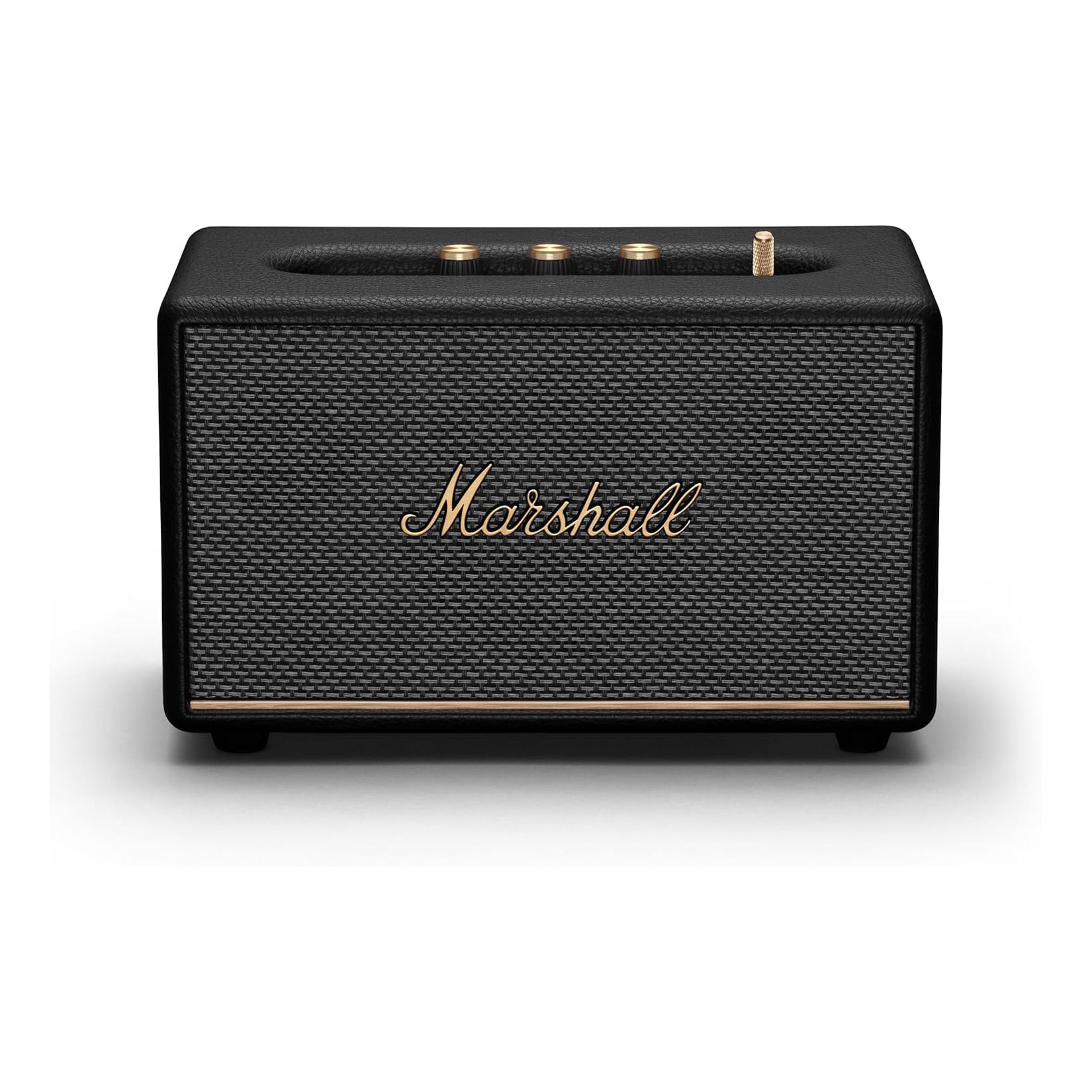 Our verdict
Marshall Acton III
Best for: Small rooms at a clearance price
- Power
- Mains only, no battery
- Amplifiers
- 30 W + 2 x 15 W Class D
- Bluetooth
- 5.2, LE Audio-ready
- Wired input
- 3.5 mm only
- Weight
- 2.85 kg (6.28 lb)
- Gets loud enough for a living room (RTINGS)
- Physical volume, bass and treble knobs
- Bluetooth multipoint for two devices
- Can join a Heddon multi-room setup
- Narrow directivity and a treble dip (RTINGS)
- No RCA input, Wi-Fi or microphone
- Replaced by the Acton IV in July 2026
Watch for: There is no RCA input, so a turntable needs a built-in phono preamp and an RCA-to-3.5 mm cable.
Check price on Amazon →What are the Marshall Acton III's key specs?
| Spec | Marshall Acton III |
|---|---|
| Type | Mains-powered stereo Bluetooth home speaker (no battery) |
| Amplifiers | One 30 W Class D for the woofer, two 15 W Class D for the tweeters |
| Rated frequency range | 45 to 20,000 Hz |
| Rated maximum volume | 95 dB SPL at 1 m |
| Bluetooth | 5.2, LE Audio-ready, 10 m rated range |
| Wired input | 3.5 mm only (no RCA) |
| Wi-Fi, microphone, voice assistant | None |
| Water resistance | None |
| Dimensions | 260 x 170 x 150 mm (10.24 x 6.69 x 5.91 in) |
| Weight | 2.85 kg (6.28 lb) |
All figures come from Marshall's Acton III specification page. Marshall does not publish driver sizes or a codec list for this model.
How does the Marshall Acton III sound in measurements and reviews?
RTINGS bought and measured the Acton III in September 2026 and rated it okay for music. Its testers found a solid amount of low-end thump and punch for a small box, enough that kick drums land with real attack, and said it gets loud enough to fill most living rooms.
The weak spots are the treble and the dispersion. RTINGS measured a cut in the treble range that can leave delicate vocals short on articulation, and narrow directivity: move off to the side or behind the speaker and the mids and highs fall away, which makes dialogue and podcast voices sound muffled.
T3's Yasmine Crossland reviewed it at launch in 2022 and came away impressed by how loud and punchy such a small cabinet could be. She described the tuning as bass-heavy and well suited to rock, and noted you can turn the bass down a long way with the knob or the app if you mostly play podcasts or classical music.
The two sources agree on loudness and bass weight. They differ on width: T3 credited the outward-angled tweeters with a wide presentation, while RTINGS' directivity measurements show the sweet spot is narrow. Treat it as a speaker you aim at your seat, not one that fills a room evenly.
Marshall's Dynamic Loudness feature adjusts the tonal balance as you change the volume, so low-volume listening keeps some bass. There is no multi-band equalizer, only bass and treble, which RTINGS lists as a limitation next to rivals with fuller app EQs.
How should I set up and place the Marshall Acton III?
The Acton III uses a bass-reflex cabinet, and Marshall's app includes Placement Compensation, which asks whether the speaker sits near an edge, against a wall or in a corner and adjusts the low end to suit. As T3 describes it, you answer a few questions about where the speaker sits and the speaker handles the rest, so run it again whenever you move the speaker.
Because of the narrow directivity RTINGS measured, height and angle matter more than usual. Put it at roughly ear height on a shelf or sideboard, pointed at where you sit, rather than on the floor in a corner.
It is small enough to move between rooms (T3 points out a recessed handle on the back panel), but it has no battery and no dust or water rating. RTINGS rates it unsuitable for outdoor use, so keep it away from sinks and open windows.
What connections and inputs does the Marshall Acton III have?
Bluetooth 5.2 handles wireless playback with a rated 10 m range, and T3 found that held when walking into the next room. RTINGS confirmed multipoint, so two phones or a phone and a laptop can stay connected at once.
The only wired input is a 3.5 mm jack on the top panel, selected with the source button. Marshall's own FAQ confirms the Acton is the one Generation III home model without RCA. A turntable will work only if it has a built-in phono preamp and you use an RCA-to-3.5 mm cable.
There is no Wi-Fi, which means no AirPlay, Chromecast or Spotify Connect. TechRadar raised the same complaint about the Acton IV: with a Bluetooth-only home speaker, notification sounds from your phone can play through it.
If you want high-bitrate Bluetooth, the Acton IV is the model to look at. Marshall lists SBC, AAC, LDAC and LC3 for the newer speaker and lists no codecs at all for the Acton III, so LDAC is off the table here and only matters on Android phones anyway.
How do the Marshall Acton III's controls, app and multi-room work?
The brass top panel carries a source button, volume, bass and treble knobs, a play and skip control, and the flip-style power switch. You never need the app for daily use, which is a large part of the speaker's appeal.
The Marshall Bluetooth app adds Placement Compensation, bass and treble adjustment and over-the-air firmware updates. Marshall commits to at least two years of software support counted from the date it last sells the product.
Multi-room is where the record has changed. The Acton III product page still says the speaker is stand-alone and cannot be grouped, but Marshall's newer Heddon support page lists the Acton III among speakers that join a Heddon broadcast at the press of a button, provided the firmware is current. Heddon is a separate Wi-Fi hub that streams via AirPlay, Google Cast, Spotify Connect or Tidal Connect and rebroadcasts to compatible Marshall speakers over Auracast. It gives you synced rooms, not a left-right stereo pair.
What changed from the Acton III to the Acton IV in July 2026?
| Spec (Marshall) | Acton III | Acton IV |
|---|---|---|
| Amplifiers | 30 W + 2 x 15 W | 60 W + 2 x 25 W |
| Rated frequency range | 45 to 20,000 Hz | 37 to 38,000 Hz |
| Bluetooth | 5.2, LE Audio-ready | 5.3 with Auracast |
| Codecs listed | None listed | SBC, AAC, LDAC, LC3 |
| Wired inputs | 3.5 mm | 3.5 mm and RCA |
| Customizable M-button | No | Yes |
| Weight | 2.85 kg | 2.65 kg |
The cabinet size barely changed, but Marshall's Acton IV spec page shows roughly double the amplifier power, a redesigned bass port and the addition of RCA, LDAC and Auracast. The Acton IV also moves to the newer Marshall app, which TechRadar and Tom's Guide both describe as having a five-band EQ.
The reviews are positive but not flawless. TechRadar's Harry Padoan praised the Acton IV's deep, controlled bass and LDAC detail and flagged compression above about 90% volume; Tom's Guide's Nikita Achanta liked the RCA addition and Auracast pairing with a Stanmore IV but heard some distortion at maximum volume.
At launch, What Hi-Fi? reported the Acton III at $279 in the US, and TechRadar and Tom's Guide list the Acton IV at about $299 at launch. Prices since then have moved, so compare the two on the day you buy.
What do Marshall Acton III owners report?
Spec sheets and lab reviews only go so far. Here is what owners say after living with it, drawn from their own posts on Reddit and X.
- Years of happy use. An owner who has had their Acton III for three years says it is still incredible for its size and recommends it even now. (r/marshall)
- Fills a big room. One buyer set it up in a great room with 20-foot vaulted ceilings to replace a failing built-in system, and says it delivers. (r/Bluetooth_Speakers)
- Thin low end at high volume. An owner of the Acton III, Stanmore III and Woburn III sold the Acton because it had the least low end and sounded screechy when pushed loud. (r/marshall)
- Quiet at low settings. A new owner says the first few steps on the volume dial are barely audible, so it only comes alive further up the dial. (r/Bluetooth_Speakers)
- A warranty question. One buyer posted on X that the bass knob stopped working after a few months and asked Marshall for warranty help. (X)
Owners love the Acton III in small and medium rooms. Anyone who wants deep bass at party volume should look at the Stanmore or Woburn.
Who should buy the Marshall Acton III, and who should skip it?
Buy the Acton III if:
- You need a small speaker for a desk, bedroom or compact living room and you sit in front of it.
- You like physical knobs and a speaker that works without an app.
- You find it at a clearance price that is clearly below the Acton IV.
- You already own, or plan to buy, a Heddon hub and want an inexpensive extra room.
Skip it if:
- You want to connect a turntable over RCA without adapters. Look at the Acton IV or the Marshall Stanmore III, which has RCA.
- You want Wi-Fi streaming or a voice assistant.
- You want the speaker outdoors or on battery. RTINGS calls the battery-powered Kilburn III a better speaker than the Acton III for most people.
- Several people listen from different spots around the room.
What speakers compete with the Marshall Acton III?
| Speaker | Power | Standout | Main drawback |
|---|---|---|---|
| Marshall Acton III | Mains | Loud for its size, knob controls | Narrow directivity, no RCA (RTINGS, Marshall) |
| Marshall Acton IV | Mains | RCA, LDAC and Auracast (Marshall) | Compresses near full volume (TechRadar) |
| Marshall Kilburn III | Battery | Dust and water rating, more bass, multi-band EQ (RTINGS) | Usually costs more (RTINGS) |
| JBL Authentics 200 | Mains | Wi-Fi with Google and Amazon voice assistants (RTINGS) | Less of the knob-and-switch retro feel (RTINGS) |
Marshall Acton IV. The straightforward upgrade if the price gap is small. You get RCA for a record player, LDAC for Android phones and a built-in Auracast receiver, which Marshall says can join a Heddon hub or a broadcast from a compatible phone.
Marshall Kilburn III. Similar in size but battery powered with a dust and water rating, and RTINGS found its sound more consistent around the speaker. It is the better choice if you want one speaker for the house and the patio. Our guide to the best Marshall speakers covers it alongside the rest of the range.
JBL Authentics 200. RTINGS compares it directly with the Acton III: a similar size and retro styling, but with Wi-Fi and built-in voice assistants, which suits a speaker that never leaves the house. See our JBL Authentics 200 review.
Need more room-filling power from the same family? Our Woburn III vs Stanmore III comparison explains when the bigger cabinets earn their extra size, and the Marshall Woburn III review covers the flagship with HDMI.
Frequently asked questions
Is the Marshall Acton III discontinued?
It has been replaced. Marshall released the Acton IV in July 2026, and Tom's Guide describes it as the successor to the Acton III. Marshall's US store still sells the Acton III as a special offer in some colors, so stock remains for now. Marshall promises at least two years of software and firmware support counted from the date it last sells the product.
Can I connect a turntable to the Marshall Acton III?
Only through its 3.5 mm input. The Acton III has no RCA jacks, and Marshall's FAQ confirms it is the one Generation III home speaker without them. Your turntable needs a built-in phono preamp, or a separate preamp, plus an RCA-to-3.5 mm cable. The Acton IV and Stanmore III both add RCA inputs, which is the cleaner setup for vinyl.
Does the Marshall Acton III have Wi-Fi, AirPlay or Alexa?
No. Marshall lists no Wi-Fi, no microphone and no voice control for the Acton III, so there is no AirPlay, Chromecast or Alexa built in. You can add Wi-Fi streaming indirectly with Marshall's Heddon hub, which receives AirPlay, Google Cast, Spotify Connect or Tidal Connect and rebroadcasts to compatible Marshall speakers, including the Acton III.
Can you pair two Acton III speakers for stereo?
Not as a left and right stereo pair. Marshall's product page describes the Acton III as a stand-alone speaker. With current firmware and a Heddon hub, several Acton III speakers can play the same music in sync around your home, but each one still plays its own stereo mix rather than acting as one channel of a pair.
Is the Acton III portable or waterproof?
Neither. It runs only on mains power and Marshall lists no water resistance, and RTINGS rates it unsuitable for outdoor use. RTINGS points to the battery-powered Kilburn III, which has a dust and water rating, as the better all-round Marshall for most people. For something smaller to carry, see our Marshall Emberton III review.
Should I get the Acton III or the Stanmore III?
Pick by room size and inputs. The Stanmore III has a 50 W woofer amplifier against the Acton's 30 W, according to What Hi-Fi?'s launch report, and it adds RCA inputs. The Acton III is smaller and lighter, which suits desks and bedrooms. Both are now replaced by IV models, so compare clearance prices before deciding.
Sources
- Marshall: Acton III product page and specifications
- Marshall: Acton IV product page and specifications
- Marshall: US home speaker range (current listings)
- Marshall support: Heddon compatible speakers
- Marshall: Heddon streaming hub product page
- RTINGS: Marshall Acton III speaker review (September 2026)
- T3: Marshall Acton III review (October 2022)
- TechRadar: Marshall Acton IV review (July 2026)
- Tom's Guide: Marshall Acton IV review (July 2026)
- What Hi-Fi?: Marshall Homeline III launch report (June 2022)
How does the Acton III compare with the Acton IV on paper?
The Acton IV keeps a similar cabinet size and adds more power and inputs. Price is the deciding factor for the older model.
- The Acton IV pairs 60 W and two 25 W amplifiers, roughly double the Acton III's power. (marshall.com)
- Marshall rates the Acton III at 95 dB SPL at 1 m, so it gets loud for its size. (marshall.com)