For most people, a Stanmore is the better Marshall home speaker. It fits on an ordinary shelf, takes RCA and 3.5 mm sources, and gets loud enough for a typical living room. Choose the Woburn III only if you want one speaker under the TV, since it is the only one of the two with HDMI, or you have a large open-plan room and space for a 7.45 kg cabinet.
The lineup changed in July 2026. Marshall replaced the Stanmore III with the Stanmore IV, while the Woburn III stays on as the largest speaker in Marshall's home range. If you are buying new at list price, the fair fight is Woburn III against Stanmore IV; the Stanmore III is now a clearance buy.
Stanmore for most rooms, Woburn III for TV setups
A Stanmore is easier to place and costs less; the Woburn III earns its size with HDMI, a three-way driver layout and more rated output for large rooms.
- Stanmore IV: shelves and medium living rooms
- Woburn III: under-TV setups and open-plan rooms
- Stanmore III: buyers who find a steep discount
- You need Wi-Fi or a voice assistant built in
- You want a battery-powered speaker
Shopping for speakers? Start with these brands
Each button opens the brand's own store or its official Amazon storefront, so you can check current prices and the return window.
Anker audio
soundcore
Headphones, earbuds and speakers from Anker's soundcore
- Anker's audio brand: Bluetooth headphones, true wireless earbuds and speakers
- ArmorSound has reviewed the Liberty 4 NC, Space Q45 and AeroFit 2
- Opens soundcore's official Amazon store
Desk and home speakers
Edifier
Upgrade your desk or living room with Edifier speakers
- Speakers and headphones for home, desktop and portable listening
- Line-up includes the M90, MR5 and S1000 MKII
- Sold direct from Edifier's US store
Our picks at a glance
 Best for TV and big rooms
Marshall Woburn III
Best for: TV setups and large open rooms
- Driver layout
- Three-way: woofer, 2 mids, 2 tweeters
- Amplifiers
- 90 W + 2 x 15 W + 2 x 15 W
- Inputs
- HDMI, RCA, 3.5 mm, Bluetooth 5.2
- Weight
- 7.45 kg (16.42 lb)
- HDMI ARC with TV power and volume control
- Extended low bass and high max volume (RTINGS)
- Night Mode for late TV viewing
- Large cabinet is hard to fit under a TV (RTINGS)
- No graphic EQ, Wi-Fi or voice assistant
Watch for: At 317 mm tall it can block the bottom of a TV screen, so measure the space before you buy.
Check price on Amazon →Marshall Stanmore IV
Best for: Shelves and medium living rooms
- Amplifiers
- 60 W + 2 x 25 W
- Codecs
- SBC, AAC, LDAC, LC3
- Inputs
- RCA, 3.5 mm, Bluetooth 5.3
- Weight
- 3.99 kg (8.79 lb)
- LDAC and built-in Auracast
- Better control at high volume (TechRadar)
- Five-band EQ in the new Marshall app (TechRadar)
- No HDMI input
- No Wi-Fi or voice assistant
Watch for: It has no HDMI, so a TV connection means an analog cable or Bluetooth.
Check price on Amazon →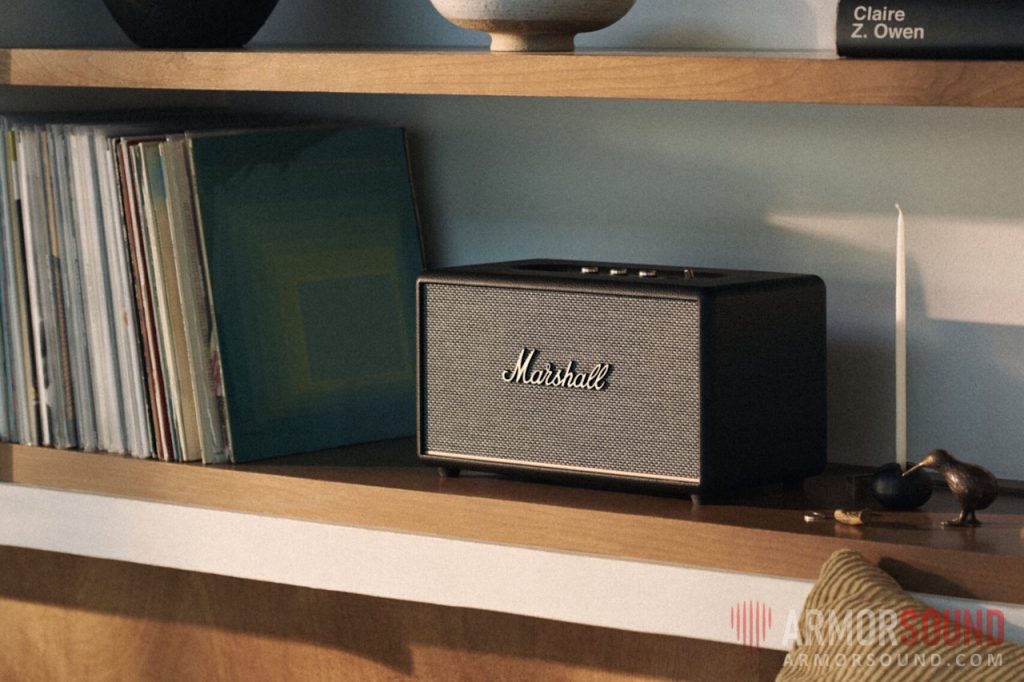 Best value on clearance
Marshall Stanmore III
Best for: Medium rooms on a budget
- Driver layout
- Two-way: woofer, 2 tweeters
- Amplifiers
- 50 W + 2 x 15 W
- Inputs
- RCA, 3.5 mm, Bluetooth 5.2
- Weight
- 4.25 kg (9.37 lb)
- Shelf-friendly size
- RCA and 3.5 mm inputs
- Deep bass extension for its size (DXOMARK)
- Recessed midrange in default tuning (DXOMARK)
- Superseded by the Stanmore IV
Watch for: Only buy it if the discount against the Stanmore IV is large.
Check price on Amazon →How do the Woburn III, Stanmore III and Stanmore IV specs compare?
| Spec (Marshall) | Woburn III | Stanmore III | Stanmore IV |
|---|---|---|---|
| Driver layout | Three-way: woofer, 2 mids, 2 tweeters | Two-way: woofer, 2 tweeters | Two-way: 5-inch woofer, 2 x 0.75-inch tweeters |
| Amplifiers | 90 W + 2 x 15 W + 2 x 15 W | 50 W + 2 x 15 W | 60 W + 2 x 25 W |
| Rated frequency range | 35 to 20,000 Hz | 45 to 20,000 Hz | 36 to 38,000 Hz |
| Rated maximum volume | 100.5 dB SPL at 1 m | 97 dB SPL at 1 m | 97 dB SPL at 1 m |
| Wired inputs | 3.5 mm, RCA, HDMI | 3.5 mm, RCA | 3.5 mm, RCA |
| Bluetooth | 5.2, LE Audio-ready | 5.2, LE Audio-ready | 5.3 with Auracast; LDAC |
| Size (W x H x D) | 400 x 317 x 203 mm | 350 x 203 x 188 mm | 350 x 203 x 185 mm |
| Weight | 7.45 kg (16.42 lb) | 4.25 kg (9.37 lb) | 3.99 kg (8.79 lb) |
| Wi-Fi, mic, voice assistant | None | None | None |
Specs come from Marshall's Woburn III, Stanmore III and Stanmore IV pages. At launch in June 2022, What Hi-Fi? reported US prices of $579 for the Woburn III and $379 for the Stanmore III; TechRadar reviewed the Stanmore IV at $399.99 in July 2026.
How much space do the Woburn III and Stanmore need?
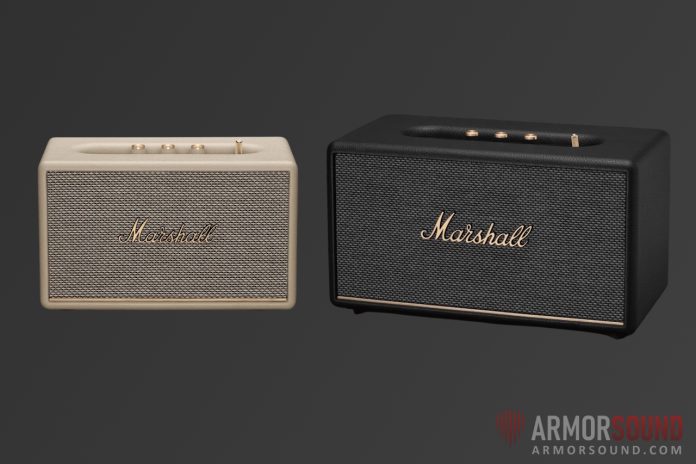
This is the first filter. The Woburn III is 317 mm tall and weighs 7.45 kg, close to a small guitar combo amp. The Stanmore is 203 mm tall and roughly 4 kg, which fits a sideboard or a deep bookshelf.
Both have rear bass ports, so neither wants to be pushed into a cabinet. STEREO GUIDE's Woburn review advises keeping it at least a little away from the wall, and DXOMARK found the Stanmore III's bass stayed boomy near walls even after calibration. Each has Placement Compensation in the app to trim the low end for wall and corner placement.
Under a TV, height matters. RTINGS notes the Woburn III's large design isn't always easy to fit in front of a television, and STEREO GUIDE lists its bulk for a spot under the TV as its main drawback. Measure the gap between your TV stand and the bottom of the screen before ordering.
How do the Woburn III and Stanmore speakers sound?
Woburn III
RTINGS rates the Woburn III very good for music, highlighting extended low bass and a high maximum volume, with the main gap being the lack of a graphic EQ beyond bass and treble. STEREO GUIDE scored it 90% and was more effusive, describing a true three-way design with a 6-inch woofer, two 2-inch midrange drivers and two tweeters on waveguides, deep and fast bass, and clear voices that stay smooth rather than harsh.
The limit is imaging: STEREO GUIDE notes a single narrow box gives a wide, vague stage rather than the focused stereo image of two separate speakers.
Stanmore III
DXOMARK's lab test gave the Stanmore III deep low-end extension and bright treble but found its midrange too quiet in default tuning, which made voices sound distant in podcasts and films. It also flagged bass punch that varies with volume and some pumping on loud bass. It remains loud: DXOMARK measured 94.3 dBA at maximum with correlated pink noise.
Stanmore IV
TechRadar found the Stanmore IV's bass powerful yet controlled, its soundstage wider than the III's, and its control at high volume better than the smaller Acton IV's. The reviewer owns a Stanmore III and rated the IV an improvement.
The pattern: the Woburn's extra cabinet and dedicated midrange drivers are what you pay for. If you care about voices and low bass in a large room, that difference shows in the reviews. In a medium room at normal volume, a Stanmore covers most needs.
Which Marshall speaker works best with a TV over HDMI?
The Woburn III is the only one of the three with HDMI. RTINGS and STEREO GUIDE both identify it as HDMI ARC, and Marshall says that with the speaker left on it powers up and down with the TV and follows the TV's volume, so your TV remote controls it.
Marshall also gives the Woburn III a Night Mode that reduces sudden loud sounds and lifts voices. STEREO GUIDE found the bass reduction in that mode marginal, so do not count on it to keep the peace with neighbors at high volume. RTINGS found dialogue clear and Bluetooth latency fairly low on both iOS and Android.
The Stanmores connect to a TV over RCA or 3.5 mm from the TV's analog output, or over Bluetooth. That works, but you lose remote volume control and automatic power, and DXOMARK rated the Stanmore III weakest in its TV scenario, partly because of the recessed midrange.
What connectivity, app and multi-room options do the Woburn III and Stanmore have?
None of these speakers has Wi-Fi, AirPlay, Chromecast or a voice assistant. The Woburn III and Stanmore III use Bluetooth 5.2; the Stanmore IV moves to Bluetooth 5.3 and adds LDAC and LC3, which matter only if your phone supports them.
All three can now play in sync across rooms. Marshall's Heddon compatibility list includes the Woburn III, Stanmore III and Stanmore IV among speakers that join a Heddon hub's broadcast with a button press, once their firmware is current. The Stanmore IV is a built-in Auracast receiver, and Marshall says it can also join a broadcast from a compatible phone through the app's Listen to Broadcast feature.
The Woburn III and Stanmore III use the Marshall Bluetooth app for Placement Compensation and bass and treble settings. TechRadar reports the Stanmore IV uses the newer Marshall app with a five-band EQ and a customizable M-button.
How easy are the Woburn III and Stanmore controls to use day to day?
Both Generation III speakers share the same brass top panel: a source button, volume, bass and treble knobs, a play and skip control, and a flip-style power switch. Marshall lists identical controls on both product pages, and both work fully without the app.
The detail that catches people out is where those controls sit. STEREO GUIDE points out that the Woburn III's knobs and switches are on top of a 317 mm cabinet, so you need clear space above it to reach them. Slide it onto a low shelf under another shelf and the knobs become hard to use, which matters less if HDMI lets your TV remote handle volume.
STEREO GUIDE also notes the knobs turn continuously and stay in sync with the app, so the position you see on the panel matches what you set on your phone. The Stanmore IV keeps the knob layout and adds a customizable M-button that, according to Marshall, can jump to an EQ preset or start Spotify Tap.
How does the Stanmore IV change the choice?
Marshall's Stanmore IV keeps the Stanmore III's footprint and inputs and changes the parts that drew criticism: more amplifier power for the woofer and tweeters, upgraded tweeters and waveguides, and a reworked bass port that Marshall says handles wall placement better. TechRadar's remaining complaints are the same ones that apply to the Woburn III: no Wi-Fi and no voice assistant.
Pricing moves the needle too. Marshall's US home speaker page lists both the Stanmore III and the Woburn III as special offers alongside the full-price Stanmore IV, so compare all three on the same day rather than relying on launch prices.
That makes the decision simpler than the name suggests. HDMI and a big room point to the Woburn III. Anything else points to a Stanmore, and the IV unless the III is on a steep discount.
Is it worth upgrading from a Stanmore II or Woburn II?
If you already own a Generation II Marshall, the upgrade case is weaker than the model numbers suggest. DXOMARK tested the Stanmore III against the Stanmore II and found the newer speaker brighter and bassier but less warm, with a quieter midrange, slightly lower maximum output (94.3 dBA against 96.9 dBA with correlated pink noise) and higher Bluetooth latency. Its overall score put the Stanmore III a little behind its predecessor.
STEREO GUIDE similarly found little changed on the outside of the Woburn III, and pointed to the app's room compensation and the HDMI ARC input as the meaningful changes.
Older speakers also keep a place in a multi-room setup. Marshall's Heddon compatibility page lists the Stanmore II and Woburn II among legacy models that connect to the hub with an RCA cable, one speaker at a time, while the Generation III and IV models join wirelessly. If your Stanmore II still works, a hub may be a cheaper route to whole-home audio than replacing it.
How do I choose between the Woburn III and a Stanmore?
- The speaker sits under or beside a TV: Woburn III, if it physically fits below the screen.
- Large open-plan room, loud listening: Woburn III, for its higher rated output and dedicated mids.
- Shelf or sideboard in a medium room: Stanmore IV, or Stanmore III on clearance.
- Record player: any of the three via RCA, with a phono preamp built into the deck or added separately.
- Small room or desk: neither. See our Marshall Acton III review for the compact model.
- Wi-Fi streaming or voice control is a must: neither out of the box. Add Marshall's Heddon hub, or consider a Wi-Fi speaker such as the one in our Sonos Five review.
For full write-ups, read our Marshall Woburn III review and Marshall Stanmore III review. Our best Marshall speakers guide covers the portable models too.
What do owners say about the Woburn III and Stanmore III?
Spec sheets and lab reviews only go so far. Here is what owners say after living with it, drawn from their own posts on Reddit and X.
- Woburn wins for owners of both. An owner of the Woburn III, Stanmore III and Acton III plans to sell the Stanmore because the Woburn is better in every respect. (r/marshall)
- Woburn III fills an office. An owner uses a Woburn III in a large open office with 15 people, gets nothing but compliments, and finds the bass surprising when it sits against a wall. (r/Bluetooth_Speakers)
- Mind the neighbors. A Woburn III owner in an apartment says their neighbor complained twice with the bass set to three-quarters. (r/Bluetooth_Speakers)
- Stanmore III for living rooms. A Stanmore III owner recommends it for a living-room home stereo, and the Acton for smaller rooms. (r/marshall)
Owners who have heard both pick the Woburn for size and bass. The Stanmore III is the sensible choice for most living rooms and apartments.
Partner brands for speakers at a glance
| Brand | What they make | Where you buy | |
|---|---|---|---|
| soundcore Anker audio | Anker's audio brand: Bluetooth headphones, true wireless earbuds and speakers | Official Amazon store | Shop soundcore → |
| Edifier Desk and home speakers | Speakers and headphones for home, desktop and portable listening | Brand's own store | Check price → |
Frequently asked questions
Is the Woburn III louder than the Stanmore III?
On paper, yes. Marshall rates the Woburn III at 100.5 dB SPL at 1 m against 97 dB for the Stanmore III, and it has 90 W of woofer amplification against 50 W. RTINGS lists high maximum volume among the Woburn's strengths. In a medium room you will rarely need the difference; in a large open-plan space, the extra headroom helps.
Does the Stanmore III have HDMI?
No. Marshall's FAQ says the Woburn III is the only Generation III home speaker with an HDMI connector. The Stanmore III and the newer Stanmore IV connect to a TV through RCA or 3.5 mm from the TV's analog output, or over Bluetooth. With HDMI ARC, the Woburn III follows your TV's power and volume, which the Stanmores cannot do.
Is there a Marshall Woburn IV?
Not as of October 2026. Marshall launched the Acton IV and Stanmore IV together in July 2026, and its US home speaker page still lists the Woburn III as the largest model in the range. If you want Marshall's biggest home speaker with HDMI today, the Woburn III is the current product rather than an outgoing one.
Can a Woburn III and a Stanmore play music together?
Yes, through Marshall's Heddon hub. Marshall's compatibility list shows the Woburn III, Stanmore III and Stanmore IV can all join a Heddon broadcast at the press of a button with current firmware. That gives you synced music across rooms rather than a stereo pair, with each speaker playing its own full mix in its own room.
Which is better for a record player?
All three have RCA inputs, so the choice comes down to room size. None has a phono stage, so the turntable needs a built-in preamp or a separate one. For a typical living room, the Stanmore IV is the simplest pick; the Woburn III makes sense if the turntable shares a big room with a TV.
Do the Woburn III and Stanmore III work with Alexa or AirPlay?
Not on their own. Marshall lists no Wi-Fi, microphone or voice control for either speaker, and RTINGS confirms the Woburn III has no Wi-Fi or voice assistant. Both play over Bluetooth or wired inputs. For Wi-Fi streaming you need an external source, such as Marshall's Heddon hub, which both speakers can join after a firmware update.
Sources
- Marshall: Woburn III product page and specifications
- Marshall: Stanmore III product page and specifications
- Marshall: Stanmore IV product page and specifications
- Marshall: US home speaker range (current listings)
- Marshall support: Heddon compatible speakers
- RTINGS: Marshall Woburn III speaker review
- DXOMARK: Marshall Stanmore III speaker test (December 2022)
- STEREO GUIDE: Marshall Woburn 3 review (November 2022)
- TechRadar: Marshall Stanmore IV review (July 2026)
- What Hi-Fi?: Marshall Homeline III launch report (June 2022)
Which specs decide between the Woburn III and a Stanmore?
Size, rated loudness and price matter most here. Here is what each number means for your room.
- The Woburn III is rated at 100.5 dB SPL at 1 m, extra headroom for a big open-plan room. (marshall.com)
- The Stanmore III weighs 4.25 kg and stands 203 mm tall, so it suits a sideboard or deep bookshelf. (marshall.com)
- The Stanmore IV gives its woofer 60 W against 50 W in the Stanmore III, more power for bass. (marshall.com)
- DXOMARK measured the Stanmore III at 94.3 dBA at maximum, still loud for a typical living room. (dxomark.com)