This Sonos Five speaker review looks at a wireless hi-fi home speaker built for listeners who want powerful, detailed sound that fills a large room. The Sonos Five suits music lovers, vinyl fans, and multi-room households that want clarity, deep bass, and wide stereo imaging.
Its standout appeal comes from its six custom drivers, sealed acoustic enclosure, Trueplay tuning, and its ability to serve as both a standalone stereo speaker and a paired left–right setup for even greater soundstage performance. That makes it popular with audiophiles and anyone building a home audio system around Sonos, and it's one of the top 10 best home speakers of 2026.
Throughout this review, the Sonos Five faces strong competitors including the Sonos Era 300, Denon Home 350, Marshall Woburn III, and JBL Authentics 500 to show how it stacks up in real-world listening scenarios. The key features come first. Read on to see what makes it one of the best speakers in 2026.
Table of Contents
What are the key features of the Sonos Five?
The Sonos Five's main strengths are powerful sound that fills a large room, a sealed acoustic enclosure for distortion-free bass, six precision engineered drivers, Wi-Fi and AirPlay 2 streaming, multi-room audio support, and a rare 3.5 mm line-in port that makes it a favorite among vinyl enthusiasts.
It delivers rich sound with a wide stereo soundstage, which suits large living rooms, creative studios, and listeners who want hi-fi performance without building a full AV setup. It also has Trueplay tuning, Sonos S2 compatibility, EQ controls, and multi-room streaming.
Quick Specs at Glance
- Six Class-D digital amplifiers with three tweeters and three high-excursion woofers
- Sealed acoustic enclosure for deep, controlled bass
- Wi-Fi and Apple AirPlay 2 wireless streaming
- 3.5 mm analog line-in port for turntables and CD players
- Ethernet port for wired networking stability
- Trueplay tuning and in-app EQ customization
- Multi-room audio and stereo pairing support through Sonos S2
- Compatible with smartphones, tablets, laptops, and computers
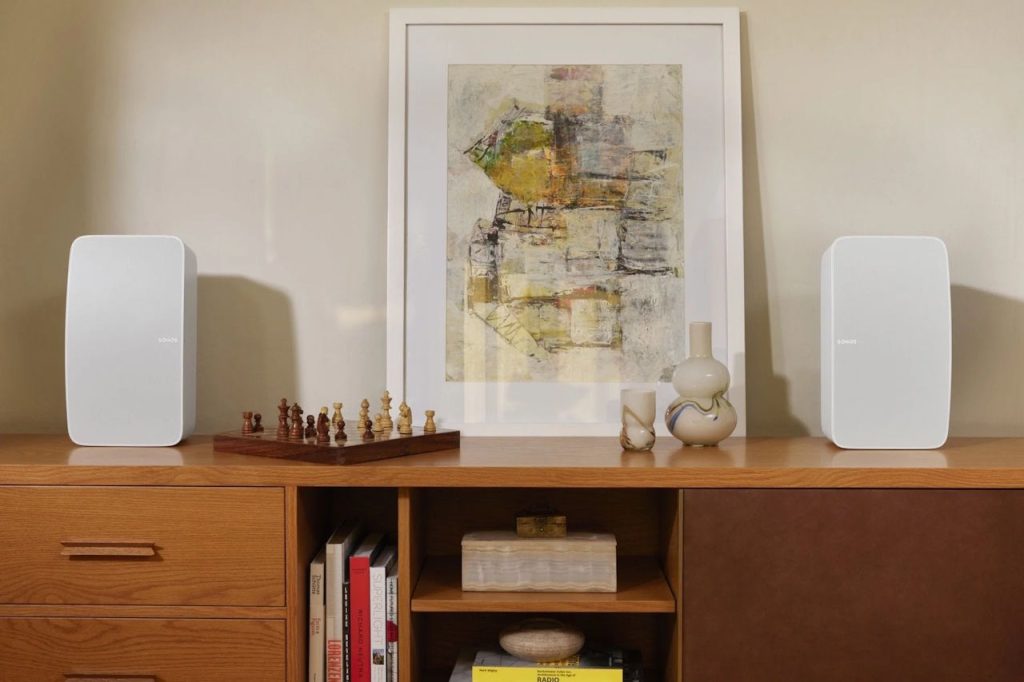
- Premium polycarbonate build available in black or white
- Touch-sensitive controls for playback and volume adjustments
- Designed for indoor home audio with no Bluetooth and no battery
- Ideal for large rooms, music listening, vinyl playback, and high-resolution streaming
How well is the Sonos Five designed and built?

The Sonos Five is a flagship Sonos home speaker with a minimalist look and a substantial build that suits modern interiors.
The sealed acoustic enclosure tightens the bass, and the soft matte finish gives the speaker a contemporary look. It fits on shelves, media consoles, desks, and studio tables. It's worth following proper maintenance tips for speakers to keep it in good shape.
Overall Aesthetic
The Sonos Five features a clean, monochromatic design available in black or white, allowing it to blend into most rooms. Its smooth polycarbonate exterior looks polished and suits upscale décor.
The perforated front grille stretches across the entire face of the speaker, protecting the internal drivers. It looks the same whether you use it horizontally for stereo playback or pair two vertically for dedicated left and right channels.
Durability
The Sonos Five is not built for rugged outdoor use, but its construction is solid for an indoor speaker. The sealed enclosure design adds stability and helps prevent unwanted resonance, which enhances audio performance.
The polycarbonate shell offers strong structural integrity, and the speaker’s weight provides a stable foundation that reduces vibrations during loud playback. Although it has no water resistance or dust protection ratings, its durable materials ensure long-term reliability in typical home environments such as living rooms, studios, entertainment rooms, and offices.
Form Factor and Dimensions
The Sonos Five is a substantial speaker measuring 8.06 inches deep, 14.33 inches wide, and 6.06 inches tall. It weighs 6.35 kilograms, making it heavier than most wireless multi-room audio speakers. This weight contributes to its stable placement but means it is not intended for portable or on-the-go use.
Its form factor suits stationary setups where sound quality is the priority, such as bookshelves, side tables, entertainment consoles, and studio desks. If you want a solid, powerful speaker instead of a lightweight portable one, this is the kind of speaker that fits.
Controls and Buttons
The Sonos Five uses intuitive capacitive touch controls located on the top panel. Users can tap or swipe to adjust volume, play or pause music, or skip tracks with simple gestures. The layout is clean, minimalist, and designed to avoid physical buttons that might disrupt the speaker’s sleek aesthetic.
The touch surface is highly responsive and works well even with light input, making it easy for anyone to manage playback without relying entirely on the Sonos app or AirPlay controls. LED status indicators subtly communicate volume and playback actions without drawing unnecessary attention.
Physical Features
The Sonos Five keeps its physical features clean and simple. There are no handles, straps, or grips because you do not carry this speaker around like a portable one. Its shape works in two orientations. In the horizontal position, it functions as a true stereo speaker with left and right channels.
When you position it vertically, it automatically switches to mono mode, and pairing two units in this orientation creates a wide stereo image. Rubberized feet help keep the speaker planted and stable on flat surfaces, preventing sliding or vibration during high-volume playback.
How does the Sonos Five sound?
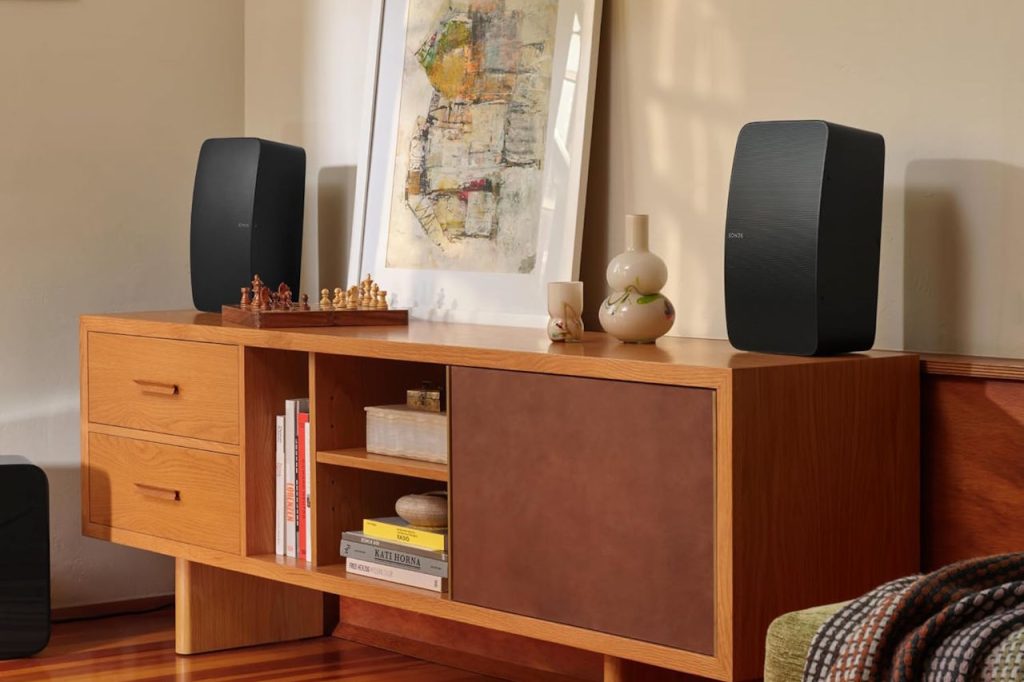
Audio performance is where the Sonos Five is strongest. It suits listeners who want deep, natural sound from streaming music and vinyl alike. With its sealed acoustic enclosure, six-driver array, and tuning by producer Giles Martin, it delivers fidelity and stereo imaging that beat many competing wireless multi-room speakers.
It suits music rooms, living spaces, and studios. The Five performs best when used as a stationary home audio speaker rather than a portable device, allowing its internal components to deliver full dynamic range.
Sound Profile
The Sonos Five produces a balanced and full-bodied sound signature that appeals to audiophiles and everyday listeners alike. Bass is deep, punchy, and exceptionally controlled thanks to its three high-excursion woofers. The sealed enclosure prevents reverb and keeps low frequencies tight and accurate, avoiding the muddiness common in many wireless speakers.
Its midrange is warm and expressive with excellent detail reproduction. Vocals sound natural, instruments retain their character, and musical layers remain clear and defined. Three precision tweeters handle the high frequencies, delivering smooth treble extension without harshness, resulting in an overall sound profile that is refined, rich, and highly engaging.
Driver Configuration
Inside the Sonos Five is a powerful six-driver acoustic system powered by individual Class-D amplifiers. Three tweeters handle the high-end detail, with one firing forward and two angled outward to expand the soundstage. The three custom woofers manage low and mid frequencies with impressive depth and musicality.
Sonos does not publish exact driver sizes or wattage, but industry analysis suggests the woofers measure around four inches in diameter. The sealed cabinet enhances their performance by reducing internal resonance and improving driver control. Instead of passive radiators, the enclosure’s internal structure stabilizes airflow to deliver strong bass output.
Loudness and Clarity
The Sonos Five handles high-volume performance and can fill large rooms with powerful, clean sound. Thanks to its six dedicated amplifiers and DSP optimization, the speaker maintains clarity even at maximum volume. High frequencies remain crisp, vocals stay sharp, and instruments do not lose definition.
The Five keeps distortion impressively low. The sealed design prevents turbulence and coloration, allowing the Five to maintain fidelity across all genres, whether you are listening to energetic electronic tracks, rock, hip-hop, acoustic pieces, or orchestral recordings. This makes it one of the most reliable high-volume performers among Wi-Fi home speakers.
Soundstage and Immersion
One of the greatest strengths of the Sonos Five is its expansive soundstage. The side-angled tweeters push sound outward, creating a wider stereo field than most single-speaker designs. When placed horizontally, the speaker delivers true stereo playback, giving instruments and vocals more space and separation.
A pair of Sonos Five speakers placed vertically improves on that. Each speaker switches to mono mode, creating a more defined left and right channel for authentic stereo imaging. The effect suits larger rooms. The Five is not intended for outdoor use due to its size, weight, and lack of water resistance.
Special Audio Tech
The Sonos Five uses advanced digital signal processing to maintain clarity, balance, and tonal accuracy at all volume levels. Trueplay tuning, available on compatible iOS devices, analyzes your room and automatically adjusts the EQ to deliver the most accurate sound for your environment. That helps the speaker sound its best in different rooms.
The Sonos S2 app provides manual EQ adjustments for bass, treble, and loudness, offering even more customization for listeners. While the Sonos Five does not include branded modes like XBass or outdoor boosts, its natural tuning and DSP refinement create an audiophile-grade sound without relying on artificial enhancement. It also supports Apple AirPlay 2 and lossless streaming.
What connectivity and compatibility does the Sonos Five offer?

The Sonos Five centers on Wi-Fi stability and multi-room playback, and it works with smartphones, tablets, laptops, and turntables through both wireless and wired options.
Wireless Technology
The Sonos Five relies primarily on Wi-Fi 802.11b, g, and n connectivity. That gives stable, high-bandwidth wireless audio streaming without the compression or signal limitations that Bluetooth often introduces. With Apple AirPlay 2 support, iPhone and iPad users can enjoy low-latency, high-quality playback directly from their devices. The lack of Bluetooth may look limiting, but the Five delivers lossless audio over Wi-Fi and stays consistent across the Sonos multi-room system.
Wireless stability is excellent, even in large or device-heavy households. Streaming from services within the Sonos S2 app or through AirPlay 2 feels smooth and responsive, with minimal lag or dropouts. That suits listeners who want a Wi-Fi speaker with AirPlay and multi-room support.
Wired Connectivity
The 3.5 millimeter line-in port is one of the Five's strongest features. This allows the Five to support turntables with built-in preamps, CD players, digital audio converters, and older audio sources that many modern wireless speakers no longer accommodate. Vinyl enthusiasts especially appreciate this flexibility, as it offers an easy way to enjoy analog music through a high-fidelity wireless home speaker.
Alongside line-in, the Sonos Five offers an Ethernet port for users who prefer a wired network connection. This enhances streaming stability, especially in environments with weak Wi-Fi signals. Although the speaker does not offer USB-C, optical inputs, or HDMI, its combination of line-in and Ethernet makes it versatile enough for most home audio setups.
Multi-Device Support
Even without Bluetooth, the Sonos Five handles multi-device audio streaming with ease. Switching between AirPlay 2 sources, Sonos app control, and line-in audio is smooth and intuitive. Latency performance is excellent when using Wi-Fi or AirPlay 2 for normal music playback, podcasts, or multi-room audio synchronization.
For movies or gaming, the Sonos Five is best used as a dedicated music speaker rather than a TV speaker, as it lacks HDMI ARC, optical input, and low-latency gaming modes. However, users who route audio through a computer, DAC, or AirPlay 2 streaming device can still use the Five for casual video watching. Within multi-room setups, the speaker performs flawlessly, syncing audio throughout the house without delay.
App Support
App integration is one of the Five's biggest advantages. The Sonos S2 app is polished and powerful. Users can adjust EQ settings, create room groups, toggle loudness optimization, set up stereo pairs, and fine-tune audio through Trueplay room tuning.
Firmware updates are automatic, so the speaker improves over time. The app also supports a huge library of streaming services, letting you access Spotify, Apple Music, Tidal, Amazon Music HD, and more from a single interface. For listeners who want deep customization and a well-designed control app, the Sonos Five is one of the top multi-room speakers.
Platform Compatibility
The Sonos Five works smoothly with smartphones, laptops, tablets, and desktop computers. iOS users can stream instantly using AirPlay 2, while Android and Windows users rely on the Sonos S2 app. The line-in port extends compatibility to turntables, CD players, and other legacy audio gear.
While the Sonos Five does not offer direct TV or console connectivity, it can still work as part of a broader multi-room system that includes a Sonos soundbar connected to a TV. That suits households building a full home audio system with Sonos Era speakers, the Sonos Arc, Sonos Sub, and other wireless multi-room components.
Does the Sonos Five have a battery or need charging?
The Sonos Five is a fully AC-powered home audio speaker with no internal battery, no portable mode, and no charging cycle. This design choice allows the speaker to deliver higher acoustic performance without the limitations of mAh capacity, battery drain, or power-saving algorithms. As a result, the Sonos Five performs consistently at all volumes and remains stable as part of a multi-room speaker setup.
Battery Performance
The Sonos Five does not include a built-in battery, so it has no rated playtime or portable runtime. It requires constant AC power through its supplied power cable. This allows the speaker to maintain full amplifier output, deep bass performance, and distortion-free playback without the compromises commonly seen in battery-powered wireless speakers.
Because the speaker is always plugged in, audio performance does not degrade at higher volume levels. The Sonos Five delivers consistent clarity and bass response whether played at low volumes for background listening or at high volumes for lively music sessions. This consistency is one of the advantages of owning a fully AC-powered home speaker.
Power Capacity
Since the Sonos Five is not a portable device, it does not contain a battery measured in milliamp hours and does not rely on any rechargeable internal cells. There is no battery longevity to consider, no charge cycles, and no long-term battery wear. This makes the speaker a maintenance-free choice for users who want a long-lasting home audio system without the need to replace internal batteries or worry about reducing runtime over years of use.
Instead, the speaker draws stable power directly from the wall, ensuring the six Class-D amplifiers receive the energy they need to deliver high-fidelity sound at all times.
Charging Experience
There is no charging process involved with the Sonos Five. The speaker connects directly to wall power using the included AC cable. It does not support USB-C, micro-USB, or any form of fast charging because it is not designed to be portable. Plug it in once, set it in position, and the speaker is ready for long-term operation without needing to recharge.
This makes the setup simple and convenient. Users never have to worry about charging time, low battery warnings, or battery-related audio limitations.
Power Features
Although the Sonos Five lacks battery-powered features like auto-shutoff or power bank functions, it does include intelligent power management through the Sonos system. The speaker can enter a low-power idle mode when not actively playing audio, helping reduce energy consumption without fully powering down.
Since there is no internal battery, the Sonos Five does not include battery indicators or portable power-saving modes. Its electrical design centers on stable, plugged-in performance for reliable, high-quality home listening.
What smart features and extra functions does the Sonos Five have?
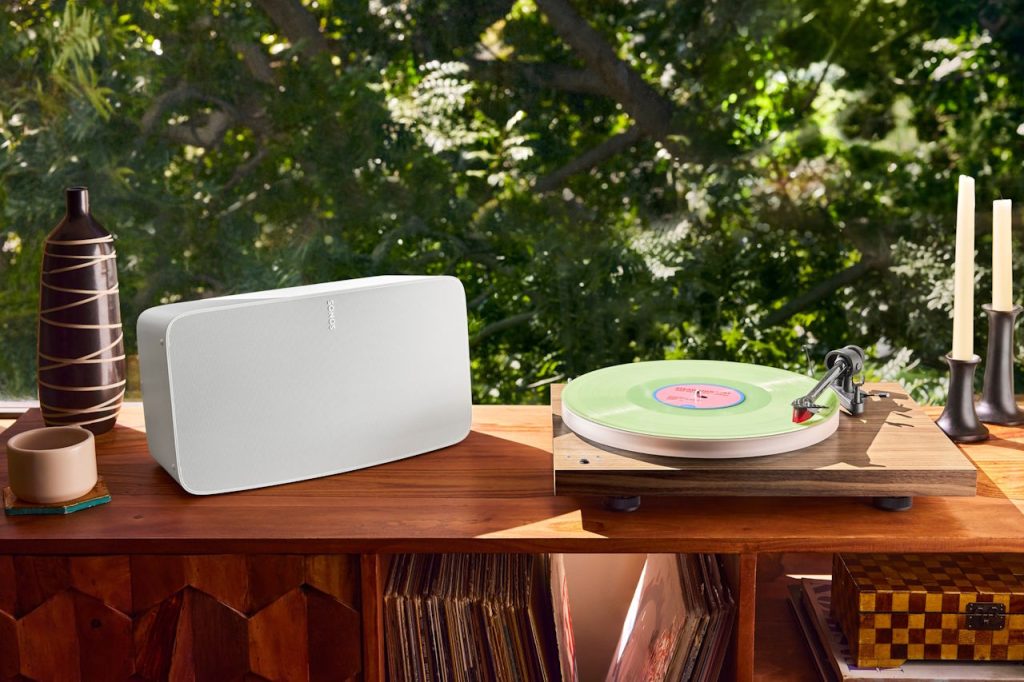
The Sonos Five focuses on sound quality and multi-room performance, but it still has useful smart features for convenience, customization, and integration with the wider Sonos ecosystem.
Although the Sonos Five does not include built-in microphones or voice assistants, it handles multi-room audio, stereo pairing, app-based control, and visual indicators well.
Voice Assistant Integration
While the Sonos Five does not feature built-in microphones for Alexa, Google Assistant, or Siri, it still works with voice assistants indirectly through compatible devices in your home. Users can control playback using voice commands via an iPhone (Siri with AirPlay 2), a Sonos soundbar with microphones, or an external smart speaker such as an Amazon Echo or Google Nest device. This allows the Sonos Five to operate within voice-enabled ecosystems without embedding microphones inside the speaker itself. If you value privacy or prefer a microphone-free design, that is an advantage.
Built-In Microphone Performance
There are no built-in microphones on the Sonos Five, which means you cannot use the speaker for voice calls, smart assistant communication, or voice-based room tuning directly. Instead, Trueplay room calibration uses a compatible iOS device’s microphone. Leaving out microphones keeps the hardware focused on audio and avoids privacy concerns.
Stereo Pairing and Chaining
The Five supports stereo pairing. When you pair two units vertically, they form a true left and right stereo configuration that widens the soundstage. Vertical orientation puts each speaker into mono mode for optimal channel separation, while horizontal placement keeps a single unit operating in true stereo.
LED Indicators or Lighting Effects
The Sonos Five uses subtle LED indicators located on the top control area to communicate important functions such as power status, connection state, and audio playback response. These LEDs are minimal and intentionally designed not to distract during nighttime listening or when watching movies. There are no RGB lighting effects or decorative LEDs, which fits the speaker's minimalist look.
Multi-Room or Multi-Speaker Ecosystem
The Sonos Five works as part of the larger Sonos multi-room ecosystem. You can add multiple speakers throughout the house and manage them through the Sonos S2 app, grouping or splitting audio zones as needed. You can sync music in every room or set up separate zones with different playlists.
How does the Sonos Five compare to other home speakers?
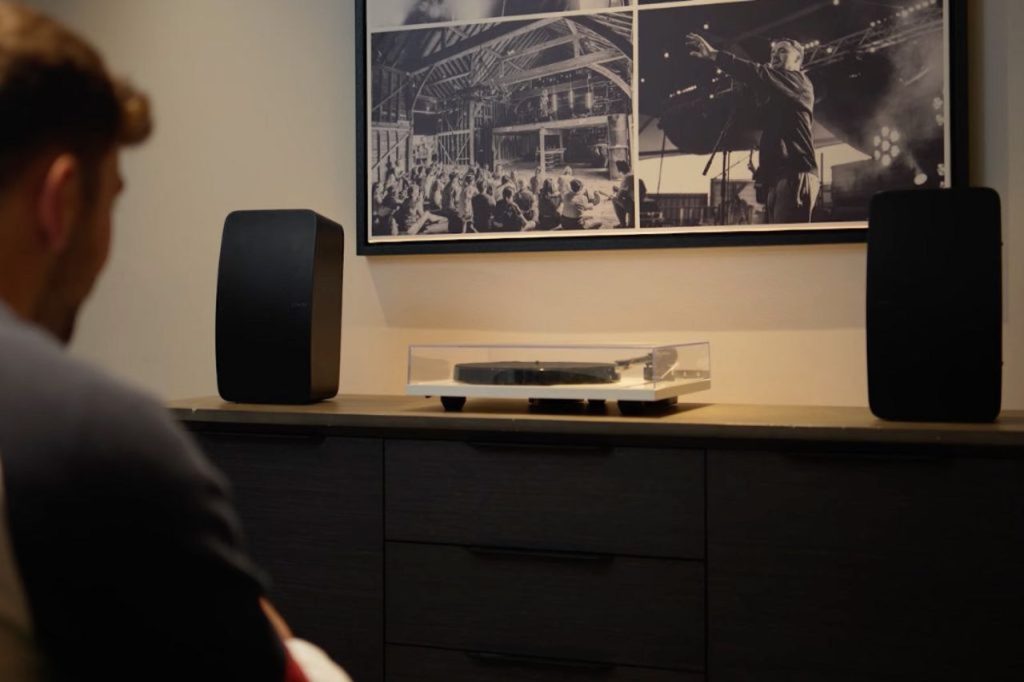
The Sonos Five competes directly with several high-performance home speakers that emphasize powerful sound, deep bass, wide soundstage, and smart home compatibility.
In this section, we compare the Sonos Five against four major competitors: Sonos Era 300, Denon Home 350, Marshall Woburn III, and JBL Authentics 500. Each speaker has its own strengths. The Sonos Five's are sealed-enclosure bass precision, analog line-in flexibility, multi-room stability, and studio-grade tuning. Alternatives may suit other listeners better.
Sonos Five vs Sonos Era 300
The Sonos Era 300 takes a spatial-audio approach compared to the traditional stereo architecture of the Sonos Five. While both models deliver powerful sound and integrate perfectly into the Sonos multi-room audio system, the Five focuses on classic left–right stereo fidelity, deeper bass output from its sealed enclosure, and better performance for vinyl setups thanks to its 3.5 mm line-in input. The Era 300, on the other hand, targets Dolby Atmos music and multi-directional audio.
The Sonos Five remains the stronger choice for pure stereo music listening, audiophile accuracy, and turntable users who want a clean, wide soundstage. Read in-depth Sonos Era 300 speaker review to learn more about its features, performance, and specifications in details.
| Feature | Sonos Five | Sonos Era 300 |
|---|---|---|
| Sound Signature | Deep bass, wide stereo | Spatial audio |
| Inputs | 3.5 mm line-in, Ethernet | USB-C (adapter), Wi-Fi |
| Bass Performance | Stronger, sealed enclosure | Very good, less controlled |
| Best For | Stereo music, vinyl, large rooms | Dolby Atmos music, spatial audio |
| Voice Control | Via external devices | Built-in microphones |
| Orientation | Horizontal or vertical | Single orientation |
| Price | See Price | See Price |
Sonos Five vs Denon Home 350
The Denon Home 350 is a powerhouse Bluetooth and Wi-Fi speaker that competes closely with the Sonos Five in terms of output and size. The Denon model offers Bluetooth streaming and built-in Alexa, which the Sonos Five lacks.
However, the Five wins in sound purity, sealed-enclosure bass control, and cleaner stereo imaging. The Sonos multi-room ecosystem also tends to be more stable and intuitive than Denon’s HEOS platform. For deep, accurate bass and premium stereo reproduction, the Sonos Five remains the superior choice, while the Denon Home 350 is best suited for buyers who prioritize built-in voice assistants and Bluetooth.
| Feature | Sonos Five | Denon Home 350 |
|---|---|---|
| Wireless Streaming | Wi-Fi, AirPlay 2 | Wi-Fi, AirPlay 2, Bluetooth |
| Bass Response | Tighter, more accurate | Very powerful, slightly boomy |
| Smart Features | No built-in voice | Alexa + Google available |
| Inputs | 3.5 mm line-in | USB, AUX, Ethernet |
| Acoustic Design | Sealed enclosure | Ported enclosure |
| Ecosystem | Sonos S2 | Denon HEOS |
| Price | See Price | See Price |
Sonos Five vs Marshall Woburn III
The Marshall Woburn III is a stylish and powerful speaker inspired by classic guitar amplifiers. It includes Bluetooth, HDMI ARC, and a lively mid-forward sound signature that appeals to rock and pop music fans. The Sonos Five, however, delivers more accurate and neutral sound, deeper bass control, and stronger performance at higher volumes thanks to its sealed acoustic engineering.
While the Woburn III excels in visual design and TV connectivity, the Sonos Five outperforms it in overall fidelity, clarity, and multi-room ecosystem flexibility. Read in-depth Marshall Woburn III speaker review to learn more about its performance and specifications in details. Alternatively, you can explore the top best Marshall speakers of 2026 if you are an avid fan of their branded products.
| Feature | Sonos Five | Marshall Woburn III |
|---|---|---|
| Design Style | Modern minimal | Vintage amplifier |
| Bluetooth | Not supported | Bluetooth supported |
| TV Accessibility | No HDMI | HDMI ARC included |
| Sound Quality | Neutral, accurate, deep bass | Warm, punchy, energetic |
| Multi-Room | Full Sonos ecosystem | Limited multi-room options |
| Inputs | 3.5 mm line-in | RCA, AUX, HDMI ARC |
| Price | See Price | See Price |
Sonos Five vs JBL Authentics 500
The JBL Authentics 500 is a powerful Wi-Fi and Bluetooth home speaker that supports Dolby Atmos music and dual voice assistants. With strong bass and a bold sound signature, it competes closely with the Sonos Five in raw output. However, the Sonos Five has more accurate stereo imaging, tighter low-end performance from its sealed enclosure, and arguably one of the best multi-room experiences in the industry.
The JBL model is ideal for buyers who want Bluetooth, portable device pairing, and a slightly more aggressive sound, while the Sonos Five wins for pure music fidelity and whole-home audio integration. Alternatively, if you are looking to get your hands on the next top 10 best portable speakers of 2026, the JBL Boombox 3 speaker review and the JBL Xtreme 4 speaker review both are very strong alternative choices to the Sonos Five home speaker given its combination of portability and IP67 ratings.
| Feature | Sonos Five | JBL Authentics 500 |
|---|---|---|
| Sound Profile | Balanced, refined | Bold, energetic |
| Connectivity | Wi-Fi, AirPlay 2 | Wi-Fi, AirPlay 2, Bluetooth |
| Spatial Audio | Not supported | Dolby Atmos music |
| Voice Assistants | External only | Dual built-in assistants |
| Bass Performance | Tighter, more controlled | Strong, high output |
| Stereo Pairing | Yes, with another Five | Not as optimized for stereo pairs |
| Price | See Price | See Price |
Should You Buy the Sonos Five Hi-Fi Home Speaker?

The Sonos Five is a strong choice for listeners who want premium stereo sound, rich bass, a wide soundstage, and multi-room audio. Its sealed acoustic design and Wi-Fi streaming suit music lovers who want powerful, detailed playback without separate receivers or a complex setup.
The Sonos Five especially appeals to vinyl enthusiasts, audiophiles seeking accurate stereo imaging, and home audio users who want a modern wireless speaker that fits into a full multi-room system. It is not portable or outdoor-focused, but it works well in dedicated listening spaces and large indoor rooms.
Buy Sonos Five Hi-Fi Home Speaker if:
- You want one of the best-sounding wireless hi-fi home speakers with rich bass and wide stereo imaging
- You listen to vinyl and need a speaker with a 3.5 mm line-in port for turntables or CD players
- You want a high-end Sonos wireless home speaker that fits into a multi-room audio system
- You prefer a Wi-Fi speaker with AirPlay 2 for stable, lossless streaming instead of Bluetooth
- You need strong output for large rooms, open living spaces, or creative studios
- You want premium build quality with a clean, modern aesthetic that fits upscale home décor
- You value Trueplay tuning and advanced DSP for accurate, optimized sound in any room
Don’t Buy Sonos Five Hi-Fi Home Speaker if:
- You need Bluetooth connectivity for quick pairing with any mobile device
- You want a portable speaker with a built-in battery for outdoor or on-the-go listening
- You require a TV speaker with HDMI ARC or optical inputs
- You want built-in microphones for Alexa, Google Assistant, or hands-free voice commands
- You prefer lightweight speakers or small form factors that fit tight spaces
- You need waterproofing or weatherproof features for outdoor environments
Bottom Line
The Sonos Five delivers strong stereo sound, deep and accurate bass, and multi-room performance that few competitors match. It is not designed for portability or outdoor use, but its build, soundstage, Trueplay tuning, and Sonos integration suit music enthusiasts, vinyl lovers, and anyone building a multi-room system.
You can get the Sonos Five Wireless Hi-Fi Speaker here on Amazon.
Frequently Asked Questions
These FAQs cover connectivity, multi-room features, audio performance, and home setups for the Sonos Five.
Is the Sonos Five a good speaker for high-fidelity music listening?
Yes, the Sonos Five is excellent for high-fidelity music listening. The speaker has six custom drivers, a sealed acoustic enclosure, and tuning by Giles Martin to produce a clean, dynamic, and highly detailed sound profile. It delivers rich bass, crystal-clear mids, and smooth treble, making it ideal for audiophiles and listeners who want studio-grade sound from a wireless home speaker.
Does the Sonos Five support Bluetooth connectivity?
No, the Sonos Five does not support Bluetooth. Instead, it relies on Wi-Fi and Apple AirPlay 2 for superior audio quality. This design choice ensures stable, high-bandwidth streaming without compression. Wi-Fi performance is stronger and more consistent for multi-room audio.
Can the Sonos Five be used with a turntable?
Yes. One of the standout features of the Sonos Five is its 3.5 mm line-in port, which allows direct connection to turntables with built-in preamps. Vinyl lovers often choose the Sonos Five specifically for this reason, as it provides a high-fidelity wireless home speaker option compatible with analog audio sources.
How powerful is the bass performance on the Sonos Five?
The Sonos Five offers exceptional bass performance thanks to its sealed cabinet and three high-excursion woofers. Bass remains tight, deep, and controlled without creating muddiness or distortion. That is one of its clearest advantages, especially for users who enjoy hip-hop, electronic, or orchestral music.
Does the Sonos Five work with voice assistants like Alexa or Google Assistant?
The Sonos Five does not have built-in microphones, so it cannot directly host Alexa or Google Assistant. However, you can control it through external voice-enabled devices such as a Sonos soundbar, Echo speaker, or Google Nest speaker. Siri also controls the Five through AirPlay 2.
Can two Sonos Five speakers be paired for stereo sound?
Yes, two Sonos Five speakers create an impressive stereo pair. When you place them vertically, each speaker automatically switches to mono mode, forming a true left and right channel setup. This pairing significantly enhances the soundstage and suits large rooms or dedicated music listening spaces especially well.
Does the Sonos Five support Dolby Atmos or spatial audio?
No, the Sonos Five focuses on pure stereo performance rather than surround or spatial audio formats. If spatial audio or Dolby Atmos is a priority, the Sonos Era 300 would be a better choice. However, for stereo music and vinyl playback, the Sonos Five offers superior accuracy and bass depth.
Is the Sonos Five good for TV audio?
The Sonos Five is not optimized for TV audio because it lacks HDMI ARC and optical inputs. While you can connect a TV through AirPlay 2 or line-in (depending on the setup), latency may not be ideal for lip-sync accuracy. For a true TV-centric setup, consider pairing a Sonos Arc or Beam with the Sonos Five in a multi-room configuration.
How does the Sonos Five perform at high volume levels?
The Sonos Five performs exceptionally well at high volume. With six Class-D amplifiers and a sealed enclosure, it maintains clarity and power without distortion. Even at loud listening levels, the speaker delivers clean treble, controlled bass, and accurate vocals, making it one of the strongest performers in its class.
Does the Sonos Five support multi-room audio?
Yes, the Sonos Five works with the full Sonos multi-room ecosystem. Using the Sonos S2 app, you can group speakers, play different songs in each room, or synchronize audio across your entire home. That is a major advantage over many competitors.
Is the Sonos Five compatible with Android and iOS devices?
Absolutely. The Sonos Five works with both Android and iOS devices through the Sonos S2 app. iOS users also benefit from AirPlay 2 support for direct streaming. Android users stream through the app or via supported streaming services linked to the Sonos ecosystem.
What streaming services work with the Sonos Five?
The Sonos Five supports virtually every major streaming service through the Sonos S2 platform, including Spotify, Apple Music, Tidal, Amazon Music, YouTube Music, Deezer, and more. Many services also support lossless audio, allowing the Sonos Five to deliver high-quality playback.
How does the Sonos Five compare to the Sonos Era 300?
The Sonos Five excels in stereo fidelity, deeper bass, and line-in flexibility, while the Sonos Era 300 focuses on Dolby Atmos and spatial audio. The Five remains the better choice for pure stereo enthusiasts and vinyl users.
Can the Sonos Five be used outdoors?
The Sonos Five is not designed for outdoor use. It is not water-resistant or weatherproof, and its AC-powered design requires an indoor wall outlet. It performs best in indoor audio setups where Trueplay can tune the acoustics.
Is the Sonos Five worth the price?
Yes. For listeners who value high-fidelity sound, rich bass, modern Wi-Fi streaming, and multi-room audio, the Sonos Five offers outstanding value. Its sealed enclosure, premium build, and powerful stereo performance place it among the top wireless hi-fi speakers in its category.
What do the Sonos Five specs mean for your home setup?
The Sonos Five is a large, plugged-in speaker built for one spot in your home. These figures show where it fits and what it connects to.
- It weighs 6.35 kilograms, so it suits a fixed spot like a shelf or console, not travel.
- It measures 14.33 inches wide, 8.06 inches deep and 6.06 inches tall, so plan for shelf space.
- The 3.5 mm line-in lets you connect a turntable with a built-in preamp or a CD player.
- Wi-Fi 802.11b, g and n handles streaming, and an Ethernet port helps in weak Wi-Fi areas.
- Six drivers, with three tweeters and three woofers, spread sound wide enough for large rooms.