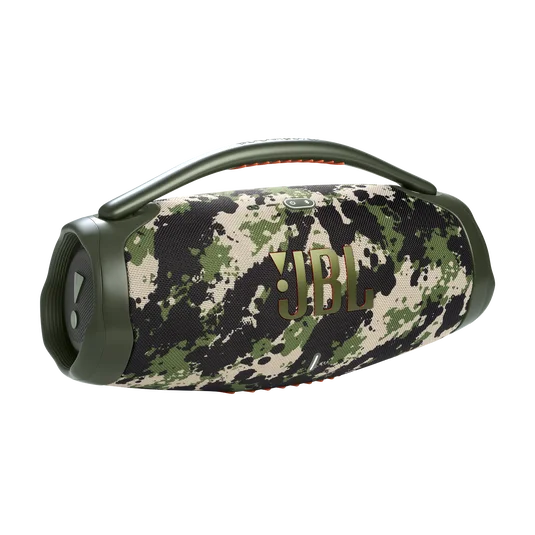
The JBL Boombox 3 is for buyers who want a loud, bass-forward outdoor speaker and accept that “portable” means carrying 6.7 kg by a handle. Its three-way front-facing system, 3.5mm input, USB-A power bank, IP67 rating and PartyBoost support make it more flexible than a typical party speaker. Its drawbacks are just as concrete: the body is large, the sound is not 360 degrees, the app EQ is basic, and the standard Bluetooth model is now an older generation beside the Boombox 4.
This review covers the standard JBL Boombox 3, model JBLBOOMBOX3BLKAM or the equivalent Squad colorway—not the separate Boombox 3 Wi-Fi. The official JBL page I checked on September 12, 2026 listed the standard product and its specifications but no stable US sale price. SoundGuys’ exact-model review uses a $499.95 USD MSRP, while WiFiHiFi reported C$600 in March 2024. Use those as dated reference points and check the seller before buying. If you need a lighter JBL, compare it with the JBL Xtreme 4 review.
Table of Contents
Is the JBL Boombox 3 a powerful outdoor speaker worth its carrying cost?
| Best for | Backyards, pool decks, tailgates and larger gatherings where high output matters |
|---|---|
| Strongest evidence | JBL’s current specification page plus RTINGS, SoundGuys and WiFiHiFi exact-model reviews |
| Main compromise | 6.7 kg, front-facing sound and only a three-band app EQ |
| Manufacturer claim | Up to 24 hours, IP67 protection, Bluetooth 5.3, 3-way speakers and PartyBoost |
| Buy when | You find the standard model substantially below its old $499.95 MSRP and need AUX or serious volume |
The Boombox 3 earns its size when people are spread across a yard or when a small speaker would run out of headroom. It is a poor fit for someone who carries audio on foot, stores it in a small apartment, or expects even sound from every side. The Boombox 4 is lighter and newer, but a discounted Boombox 3 remains sensible when the old model’s stronger bass balance and physical inputs fit the use case.
Which Boombox 3 Is This?
JBL sells a standard Bluetooth Boombox 3 alongside a Boombox 3 Wi-Fi variant. The standard model reviewed here has Bluetooth 5.3, a 3.5mm audio input, USB-A charge-out, and JBL PartyBoost. The Wi-Fi model adds network and home-theater features but is not the same connectivity package. RTINGS’ exact-model review explicitly says its test results represent the Black variant and separately describes the Wi-Fi version. It also says the Wi-Fi version is not compatible with PartyBoost. A listing that mentions Dolby Atmos, Wi-Fi or JBL One cannot verify the standard model’s features.
The current official JBL product page lists a three-way system: one subwoofer, two midrange drivers and two tweeters. In AC mode, JBL specifies 80W RMS for the subwoofer, 40W RMS for each midrange driver and 10W RMS for each tweeter. In battery mode, the figures are 60W, 30W and 8W respectively. That is why online descriptions may quote 180W plugged in or 136W on battery. These are JBL’s output ratings, not a third-party loudness measurement.
The same page lists 40 Hz–20 kHz frequency response, 48.2 by 25.7 by 20.0 cm dimensions, 6.7 kg weight, 6.5 hours charging time, and up to 24 hours of playtime. The global page’s current item is the Squad camouflage SKU, while RTINGS tested the Black version; both are color variants of the standard Boombox 3 family. Verify the model number on a marketplace listing because “Boombox 3 Wi-Fi” is not a harmless wording variation.
How loud is the JBL Boombox 3 and how does it sound?
RTINGS gives the standard Boombox 3 a balanced, slightly bright profile with extra high-bass warmth. Its lab review, updated August 20, 2024 with a later test-bench update, says vocals and lead instruments remain clean and present, the speaker gets loud with little compression at maximum volume, and its companion app includes a graphic EQ. The weak point is directivity: the speaker does not project evenly in all directions, so place the front toward the main listening area.
SoundGuys’ Boombox 3 review, originally published December 20, 2022 and updated November 21, 2024, describes an enjoyable bassy sound and strong volume. Sam Smart tested the speaker for four days with firmware 0.3.0.0 and calls out the same practical cost: it is expensive, large and heavy. The review says the app only gives bass, mid and treble sliders, with no finer frequency controls or presets. That is enough to tame a bass-heavy mix, but not enough for listeners who want detailed correction.
WiFiHiFi’s March 25, 2024 review is more enthusiastic about vocal detail and party output. The reviewer compared the Boombox 3 with a Sonos Era 300 and found the JBL more powerful and bass-heavy, while the Sonos sounded more spacious in that room. Those are listening impressions from a named independent review, not a universal ranking. Together with RTINGS and SoundGuys, they support a narrower conclusion: the Boombox 3 is a strong choice for loud, bass-led playback, while smaller indoor listening may reward a more evenly dispersing speaker.
The three-way layout matters here. The subwoofer handles the low end, two midrange drivers and two tweeters face forward, and passive radiators sit on the sides. That layout helps the speaker sound substantial from the front, but it explains the limited off-axis consistency. It also makes the Boombox 3 a better “set it down and aim it” speaker than a central table speaker meant to serve listeners on every side.
How heavy is the Boombox 3, what does IP67 cover and how long does the battery last?
At 6.7 kg (14.7 lb), this is a large speaker even before adding a bag or accessories. SoundGuys says the handle makes short carries manageable but describes storage and apartment use as difficult. WiFiHiFi makes the same point in more domestic terms: it works in a backyard, car trunk or park, but is not a speaker most people casually walk around with. The JBL Xtreme 4 is the more realistic choice for a long walk; the Boombox 3 repays the effort with more cabinet volume and deeper bass.
JBL rates the standard model IP67 for dust and water resistance. The official page says it can go to the pool, park or rain, with the rear rubber cover closed over the ports. IP67 means dust-tight protection and temporary immersion under the rating’s test conditions; it does not make every use case safe, and you should not charge the speaker while wet. There is conflicting secondary commentary about floating: RTINGS’ overview says it floats, while SoundGuys’ FAQ says the dense 6.7 kg enclosure will sink. JBL’s current product page emphasizes IP67 but does not promise floatability. Treat the Boombox 3 as water-resistant, not as a pool float, and keep it secured near deep water.
JBL’s 24-hour figure is a manufacturer maximum, and SoundGuys repeats it with the 6.5-hour charging time. Actual runtime depends on volume, source, EQ, temperature and whether the USB-A outlet is charging a phone. The AC input also lets the speaker operate from a wall outlet, which is useful for a fixed party setup but means the standard model is not USB-C rechargeable. A six-hour charge and large AC adapter are part of the ownership cost.
Does the Boombox 3 have Bluetooth, AUX input and PartyBoost?
The standard Boombox 3 uses Bluetooth 5.3 and supports the SBC codec, according to SoundGuys. JBL says two smartphones or tablets can connect so people can take turns playing music. In practice, multipoint reports are mixed. RTINGS lists Bluetooth multipoint support, while SoundGuys’ reviewer could not keep two devices connected at the same time across several source devices. Treat two-device pairing as a feature to test with your own phones, not a guarantee of flawless handoff.
The rear panel is more useful than many newer portable speakers: it has a 3.5mm input for wired playback and USB-A charge-out for a phone. SoundGuys confirms both ports and notes the rubber cover needs to stay closed for water and dust protection. The speaker also supports JBL PartyBoost, which can link compatible JBL speakers for stereo or a larger group setup. PartyBoost is not the same as JBL Connect+, so older Connect+ products such as the Charge 4 and Xtreme 2 cannot join this network. It also does not connect to JBL PartyBox models.
The JBL Portable app provides firmware updates, a simple three-band EQ and PartyBoost setup. It is easy to understand, but buyers who expect Wi-Fi multiroom, voice assistants or detailed room correction are looking at the wrong model. Those features belong to other products, including the Boombox 3 Wi-Fi, so keep them out of a standard Bluetooth listing.
How does the Boombox 3 compare with the Boombox 4 and other alternatives?
The newer Boombox 4 is the direct alternative. RTINGS says it adds Bluetooth LE and Auracast, uses a swappable battery, and is lighter, while the Boombox 3 can have a more even bass range and lower latency with SBC. A large discount can make the third generation worthwhile, especially for buyers who need its 3.5mm input and existing PartyBoost speakers. Pay extra for the Boombox 4 when lighter carrying, battery replacement and newer wireless features matter more.
The portable speakers under $200 guide is a better starting point for buyers who do not need this much volume. The JBL Xtreme 4 is smaller, lighter and easier to carry, though RTINGS notes that it gives up some low-bass extension and maximum output. Soundcore’s Boom 2 is much cheaper and lighter, but its front-facing output, no-AUX design and less controlled treble place it in a different value class.
Recent owner discussion is too mixed with Boombox 4, Boombox 3 Wi-Fi, retailer posts and older reviews to establish a clean current consensus. The exact-model social sample does not justify a universal claim about reliability or sound. The recommendation therefore leans on the official specification page and the three named independent reviews above.
Frequently Asked Questions
Does the standard JBL Boombox 3 have an AUX input?
Yes. JBL’s specification page and SoundGuys both list a 3.5mm audio input. The rear port sits under the protective flap alongside AC power and USB-A charge-out.
How much does the JBL Boombox 3 weigh?
JBL lists 6.7 kg, or 14.7 lb. The metal handle helps with short carries, but the weight is the main reason to choose the Boombox 3 for a fixed outdoor gathering rather than routine walking.
Is the Boombox 3 the same as the Boombox 3 Wi-Fi?
No. The standard model is Bluetooth-only with AUX, USB-A charge-out and PartyBoost. The Wi-Fi version adds network features and has different compatibility. Check the listing and model number before buying.
Does the JBL Boombox 3 float?
Do not rely on that. RTINGS says it floats, but SoundGuys says the dense enclosure sinks, and JBL’s current product page promises IP67 protection without advertising floatability. Keep it away from deep water and close the rear cover around splashes.
Is the JBL Boombox 3 still worth buying?
Yes when discounted well below its $499.95 MSRP and you need big, bass-forward sound, AUX input and rugged outdoor protection. At a small discount, the lighter Boombox 4 or Xtreme 4 may be a better use of the money, depending on whether output or portability comes first.
What do the JBL Boombox 3 specs and prices mean for buyers?
JBL's official page lists the core specs. Independent reviews give dated price points.
- JBL lists a weight of 6.7 kg, so plan on short carries by the handle. (global.jbl.com)
- JBL rates the subwoofer at 80W RMS in AC mode, so plugged-in use gets the higher rated output. (global.jbl.com)
- JBL claims up to 24 hours of playtime, but volume and phone charging cut into it. (global.jbl.com)