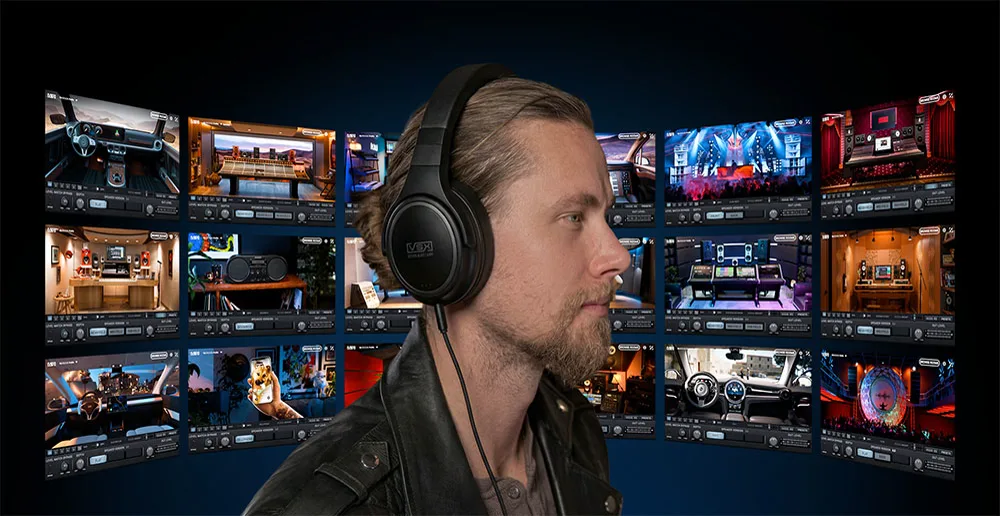
The Steven Slate Audio VSX Platinum Edition is a closed-back headphone system bundled with software that models rooms, speaker systems, cars, and consumer playback devices. The headphones do not replace a room; the software gives a mixer repeatable reference points when the real room is unreliable. The key buying decision is therefore Platinum versus Essentials, not a different headphone sound. Steven Slate Audio's current VSX page says both editions include the same VSX headphone hardware, while Platinum adds the full room and space collection plus future space upgrades.
Table of Contents
Is the VSX Platinum a room-checking system or just headphones?
VSX Platinum makes the most sense for a producer or mixer who works in an untreated, changing, or shared room and wants a consistent way to check translation. The package combines the closed-back VSX headphones with plug-ins and the Systemwide app. The Platinum purchase is mainly a bet on the breadth of the modeled library: studios, multiple speaker distances, cars, clubs, a boombox, a phone, and modeled headphones.
Its strongest advantage is repeatability. You can learn one room, switch to another perspective, and compare the same mix without moving speakers or driving around town. Its main risks are equally specific: the models are interpretations, the workflow depends on remembering bypass and level controls, and a virtual room cannot tell you whether your own monitoring habits are improving. Sound On Sound's exact VSX review moved from skepticism to a positive view of the modelling, but still questioned how anyone outside the source studio can verify a model's accuracy.
| Best fit | Mixers who need repeatable room and playback checks away from a dependable monitoring room |
|---|---|
| Platinum's reason to exist | The complete room/space library and included future space upgrades |
| Main strength | A practical translation workflow with rooms, cars, phones, boomboxes, and modeled headphones |
| Main caution | It is a monitoring aid, not proof that every modeled room or mix decision is objectively correct |
| Consider Essentials when | You will learn a small core set and only add specific spaces as your work requires |
What do you get with the VSX Platinum?
VSX has two physical and software parts. The first is a pair of closed-back headphones tuned for the system. The second is the modelling software, available as DAW plug-ins and, according to Sound On Sound, a Systemwide application that can process audio playing from the host computer outside a DAW. You can use VSX while checking reference tracks in a session, but Systemwide is the more convenient route for music, video, or a bounced mix outside the project.
The software presents a room or playback environment and a monitor choice inside that environment. A studio might offer near-field, mid-field, and far-field perspectives; a car or phone model answers a different question. This is closer to a set of controlled translation checks than to an EQ preset collection. If you only want a neutral wired headphone for editing, a conventional monitor headphone such as the AKG K371 is a simpler product.
How does VSX Platinum compare with Essentials?
Steven Slate Audio says both Essentials and Platinum include VSX headphones. Essentials supplies a core group of studios and spaces, then lets you buy individual additions in the VSX Expansion Marketplace. Platinum includes the complete collection shown on the current page and free upgrades to more studios and spaces.
That means Platinum is not automatically the better-sounding headphone. It is the more complete monitoring library. The current closed-back list includes the Steven Private Mix Room, Sonoma Studios, Desert Studios, Warren Huart's Spitfire Studios, NRG, Zuma, Archon, Mike Dean's rooms, Howie Weinberg's mastering room, club spaces, an audiophile room, several car environments, a boombox, a cellphone, and models of other headphones. Library counts can change as new spaces arrive, so treat a retailer's fixed number as a snapshot rather than a permanent specification.
Music & Arts' exact Platinum listing showed a $399 price when checked, alongside the closed-back beryllium-driver system. The official page displayed the same promotional $399 figure against a $512 reference price. Those figures are dated price observations, not a promise of future stock or sale duration. If the bundle returns to full price, ask whether you will genuinely use the additional rooms instead of paying for a library you rarely open.
What are the VSX closed-back headphones like?
Steven Slate Audio describes the VSX headphones as using lightweight beryllium hybrid drivers and APS, or Acoustically Ported Subsonics. The closed, circumaural design provides useful physical separation from the room and is part of why the system can work in a shared space. It also means the ear-pad seal matters: glasses, hair, and ear shape can change the low-frequency balance and the isolation from outside sound.
In its exact-product review, Sound On Sound describes the build as well finished and the fit as comfortably average in weight and pressure. In passive mode, the reviewer heard a reasonably wide bandwidth and extended bass, but a little upper-midrange recession and a slightly nasal character. With Systemwide's headphone EQ applied in bypass mode, the tonal balance moved closer to the reviewer's AKG K371 reference. So judge the headphones as the calibrated VSX system, not only as a cable plugged straight into a phone.
Tape Op's exact VSX review also describes the headphones as lightweight and comfortable, with a detachable straight cable, 1/4-inch adapter, and carrying case. The cable is a practical advantage for an interface or hardware output, but this is not a wireless headset; the closed-back seal is the relevant physical isolation feature, not an advertised ANC mode. This is studio equipment that happens to be easy to carry, not an all-purpose travel headset.
How do the VSX software and Systemwide app work?
The central habit is to separate headphone correction from room modelling. Sound On Sound notes that the bypass control can switch off the binaural room model while retaining the headphone EQ. That lets you hear the calibrated headphones without the virtual speakers, then return to the room perspective when checking translation. You need a complete plug-in bypass when returning to physical monitors, or the VSX headphone EQ can remain in the monitor path.
Tape Op's reviewer placed VSX last on the master bus and noted a significant level reduction, then manually disabled it before bouncing. The same review says the default setting disables room emulation on export, but the reviewer still preferred a deliberate bypass check.
Use reference mixes before trusting your own work. Pick a room, listen to several familiar tracks, and learn what a controlled vocal, kick, bass, and stereo image sound like there. Jumping through every room every few minutes makes the session entertaining but weakens the reference. The available recent owner conversation came from one r/audioengineering thread; participants discussed learning one room, possible fatigue from leaving room simulation on all day, and a zero-latency mode. It is a useful workflow suggestion, not a broad comfort or reliability consensus.
What did independent reviewers find about VSX?
Sound On Sound's hands-on review is the strongest technical counterweight to the marketing promise. The reviewer used familiar material, tested the passive headphone response, and compared room models. The binaural environments came across as convincing enough to create the impression of sitting in a different monitoring position. Cars, a boombox, and a smartphone model were also considered useful checks. The reservation was epistemic rather than purely sonic: without access to each source room, an outside listener cannot prove that the recreation is exact.
Tape Op tells a complementary story. After using Essentials, the reviewer upgraded because several additional rooms were useful and there was no trial option for individual spaces. He reports clearer low-end decisions and better translation across his listening options, while also saying he would not mix only on headphones. That is a more realistic expectation than “perfect mixes”: VSX can add a repeatable perspective to a room, but it does not remove the need to cross-check.
Older video reviews also remain relevant for understanding the original closed VSX workflow, but do not treat their prices and software behaviour as current. Be especially careful with the newer Immersion One package. ManMade Music's 2026 article is about the separate open-back Immersion One hardware, not the closed-back Platinum headphone in this guide. The two packages share the VSX software family, but their driver design, fit, and amplification questions are different.
What are the downsides of owning VSX?
First, room modelling is not room treatment. VSX can help you make decisions in a bad room, but it does not improve the acoustics for recording, other listeners, or physical monitors. Second, the result depends on your ears and learning process. Binaural presentation and HRTF differences mean that a virtual front-of-you image may feel more natural to some listeners than others.
Third, the system adds software management. Installation and license activation are part of the purchase. Tape Op describes downloading the Slate Audio Center, registering the code, and activating the license on an iLok. Confirm the current computer and plug-in requirements before buying, particularly if the studio uses multiple machines or strict offline policies. Keep the room software on the correct bus, check monitoring level after changing spaces, and enable export bypass.
Finally, Platinum's value is personal. A bedroom producer who needs a single dependable mix room may be better served by Essentials plus one carefully chosen expansion. A mixer who wants deliberate checks through cars, phones, consumer headphones, and several speaker distances has a stronger case for Platinum. The package is expensive if the extra environments become a novelty rather than a routine decision tool.
Who Should Buy VSX Platinum?
Buy the Steven Slate Audio VSX Platinum Edition when you need closed-back monitoring, work away from a trustworthy control room, and will spend time learning a small set of reference spaces. It is particularly defensible for producers working in changing rooms, engineers who travel, and mixers who want repeatable car/phone/headphone checks without physically visiting each system.
Choose Essentials when the budget is tight, you are still learning headphone mixing, or you already know which additional room you would buy later. Choose a conventional wired monitor headphone when you do not need room simulation. For more options, browse our studio monitor headphones guide and the wider headphones section.
Frequently Asked Questions
Does Platinum include different headphones than Essentials?
No. Steven Slate Audio's current page says both editions include the VSX headphone hardware. Platinum's upgrade is the larger room and space library plus included future space upgrades.
Can VSX be used without a DAW?
Yes. Sound On Sound documents the Systemwide application for processing audio from the host computer outside a DAW, alongside AAX, AU, and VST plug-ins.
Are VSX headphones wireless or noise cancelling?
They are closed-back wired headphones with a detachable cable, and the VSX package does not position itself as a wireless or ANC headset. The physical design provides passive separation, while the VSX software handles the room and headphone modelling.
Is VSX a replacement for studio monitors?
It is better understood as a repeatable monitoring supplement. Independent reviewers found the virtual rooms useful, but still recommended returning to physical monitors or other playback checks when possible.
Should I buy Platinum or Essentials?
Choose Platinum if you will use many modeled rooms and playback systems. Choose Essentials if you only need a core set and prefer to add individual spaces later.
What do the VSX Platinum numbers mean for buyers?
Two of these numbers are dated prices and two are product details. Here is what each one tells a buyer.
- Tape Op lists a 1/4-inch adapter with the detachable cable, so this is a wired system. (tapeop.com)
- ManMade Music's 2026 article covers the open-back Immersion One, not this closed-back Platinum. (manmade-music.com)