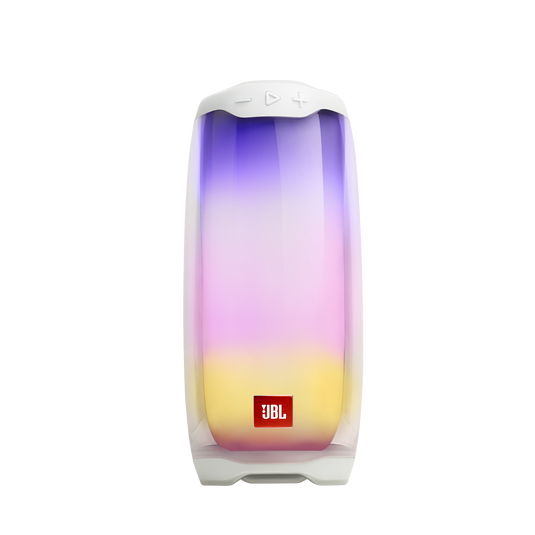
The JBL Pulse 4 is a portable speaker built around its light show. The transparent 360-degree shell and colorful LEDs are the reason to choose it; the sound and battery are supporting features rather than a clean sweep over newer JBL models. JBL rates it for up to 12 hours and IPX7 protection, while RTINGS measured about 11.5 hours and found weak low bass and no EQ. The Pulse 4 has no AUX input or microphone, uses PartyBoost instead of the Charge 4’s Connect+, and the Pulse 5 has replaced it. Buy it as discounted old stock when the lights are the point, not because a marketplace listing calls it a current flagship.
Table of Contents
What is the short version of the JBL Pulse 4 review?
| Best fit | Small gatherings, bedrooms, patios, and buyers who want music plus a visible light display |
|---|---|
| Strongest feature | Customizable 360-degree RGB light show and soundstage |
| Main compromise | Weak low bass, no EQ, no AUX, no microphone, and legacy availability |
| Battery claim | Up to 12 hours from JBL; RTINGS measured 11.5 hours |
| Buy when | The light show matters more than maximum loudness or a neutral balance |
Our portable Bluetooth speaker guide is a better first stop if you do not care about lighting. The speakers section can also help you compare current waterproof models. Pulse 4 is a narrower recommendation, and a speaker with a clear job is easier to judge.
How do the Pulse 4 light show and 360-degree design work?
JBL’s official Pulse 4 page lists a high-resolution 360-degree LED light show, a 360-degree speaker array, IPX7 protection, PartyBoost, and up to 12 hours of playtime. The LED shell covers the product’s full outer surface. The JBL Connect app can change light themes and patterns, and JBL says the light show can work as an ambient display with music off.
That design changes placement. A directional bar-shaped portable speaker rewards facing the listener toward its front. Pulse 4 is easier to put in the middle of a small room or table because the visual display and sound spread around the cylinder. It does not make the speaker equally loud in every direction or create a large-room sound system. RTINGS says the Pulse 4 is not loud enough to fill bigger open spaces, so a backyard party is a different job from a bedroom, kitchen, or small patio.
The lighting also makes the unit less discreet and less practical for every occasion. It consumes power, draws attention, and can be visually distracting when you want background music. What matters is whether you will use the RGB after the novelty fades. If the answer is rarely, a plain current portable speaker will usually make more sense.
How does the Pulse 4 sound, and where should you place it?
RTINGS’ exact-model review finds an acceptable music performance with balanced midrange, clear vocals and lead instruments, but weak low bass and no sound-customization tools. It also says dialogue is understandable for phone videos, although the missing bass and limited loudness keep it from being a strong movie speaker. This is a speaker for playlists, podcasts, and casual social listening, not for reproducing deep electronic drops or cinematic rumble.
The open presentation is where Pulse 4 can feel different from a Charge-shaped JBL. RTINGS describes its soundstage as more natural and open than the Charge 4’s, while also noting that the Charge 4 has slightly longer battery life and lower Bluetooth latency in its tests. The array helps sound reach listeners around the speaker, but it does not add missing sub-bass.
eCoustics’ March 7, 2021 review hears a different balance: a V-shaped presentation with boosted treble, recessed mids, and strong lower-register output. Its reviewer says the Pulse 4 can produce enough bass to vibrate a table or balcony floor, while treble can flatten at some frequencies. That is a listening impression from a different review, not a reason to claim a universal tuning. Placement, volume, music choice, and listener preference can make the Pulse 4 feel bass-forward even while RTINGS’ measurements identify limited deep bass.
At higher volume or outdoors, the Pulse 4’s balance can make more sense because bass loses energy across distance. For critical listening, the absence of EQ is a more serious limitation. The app changes the light show, but RTINGS says it does not provide sound customization. If you need to correct a bright room or a bass-heavy playlist, choose a speaker with a graphic EQ instead.
What PartyBoost, Bluetooth and port options does the Pulse 4 have?
Pulse 4 uses JBL PartyBoost. JBL says you can link two PartyBoost-compatible speakers for stereo, or join multiple units in party mode. That does not include the older Connect+ family. You cannot pair a Pulse 4 with a Charge 4 for a shared stereo system because Charge 4 uses Connect+. Check the ecosystem before buying a second speaker; similar JBL cylinders do not guarantee cross-generation pairing.
There is a laptop caveat, too. JBL’s support information says PartyBoost is unavailable when you connect the speaker to a computer over Bluetooth, because the computer acts as the primary device and cannot retransmit the Bluetooth signal to other PartyBoost speakers. Phone-based playback is the safer path for a paired multi-speaker setup.
Pulse 4 has no AUX input, so there is no analog cable fallback. JBL’s support material also says it has no microphone, speakerphone, or voice-assistant functionality. They are fine if the speaker is for Bluetooth music from a phone; they are deal-breakers if you want a wired source or hands-free calls. Bluetooth pairing supports multiple devices according to RTINGS, but that does not turn the speaker into a smart speaker.
How long does the Pulse 4 battery last with the lights on, and is it IPX7?
JBL rates Pulse 4 for up to 12 hours, while RTINGS reports an 11.5-hour battery result. The difference is small enough that the practical advice is straightforward: expect roughly a day of casual use, not a week of all-night parties. Volume, Bluetooth conditions, battery age, and especially light brightness affect the result. Running the LED display at its most active setting is part of the Pulse 4’s appeal, but it is also the feature most likely to reduce endurance.
The speaker charges over USB-C and JBL lists a 3.5-hour charging time. Pulse 4 is not a power bank; the official specification does not present a USB charge-out feature like the Charge 4. That makes the two models complementary rather than interchangeable. Pulse 4 spends its design budget on illumination and 360-degree presentation, while Charge 4 spends more of it on battery capacity and phone charging.
IPX7 is useful for poolside or a sudden shower. JBL describes the Pulse 4 as submersible to roughly three feet for up to 30 minutes, and its support page defines IPX7 as immersion to 1 m for that duration. Close the port cover before exposure and keep expectations sensible: IPX7 is not a dustproof rating, and salt, sand, sunscreen, and grit can still cause problems. Waterproofing protects against a defined water test; it is not permission to neglect the enclosure.
What did independent reviews find about the Pulse 4?
RTINGS says Pulse 4 is small and portable, has an eye-catching customizable display, supports multi-device pairing, and works well for podcasts. It also says Pulse 5 is the better overall next generation because it adds features such as a graphic EQ and ambient settings and reaches somewhat deeper low bass. Pulse 4 retains on-device play/pause and volume controls that RTINGS says Pulse 5 lacks, so “newer” does not mean every interaction is better.
eCoustics is more enthusiastic about the party role. Its reviewer calls the light show entertaining and well executed, reports sturdy construction, and likes the bass quantity and app visualizer. The same review mentions treble artifacts, no NFC, and the weight the transparent outer layer adds. These details support the same conditional verdict: Pulse 4 works when the light display is part of the experience, but it is not a neutral all-purpose speaker.
Recent owner discussion does not provide a reliable third opinion. A search covering August 13 through September 12, 2026 returned six Reddit posts, but none mentioned Pulse 4. The items concerned a JBL color, Charge 6 and Boombox 4 firmware, and Clip 4 sales. Because the exact-model social window is effectively empty, this article makes no claim about a current owner consensus on battery life, app reliability, light brightness, or durability.
Who Should Buy the Pulse 4?
Buy it if the light show is the feature you will use, you want sound that spreads around a small gathering, and you can find old stock at a reasonable price. It is a fun bedroom, kitchen, dorm, or small-patio speaker, and IPX7 makes occasional splashes less stressful. Pairing two Pulse 4 units through PartyBoost can add stereo, provided both speakers are compatible and the source is not a computer Bluetooth connection that blocks the feature.
Skip it if you want deep bass, the loudest outdoor output, EQ, a 3.5 mm input, a microphone, a power bank, or the longest possible battery with the lights bright. Also skip it if a seller charges more than a newer Pulse 5 or a better-built current alternative. Pulse 4 is best understood as a light-first legacy speaker, not a hidden bargain in every listing.
Frequently Asked Questions
Does the JBL Pulse 4 have 360-degree sound?
JBL describes a 360-degree speaker array, and RTINGS finds its soundstage more open than the Charge 4’s. It still is not equally loud in every large outdoor space.
Can Pulse 4 pair with a Charge 4?
No. Pulse 4 uses PartyBoost, while Charge 4 uses Connect+. JBL’s support information says the two systems do not pair together.
Does the Pulse 4 have an AUX input or microphone?
No. JBL’s support page says there is no AUX input and no microphone, speakerphone, or voice-assistant function.
How long does the battery last?
JBL rates it for up to 12 hours. RTINGS measured about 11.5 hours. Brightness, volume, Bluetooth conditions, and battery age affect actual runtime.
Is the Pulse 4 still worth buying?
Only when its light show and 360-degree design are the priorities and the price reflects its legacy status. RTINGS identifies Pulse 5 as the newer, better overall model, but Pulse 4 keeps physical playback and volume controls that some buyers prefer.
What do the Pulse 4 battery, charging and water specs mean for you?
The Pulse 4 is built for casual listening over a day, not a week of parties. Bright lights and high volume shorten runtime.
- JBL rates up to 12 hours of playtime, so expect roughly a day of casual use. (jbl.com)
- RTINGS measured about 11.5 hours, close to JBL's claim. (rtings.com)
- JBL lists a 3.5-hour charging time over USB-C, so plan recharges between long sessions.
- IPX7 means immersion to 1 m for up to 30 minutes, so poolside use is fine.