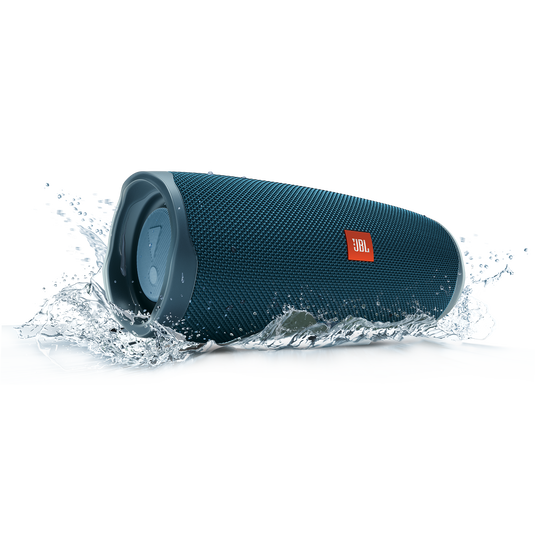
The JBL Charge 4 makes sense only as a discounted legacy speaker. It has the features newer Charges have dropped or changed (3.5 mm input, USB-A phone charging, and a simple rugged body), but it is discontinued, uses JBL Connect+ rather than PartyBoost, and plays mono from one speaker. SoundGuys’ updated review notes the discontinuation and measured 13 hours 46 minutes of playback, below JBL’s “up to 20 hours” claim. If a retailer prices old stock near a newer Charge 5 or Charge 6, buy the newer model instead. The Charge 4 is worthwhile when the discount is real and its older ports are exactly what you need.
Table of Contents
What should I know about the JBL Charge 4 in short?
| Best fit | Pool, patio, travel, or garage listening when you want AUX and phone charging |
|---|---|
| Useful features | IPX7 protection, USB-C charging, USB-A power-bank output, and Connect+ pairing |
| Main compromise | One speaker is mono, the model is discontinued, and it has no microphone |
| Battery claim | Up to 20 hours from JBL; independent tests are shorter and depend on volume/input |
| Buy when | Clearance pricing is substantially below a Charge 5 or newer model |
Start with our portable Bluetooth speaker guide if you are shopping from scratch, and use the speakers section to compare newer designs. The Charge 4 is a good answer to a port and pairing question, not automatically the best answer to a sound-quality question.
Why is the Charge 4 a legacy buy?
JBL’s official Charge 4 page remains useful for the specification sheet, but the product launched in 2018 and JBL has replaced it in its range. SoundGuys’ editor’s note says the Charge 4 is discontinued, while RTINGS’ review says the Charge 5 replaced it. That does not make every remaining unit a bad purchase. It does mean warranty coverage, battery age, and seller return terms matter more than they would on a current model.
Marketplace naming adds another risk. A listing may say “JBL Charge” in the title while showing a Charge 5 or Charge 6 photograph, or it may describe the Charge 4 as if it supported the newer JBL Portable app and PartyBoost ecosystem. Check the model label, port layout, and photos. The Charge 4 has a 3.5 mm input, USB-C charging input, and USB-A output under its rear flap. Those details are more reliable than a short retailer bullet list.
The official specification lists 30 W output, a 0.96 kg weight, 22.1 x 9.4 x 9.4 cm dimensions, Bluetooth 4.2, and up to 20 hours. JBL’s numbers are manufacturer claims. They describe what JBL designed the product to deliver, not a guarantee for an old battery bought years after launch.
How does the Charge 4 sound, and is it mono?
The Charge 4 uses one full-range driver and two passive bass radiators. That change from the Charge 3 is easy to miss because the cylinder looks familiar, but it changes stereo playback: one Charge 4 is a mono speaker. Audiostance’s review calls out the single-driver design and says you can pair two Charge 4 units for stereo.
SoundGuys describes the Charge 4’s sound as very close to the Charge 3. In its listening notes, bass has useful weight for the size, but vocals can take a back seat to bass and instrumentation. That is a plausible outdoor tuning: low-end presence survives distance, while the middle of a busy mix can become less prominent. SoundGuys did not hear distortion at high volume in its review, but that does not mean it is a small PA for a large yard.
RTINGS’ measurements and usage summaries are more critical. It finds a balanced midrange for vocals and lead instruments, underemphasized treble that can sound dull, and weak low bass. It also says the speaker has no EQ, so there is no app-based route to pull down bass or lift treble. The different descriptions are not necessarily contradictory: Audiostance heard a fun, lively presentation, while RTINGS focuses on measured balance, missing low-end extension, and the absence of sound customization. The safe buying conclusion is that the Charge 4 is enjoyable for casual playlists but not a neutral nearfield monitor.
Placement matters. SoundGuys says it can sound more pleasing in an open area because bass loses energy over distance, while RTINGS finds the soundstage fairly directional. Put it where listeners can face the speaker if clarity matters. For a wide gathering, two matching units in stereo are more convincing than expecting one cylinder to create a broad stereo image.
What ports, Bluetooth and party pairing does the Charge 4 have?
The Charge 4’s rear flap is its strongest argument against automatically choosing a newer Charge. The USB-C port charges the speaker; the USB-A port acts as a power bank; and the 3.5 mm socket accepts an analog audio source. SoundGuys specifically warns that USB-C is charging-only, so a USB-C-to-USB-C audio assumption is wrong. Audiostance also notes that JBL includes a USB-C cable but not a wall plug, so a buyer of old stock should verify the cable and use a suitable charger.
There is no microphone. JBL’s support text says the Charge 4 has no speakerphone or voice-assistant functionality, and SoundGuys lists the missing mic as a drawback for people who expect to take calls through a speaker. That can be a benefit for a pool or party setup where an incoming call should stay on the phone, but it is not a feature to discover after buying.
Bluetooth 4.2 is adequate for ordinary playback, and SoundGuys reports a connection around 30 feet in its test environment. The exact range depends on walls, interference, and the source device. JBL Connect+ can link compatible speakers and can create a stereo pair with two Charge 4 units. It cannot bridge the older regular Connect family or the newer PartyBoost family. JBL’s support documentation explicitly says PartyBoost speakers cannot connect to Connect+ products such as the Charge 4. Do not buy a Charge 4 expecting it to stereo-pair with a Charge 5, Pulse 4, or newer PartyBoost speaker.
How good are the Charge 4 battery, power bank and IPX7 rating?
JBL rates the 7,500 mAh battery for up to 20 hours and the official page describes USB charge-out for a phone. The wording “up to” matters. SoundGuys got 13 hours 46 minutes in its continuous test and notes that charging another device from USB-A reduces playback time. Audiostance reports around 20 hours at 40% volume using a physical cable, but around 10 hours at 50% over Bluetooth in its test. These are different conditions, not a reason to pick one number as the truth for every owner.
The power-bank feature is best treated as an emergency top-up rather than a second full phone battery. It can be useful at a campsite or beach, but the phone and speaker are then drawing from the same aging cell. On a discontinued unit, battery condition can matter more than the original 7,500 mAh capacity. Ask about return rights if buying used or refurbished.
IPX7 is a genuine strength. JBL and SoundGuys describe protection for immersion to roughly 1 m/3 ft for up to 30 minutes. Close the rear flap before water exposure, and remember that IPX7 is not an IP67 dust rating. Sand, grit, and saltwater still deserve care. “Waterproof” does not mean every port can stay open at the pool.
What did independent reviews find about the Charge 4?
SoundGuys rates the Charge 4 at 7.7 and praises its build, loudness, battery, USB-C, and device charging. It criticizes the modest change from Charge 3, slightly greater size and weight, hidden buttons, bass masking in vocals, no mic, and discontinuation. Its battery test is particularly useful because it shows why you should not treat the 20-hour headline as a guarantee.
RTINGS is more direct about the replacement problem. It says Charge 5 is better overall, with better-balanced sound, a stronger build, and IP67, although Charge 5 loses the AUX input and uses PartyBoost rather than Connect+. RTINGS also says Charge 4 has lower latency with iOS and Android in its testing. That comparison makes the choice practical: Charge 5 is the safer current purchase; Charge 4 is the one to consider when its AUX and USB-A output matter and the discount is large.
Audiostance’s older review is more positive about the value and character, praising the sound for casual use, waterproof construction, and long battery claim, while openly disliking the move to mono and the Connect-versus-Connect+ incompatibility. Its battery and sound impressions date from 2019, so use them as historical context rather than current availability evidence.
Recent social evidence is not useful for a new consensus. A search from August 13 through September 12, 2026 returned posts about Charge 6 firmware, Charge 5/6 shopping, and other JBL models rather than useful Charge 4 reports. There is no defensible current Charge 4 owner pattern to summarize. In particular, do not transfer recent Charge 6 app complaints to this speaker.
Who Should Buy the Charge 4?
Buy it when you find a clean, warrantied unit well below the price of a Charge 5 or 6, and when you specifically need the 3.5 mm input or USB-A phone charging. It also suits listeners who already own other Connect+ speakers and want a matching second Charge 4 for stereo. The IPX7 enclosure and familiar physical controls remain useful for patios, garages, travel, and casual outdoor listening.
Skip it when the seller wants current-model money, when you need deeper bass or an EQ, when you want one-speaker stereo, or when your existing JBL group uses PartyBoost. Also skip it if you need phone calls through the speaker or a dust rating for dusty worksites. In 2026, the Charge 4 is a targeted clearance recommendation, not a default upgrade over newer JBL portable speakers.
Frequently Asked Questions
Is the JBL Charge 4 stereo?
One Charge 4 plays mono because it uses a single full-range driver. You can pair two matching Charge 4 units for stereo through JBL Connect+.
Can it pair with a Charge 5 or Pulse 4?
No. Charge 4 uses JBL Connect+, while Charge 5 and Pulse 4 use PartyBoost. JBL’s support information says the two systems are not compatible.
Can the Charge 4 charge a phone?
Yes. The USB-A port is a power-bank output. The USB-C port is for charging the speaker, and SoundGuys warns that it is not a USB-C audio output.
Does it have a microphone?
No. JBL’s support page says the Charge 4 has no microphone, speakerphone, or voice-assistant function.
Is the Charge 4 still worth buying?
Only at a meaningful discount and when its older ports or Connect+ compatibility matter. SoundGuys and RTINGS both place it behind newer Charge models overall, while its AUX input remains a practical reason to choose old stock.
What do the JBL Charge 4 numbers mean for buyers?
JBL's claims and independent tests give different numbers. Use the tested figures to set expectations for an old unit.
- JBL lists up to 20 hours of playback, a manufacturer claim and not a guarantee for an old battery. (jbl.com)
- SoundGuys got 13 hours 46 minutes in its continuous test, so plan for less than the claim. (soundguys.com)
- Audiostance reports around 10 hours at 50% over Bluetooth, so volume and input change playback time. (audiostance.com)
- SoundGuys reports a Bluetooth connection around 30 feet, and walls or interference can cut that. (soundguys.com)