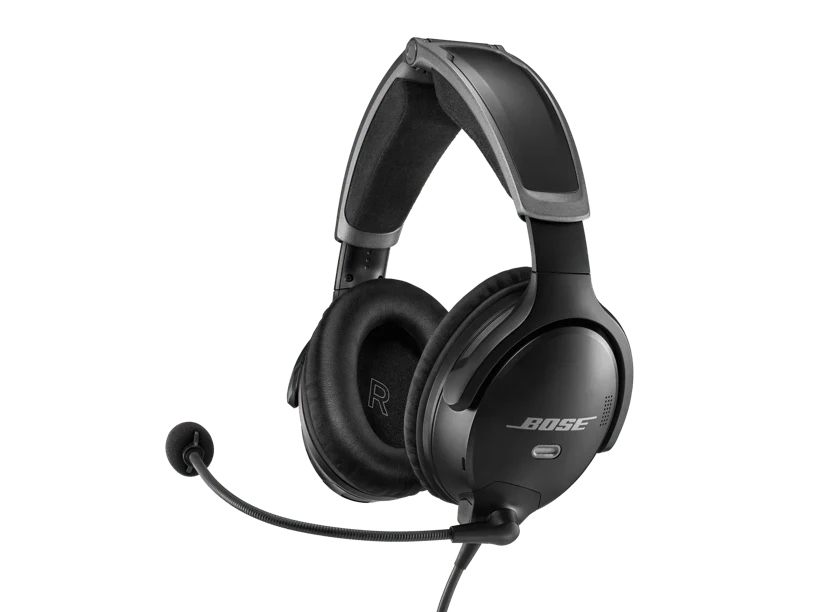
The Bose A30 makes sense for pilots who fly often enough to notice headset comfort, want active noise reduction, and need Bluetooth without giving up aviation-specific connectors. Bose’s current US page showed the Bluetooth model at $1,299 when checked on September 11, 2026. That is a dated price and availability snapshot; verify the exact plug configuration and current total on Bose’s page before ordering. The more important decision is which cable and plug configuration your aircraft actually accepts.
Table of Contents
The A30 Buying Decision
| Best for | Frequent pilots who value comfort and adjustable ANR |
|---|---|
| Strongest qualities | Low clamping force, three ANR modes, Bluetooth, replaceable cable |
| Main compromise | High price and a configuration that must match the aircraft |
| Battery claim | Bose says a Dual Plug version runs at least 45 hours on two AA alkaline batteries |
| Buy it when | You fly regularly and will keep the headset for years |
The A30 is not a universal “plug it into anything” headset. Bose sells separate Dual Plug, 6-pin LEMO, 5-pin XLR, and U-174 configurations, and lists FAA TSO and EASA E/TSO-C139a certifications on the product page. Those manufacturer-listed certifications do not establish compatibility or approval for every aircraft. Connector choice affects power and the aircraft intercom interface, so verify it with the aircraft documentation, avionics manufacturer, instructor, or an authorized dealer before ordering. This review is buying guidance, not flight or installation instruction.
Three ANR Modes and Noise Reduction
Bose gives the A30 three selectable active-noise-cancellation modes: High, Medium, and Low. Bose describes High as the maximum-noise-reduction setting for improving the signal-to-noise ratio in loud aircraft. Medium provides more consistent reduction across a wide range of frequencies, while Low targets interpersonal communication outside the intercom in quieter environments. These are manufacturer descriptions, not independent attenuation measurements.
Sporty’s provides a useful independent performance check. Its reviewers flew the A30 in five aircraft, including a Cessna 172, a Cirrus, a Pilatus, a Citation, and the very loud Piper Aztec. Sporty’s did not describe a radical leap over the A20, but it reported that the A30 handled the Aztec without the painful feedback or buzzing its pilots had encountered with other headsets. The team also said the A30 worked well in every aircraft they flew.
That combination suggests a realistic buying conclusion: the A30 offers adaptable, strong ANR, and the value goes beyond “more cancellation.” Bose presents Medium and Low as alternate operating modes for different noise and conversation conditions; do not treat them as a safety feature. Bose’s owner guide warns that active and passive noise reduction can make engines, propellers, warning alarms, and other aircraft sounds less familiar. Anyone considering the A30 should treat that warning seriously and follow the aircraft’s normal procedures for staying aware of those sounds.
Comfort, Controls, and the Swappable Mic
Comfort is where the A30’s premium price is easiest to understand. Bose says the headset has 20% less clamping force than the A20 and uses a lower-clamping, lightweight around-ear design. Sporty’s independently reported noticeably less side pressure on flights longer than three hours and said its reviewers largely forgot they were wearing the headset. That is a meaningful distinction from a spec-sheet claim because long sessions expose pressure points that a short store demo may not.
The A30 keeps physical controls on its module, including left and right sensitivity wheels. Bose says those wheels can help with differential hearing loss, stereo radio inputs, or controlling one ear’s radio input so outside sounds are easier to hear. You can move the boom microphone and down cable from one side to the other without tools. Sporty’s notes that this is particularly useful for flight instructors or first officers who regularly sit on the right side.
Bose’s product page also lists tap control for talk-through communication. The owner’s guide says the feature can shift one earcup to Low mode after a double tap, making a nearby conversation easier to hear. It is a convenience feature, not a substitute for removing distractions or following cockpit communication practices.
Plug Options and Aircraft Compatibility
The plug decision deserves its own section because an otherwise excellent headset can be the wrong purchase if its cable does not match the aircraft. Bose lists four major configurations. Its documentation describes Dual Plug, also called PJ, as separate intercom and microphone connectors commonly used in general aviation, and says this version uses two AA alkaline batteries for a minimum of 45 hours in flight.
Bose describes the 6-pin LEMO version as aircraft-powered, although AA batteries can provide additional flexibility if you disconnect aircraft power. Bose associates the 5-pin XLR configuration with Airbus aircraft and describes it as a mono connection that draws power from the aircraft or batteries depending on the aircraft’s capabilities. Bose describes U-174 as a single-plug option commonly used in military aircraft and several helicopters. Those manufacturer descriptions identify the configurations; they do not establish that any particular aircraft accepts them.
A recent r/flyingeurope thread is a useful example of why this choice causes confusion. A user described students buying the 6-pin LEMO version, while several replies pointed to a LEMO-to-Dual-GA adapter as a way to preserve flexibility. That is one community discussion, not a certification or wiring recommendation. Bose’s own page says adapters are available for some connector changes, but the aircraft’s approved audio system remains the deciding authority. Our Lightspeed Delta Zulu review is useful comparison reading if you are deciding whether another premium aviation headset’s feature set better fits your aircraft and budget.
Bluetooth, Audio Priority, and Safety
The Bluetooth version can connect a phone, tablet, or other compatible device for secondary audio. Bose also includes a 1/8-inch stereo input cable, so Bluetooth is not the only way to bring in music or another audio source. The owner’s guide describes priority settings for Bluetooth and AUX sources, including muting or mixing secondary audio when the headset detects an intercom signal. That makes the feature more useful than a generic wireless music connection because the headset puts the intercom first.
The Bose owner’s guide is clear about limits. It tells users not to make phone calls while piloting and says portable devices must not interfere with aircraft navigation or communication systems. It also warns that equipment designed only for 600-ohm headsets could suffer damage and advises consulting the avionics manufacturer if there is doubt. Those warnings are more important than the convenience of Bluetooth. Use the headset only in the configuration and operating context approved for the aircraft.
Battery expectations depend on configuration and use. Bose’s 45-hour figure applies to the Dual Plug version with two AA alkaline batteries in typical aircraft noise, while Bose lists continuous Bluetooth use at 25-plus hours. Bose says noise level, temperature, ear-cushion condition, Bluetooth use, and battery age affect runtime. A panel-powered version may use aircraft power, but that does not eliminate the need to understand the particular cable and backup-power behavior.
What Recent Owners Are Saying
Recent exact-model social coverage is thin. A review of Reddit results from the past 30 days turned up three items, but only the r/flyingeurope connector discussion was clearly about the A30 aviation headset. The other two results used “A30” for unrelated products or discussed a QC35 conversion microphone. That means there is no responsible basis for claiming a broad owner consensus about A30 sound, reliability, or comfort.
The useful owner signal is practical: connector flexibility matters, and adapters are part of the conversation for pilots who move between aircraft with different jacks. The A30’s modular cable design supports that kind of planning, but an adapter still needs to be appropriate for the aircraft’s audio system. For more general aviation-headset context, read our airplane headphone guide and verify every connector claim against the exact headset configuration before buying.
Alternatives and Buying Decision
StudentPilot’s July 2026 A30 review reaches a similar buyer-focused conclusion: low clamping force, ANR and Bluetooth are the practical attractions, while the premium price makes it a poor default first headset. Its configuration table is useful for narrowing the shopping list, but it is not an aircraft-approval database. StudentPilot recommends buying through an authorized dealer for warranty, fit and plug support.
Buy the A30 if you fly frequently, want low clamping force and adjustable ANR, and can justify a $1,299 purchase that may serve for years. Sporty’s flight work supports the comfort and noise-reduction case, while Bose’s documentation supports the configuration and battery details. The headset is a strong fit for pilots who want Bluetooth and a side-swappable microphone without moving to an unfamiliar control layout.
Skip it if you fly only occasionally, need a less expensive first headset, or cannot verify which plug and microphone impedance your aircraft requires. The A30’s price is hard to defend if the headset will spend most of the year in a case. The ArmorSound headphones section can help with non-aviation listening, but ordinary consumer ANC headphones are not replacements for an approved aviation headset, so do not treat them as one.
Bose built the A30 around comfort, intelligible communications, and configuration flexibility. Its strongest independent support is Sporty’s real-aircraft evaluation, while the owner evidence is too sparse to establish reliability trends. Confirm the cable first, then decide whether the comfort and three-mode ANR justify the premium.
Frequently Asked Questions
How long does the Bose A30 battery last?
Bose lists a minimum of 45 hours for the Dual Plug version with two AA alkaline batteries in typical aircraft noise. Bose lists continuous Bluetooth use at 25-plus hours, and actual runtime varies with conditions and features.
Does the Bose A30 work with every aircraft?
Do not assume any headset works with every aircraft. Bose offers Dual Plug, 6-pin LEMO, 5-pin XLR, and U-174 configurations. Match the cable to the aircraft’s approved audio system and confirm any uncertainty with the avionics manufacturer.
Can the A30 microphone be moved?
Yes. Bose says you can move the boom microphone and down cable to either side using the toolless connector mechanism.