Meet the Sony Float Run headphones, open-ear headphones that sit outside your ears so you can hear your surroundings while you run. If you’ve been hunting for the best open-ear headphones for running, these are worth a look.
In this Sony Float Run headphones review, we cover what these open-ear Bluetooth headphones offer runners, cyclists, gym-goers, and anyone who wants ambient awareness along with good sound. Built for movement, they sit just outside your ears, so you hear the world around you with no earbuds in your ear canal and no cords.
We cover design and build quality, battery life, how they compare to the Shokz OpenRun and other open-ear competitors, and what makes them work with hats and sunglasses. We also look at the sound from their dynamic drivers and what the IPX4 water resistance rating covers.
We also look at whether they are worth your money, where they do well, and where they fall short.
By the end, you’ll know who these Sony running headphones are for and how they stack up against the competition. You will also see why the Sony Float Run is one of the top 10 best gym headphones of 2025.
Table of Contents
Setup and Interface

Straight out of the box, the Sony Float Run headphones don’t ask for much. There is no app, and pairing is quick. These wireless sport headphones are for people who want to press play and move. Hold the power button, connect via Bluetooth 5.0, and you’re off. Whether you’re pairing them with your smartphone, smartwatch, tablet, or even a laptop, the connection is stable within a generous 10-meter Bluetooth range.
The Sony Float Run Bluetooth headphones skip “smart” extras in favor of controls that work when you’re mid-run and covered in sweat. The physical media controls sit on the rear of the right ear frame, where you can skip tracks, adjust volume, and take calls without fumbling. They are not touch-sensitive, so a sweaty forehead swipe won’t trigger a command.
These open-ear headphones with mic also feature built-in call functionality. The mic quality is solid for hands-free calls or voice assistant prompts during a workout. Clarity is not flagship-tier, but it is usable, especially when you’re jogging and just need to bark “next song” or “call Alex” without pulling your phone out of your compression shorts.
For runners who rotate between gear, the Sony Float Run headphones remember multiple devices. Switching between your phone and your smartwatch is mostly easy. There is no multipoint pairing, though, which might disappoint multitaskers.
Charging happens through USB-C, as it should in 2025. A full charge takes about 3 hours, and a 10-minute quick charge gives you a full hour of playtime. Not the fastest in the game, but enough for spontaneous workouts.
Design and Build Quality

The Sony Float Run headphones look unusual. They aren’t earbuds. They’re open-ear headphones that sit just outside your ear canal, held in place by a flexible neckband and light frame.
The frame is durable, sweat-resistant plastic rated IPX4. It doesn’t shift when you’re moving, and it works with sunglasses, hats, and helmets.
Weighing just 33 grams, the Sony Float Run open-ear headphones are light. Nothing presses on your ears, and there is no in-ear sweat buildup. Unlike bone conduction headphones, which vibrate against your cheekbones, these sit completely off your skin, so there is no vibration on your cheekbones.
The neckband is flexible enough to twist and tuck into a gym bag, yet firm enough to keep the headphones balanced while you move. It’s a non-folding design, but it comes with a compact carrying case that makes storage easy.
Controls are physical and tactile, placed exactly where your muscle memory wants them. Nothing is touch-sensitive, which helps during sweaty runs or cold-weather workouts with gloves.
Sound Performance

Don’t expect earth-shattering bass or full immersion from the Sony Float Run headphones. They are for a clean, natural sound that keeps you aware of the world.
These open-ear running headphones give clear sound without touching your ear canal. Instead of pushing sound directly into your ear, the floating drivers project it from just outside, which gives a spacious, open soundstage.
Vocals sound crisp, podcasts are easy to follow, and midrange tones come through with clarity. The treble has bite without being sharp, and while the bass won’t rattle your brain, it’s present enough to carry the rhythm during a run or workout. These are dynamic driver headphones after all, and Sony knows how to tune for balance over brute force.
Because of the open-ear design, yes, sound leakage is real. People nearby will catch a faint trace of your music if you’re blasting it in a quiet space. But these are wireless sport headphones, not noise-canceling club gear. On a busy road, a trail, or a city run, hearing both your playlist and your surroundings is the point.
The audio stays stable and doesn’t cut out, and there are no earbud dropouts or moisture muffling.
Call quality is serviceable. The built-in mic works well for quick commands or short calls but don’t expect podcast host-level audio clarity. It does the job for runners on the move.
Features

The Sony Float Run headphones stick to running and commuting. Every feature aims to stay out of your way.
The main feature is the open-ear design. It isn’t bone conduction. Sony’s floating drivers sit just outside your ears, so you hear your music and the world around you at the same time, with no vibration.
Sweat resistance comes from an IPX4 water resistance rating, which covers rain, sweat, and splashes. That matters for outdoor athletes who train in any weather.
Battery life is 10 hours, which covers multiple training sessions. If you forget to charge, the 10-minute quick charge gets you an hour of playtime.
You also get Bluetooth 5.0 connectivity, which works with phones, smartwatches, tablets, and laptops. Pairing is simple and the connection holds steady within a 10-meter range.
Controls are physical. You get buttons for volume, play, pause, and skip, positioned where you can hit them by feel even during a sprint. There’s no app to learn.
The built-in mic allows for voice commands and quick calls. It’s a useful add-on, not the main draw.
Battery Life and Connectivity

The Sony Float Run headphones pair a 10-hour battery with a stable Bluetooth connection.
Sony claims up to 10 hours of playtime on a single charge. For runners logging 30 to 60 minutes a day, that’s about a week of workouts between charges. Marathoners and long-distance cyclists can expect multi-hour sessions.
A 10-minute charge equals roughly an hour of playback. That helps when you forgot to plug in overnight. It’s not the fastest on the market. Charging is via USB-C.
On the connectivity side, the Sony Float Run Bluetooth headphones run on Bluetooth 5.0. It’s not the newest version, but the range is 10 meters. Whether your phone’s in a running belt, a backpack, or sitting on the bench while you’re stretching, the signal stays clean and stable.
Pairing is fast. Hold the button, find “WIOE610” on your device, and that’s it. Once paired, the headphones remember your device for next time. There’s no advanced multipoint functionality here, so switching between devices requires a manual reset, but for athletes who mainly connect to one phone or watch, it’s a non-issue.
There’s no companion app and no EQ customization, so the experience is minimal.
Product Comparison

The Sony Float Run headphones face competition from other open-ear running headphones. Below, we compare the Float Run against three rivals: the Shokz OpenRun, the Bose Sport Open Earbuds, and the Soundcore AeroClip.
Sony Float Run headphones vs Shokz OpenRun
Shokz pioneered bone conduction tech, so the comparison is inevitable. The Shokz OpenRun uses vibration-based audio through your cheekbones, while the Sony Float Run headphones use floating drivers that project sound just outside your ear. Sony’s approach results in cleaner mids, fuller vocals, and less fatigue during long sessions. The Shokz are slightly more rugged with a higher IP rating, but they can’t match Sony’s more natural soundstage and softer wearing experience. If your priority is safe outdoor listening, Sony’s design is the better fit for extended workouts. Alternatively, you can read our in-depth Shokz OpenRun Pro 2 headphones review if you are looking for a bone conduction headphones that feature major upgrades over its predecessor.
| Feature | Sony Float Run | Shokz OpenRun |
|---|---|---|
| Audio Technology | Open-ear floating drivers | Bone conduction |
| Sound Profile | Clear mids, natural tone | Thin, vibration-based |
| Comfort | Soft, off-ear fit | Cheekbone pressure points |
| Battery Life | 10 hours | 8 hours |
| Water Resistance | IPX4 | IP67 |
| Connectivity | Bluetooth 5.0 | Bluetooth 5.1 |
| Quick Charge | 10 min = 1 hour playtime | 10 min = 1.5 hours playtime |
| Price | See Price | See Price |
Sony Float Run headphones vs Bose Sport Open Earbuds
The Bose Sport Open Earbuds produce deep, controlled bass and crisp treble, but at the cost of bulk. The Sony Float Run headphones feel featherlight by comparison, staying secure during high-intensity runs without ear fatigue. Bose edges Sony in sound power, but Sony wins in practicality, comfort, and ease of use. For daily training or long outdoor sessions, Sony’s lightweight design offers more consistent comfort and balance.
| Feature | Sony Float Run | Bose Sport Open Earbuds |
|---|---|---|
| Audio Technology | Floating open-ear drivers | Open audio drivers |
| Sound Profile | Balanced and clear | Bass-rich, immersive |
| Weight | 33 grams | 48 grams |
| Battery Life | 10 hours | 8 hours |
| Water Resistance | IPX4 | IPX4 |
| Fit Design | Neckband, ultra light | Ear hook style |
| Charging Port | USB-C | Proprietary cradle |
| Price | See Price | See Price |
Sony Float Run headphones vs Soundcore AeroClip
The Soundcore AeroClip is the newest contender in this space, offering a clip-on open-ear format that sits above the ear instead of floating around it. While Soundcore provides EQ customization through an app and more advanced mic features, the Sony Float Run headphones win on simplicity and stability. Sony’s off-ear fit doesn’t shift even during sprints, while the AeroClip can feel slightly loose under heavy movement. Sony’s floating drivers produce more open, natural mids, while Soundcore’s smaller clip drivers lean toward thinner bass and a narrower soundstage. The AeroClip is feature-rich, but the Float Run delivers a more balanced and athlete-friendly performance. Read our in-depth Soundcore AeroClip earbuds review to learn more about it in details.
| Feature | Sony Float Run | Soundcore AeroClip |
|---|---|---|
| Audio Technology | Floating open-ear drivers | Clip-on open-ring drivers |
| Sound Profile | Natural, wide soundstage | Slightly thinner bass |
| Fit Stability | Extremely stable | May shift during motion |
| Battery Life | 10 hours | 9 hours |
| Water Resistance | IPX4 | IPX4 |
| Connectivity | Bluetooth 5.0 | Bluetooth 5.x with app |
| Quick Charge | 10 min = 1 hour playtime | 10 min = 1 hour playtime |
| Price | See Price | See Price |
Should You Buy Sony Float Run Headphones?
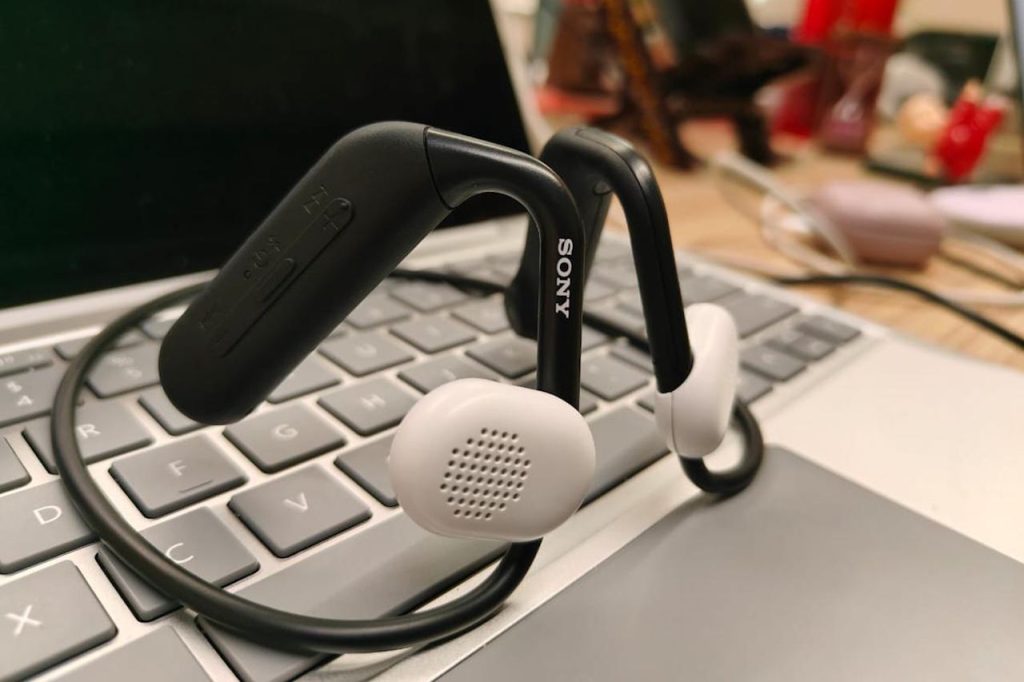
If your workouts involve movement, sweat, and the need to stay aware of your surroundings, the Sony Float Run headphones are a strong buy.
They don’t isolate you from the world like traditional earbuds. Runners, cyclists, and outdoor athletes can listen without cutting themselves off from traffic, people, or nature. That makes them one of the best open-ear headphones for running available today.
These open-ear running headphones don’t press, pinch, or slip. The lightweight design avoids the fatigue you get from in-ear tips, which suits long sessions. They also work with sunglasses, hats, and helmets.
Battery life is reliable, the Bluetooth 5.0 connection is stable, and the IPX4 water resistance keeps them safe from sweat and rain. They aren’t noise-canceling, and the bass won’t shake your core. They’re built for clarity and awareness, which suits endurance athletes, commuters, and anyone who dislikes sealed earbuds.
If you value awareness, comfort, and balance over bass-heavy isolation, the Sony Float Run headphones are worth it. You can buy Sony Float Run headphones here on Amazon.
Frequently Asked Questions
Here are answers to common questions about the Sony Float Run headphones before you buy.
What makes the Sony Float Run headphones different from regular earbuds?
The Sony Float Run headphones work differently from other headphones. Unlike traditional in-ear or over-ear designs, these use an open-ear floating driver system that sits just outside your ear canal. Instead of sealing sound inside, it projects audio naturally into your ear space. This gives you clear, detailed music while still letting in ambient noise from your surroundings. Runners, cyclists, and commuters can stay alert to traffic and people while listening.
Are the Sony Float Run headphones good for running outdoors?
Yes. The Sony Float Run open-ear headphones target runners and outdoor athletes. They provide a stable, secure fit that doesn’t bounce or slip, even during high-impact workouts. The open-ear design allows you to hear passing cars, cyclists, and pedestrians, making outdoor training safer. At only 33 grams, they feel almost weightless. With IPX4 water resistance, they handle sweat and light rain, which suits road runs and long-distance training.
Do the Sony Float Run headphones have noise cancellation?
No, and that’s intentional. They favor situational awareness over isolation, so you can hear your surroundings during outdoor runs or city commutes. If you need active noise cancellation for travel or office use, you’d want a different Sony model.
How is the sound quality of the Sony Float Run headphones?
The sound is natural. The floating dynamic drivers produce a balanced sound signature with crisp mids, clean highs, and a smooth low end. You won’t get deep sub-bass like over-ear studio headphones, but the experience is open and spacious. Podcasts, pop tracks, and acoustic playlists shine especially well. Music stays lively without drowning out your environment.
Can I use the Sony Float Run headphones with glasses or hats?
Yes. The floating frame sits around your ears rather than pressing against them, leaving room for sunglasses, hats, and helmets. There’s no pinching, no pressure, and no awkward adjustments mid-run.
Are the Sony Float Run headphones water resistant?
Yes. With an IPX4 water resistance rating, the Sony Float Run headphones can withstand sweat, splashes, and light rain. You can wear them in humid or drizzly conditions. They’re not fully waterproof, so don’t submerge them or wear them while swimming, but that covers outdoor workouts and endurance runs.
How long does the battery last on Sony Float Run headphones?
Battery life is a solid 10 hours per charge, which easily covers multiple workouts or commutes. If you ever forget to charge, the 10-minute quick charge feature gives you roughly an hour of playback. A full recharge takes about three hours via USB-C, which is standard for modern wireless gear.
Do the Sony Float Run headphones work with all devices?
Yes. These Bluetooth 5.0 wireless headphones connect to smartphones, tablets, laptops, and even smartwatches. Pairing is simple and reliable within a 10-meter range. Once you’ve connected them once, they automatically reconnect to your device next time. While they don’t support multipoint pairing, the connection remains strong and consistent throughout every session.
Can I take calls using the Sony Float Run headphones?
Yes. The built-in microphone allows for hands-free calls and voice commands. Call quality is clear in most environments, though background noise can be noticeable in windy conditions. For quick check-ins or voice assistant use while running, it performs well. The mic placement ensures your voice remains audible without needing to adjust the headset.
Are the Sony Float Run headphones worth buying?
If you care about comfort, safety, and practicality in your workouts, then yes, the Sony Float Run headphones are worth it. They’re not built for bass junkies or noise-canceling purists, but they suit runners, outdoor trainers, and anyone who wants a balanced open-ear listening experience.