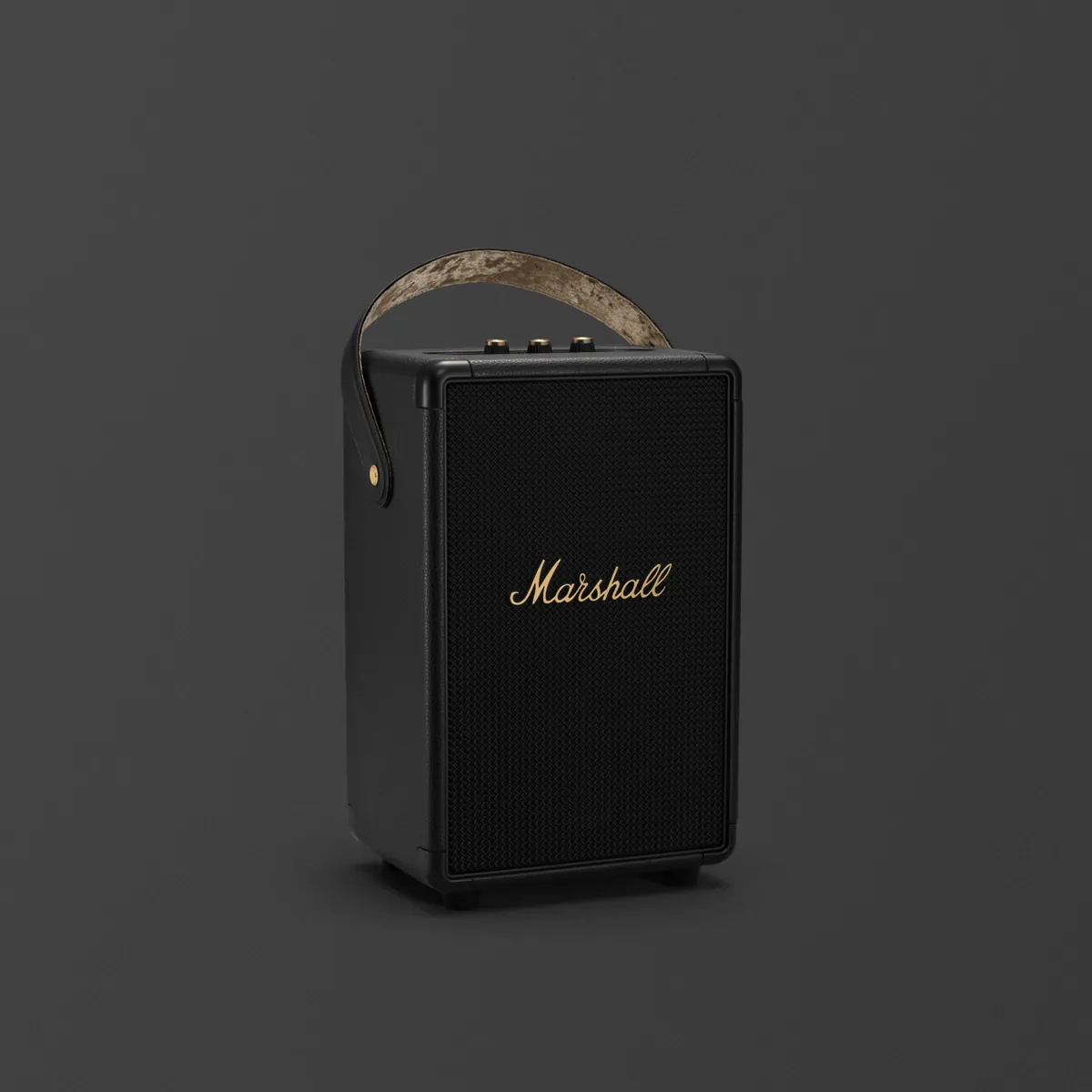
The Marshall Tufton is a portable speaker in the broadest sense: it has a carry strap and a rechargeable battery, but it weighs 4.9 kg (10.8 lb). That makes it a speaker for moving from the house to the patio, car, or picnic table, not something most people will carry all afternoon. Marshall released it in 2019, and the buying question in 2026 is less about whether the Tufton looks like a Marshall amp and more about whether its loud, bass-forward presentation and physical controls justify its size and price. Marshall’s current product page lists the model at $479.99 in the U.S. at the time of writing, so this is a buy-on-sale or buy-for-the-specific-features proposition.
Table of Contents
The Short Version
Buy the Tufton if you want a substantial Bluetooth speaker with real bass and treble knobs, a strap for short carries, and enough output for a party or large living space. Do not buy it expecting a waterproof outdoor speaker, a smart speaker, or a multi-room system. Marshall’s own support page says the Tufton cannot pair with other Marshall speakers, does not work with a Marshall app, and carries an IPX2 rating.
| Best fit | Patio, living room, garage, or car-to-picnic listening |
|---|---|
| Sound profile | Powerful and bass-forward, with an energetic Marshall character |
| Battery | 20+ hours claimed; Marshall specifies about 20 hours at medium volume |
| Inputs | Bluetooth 5.0 with aptX and 3.5 mm stereo input |
| Weather rating | IPX2: protection from dripping water, not pool or heavy-rain protection |
| Weight | 4.9 kg / 10.8 lb |
What the Tufton Actually Gives You
Marshall builds the Tufton around a three-way design with an additional rear-facing midrange driver. The company calls the result True Stereophonic, or 360-degree sound. That description is useful for placement: the speaker is not limited to pointing directly at one chair. It is less useful if you interpret “360-degree” as wide stereo separation from a pair of left and right speakers. It remains one cabinet, and the independent reviews below describe the stereo image as limited.
The official specification is unusually clear about the basics. There is one 40-watt Class D amplifier for the woofer, two 15-watt amplifiers for the full-range drivers, and a 10-watt amplifier for the tweeter. Marshall lists a 40–20,000 Hz frequency range, stereo output, a 10-meter (30-foot) Bluetooth range, and an analogue 3.5 mm input. On top are dedicated volume, bass, and treble knobs, a Bluetooth button, and a battery indicator. There is no Wi-Fi, microphone, voice command, or companion app. If you prefer a speaker that works without an account or firmware dashboard, that simplicity is an advantage. If you expect modern multi-room features, it is a dead end.
Sound: Big, Lively, and Not Neutral
The clearest pattern across the independent reviews is a powerful, lively presentation rather than a neutral studio balance. TechRadar’s 2019 review praised the soundstage and bass, reporting that the speaker produced a full, clean bass line and punchy vocals in its listening tests. It also found that midrange information could get lost between the bass and treble. The review considered the tone controls useful and preferred the sound with bass and treble near their middle positions.
AppleInsider’s review reached a similar practical conclusion from a different test setup. It described the output as bass-strong and clear with little distortion at high volume, while noting that stereo separation is modest because the midrange drivers fire toward the front and rear. Its description of a slightly gritty, rock-friendly Marshall voicing explains the appeal: guitars, drums, and energetic playlists have presence, but listeners wanting an even response for every genre should be more cautious.
The Tufton can be a convincing single-speaker party source, especially when placed where people are not all sitting in front of it. It is not a replacement for a two-speaker stereo pair if left-right imaging is the priority. Marshall’s support page also says the Tufton cannot combine with other Marshall speakers, so there is no later upgrade path to a matched pair.
Portability, Battery, and Water Resistance
The strap makes the Tufton movable, but the weight sets the boundary. TechRadar describes it as manageable from a car to a picnic spot and uncomfortable for an all-day festival. The speaker is portable between locations, not portable in the small-bag sense. Its 229 x 350 x 163 mm body also needs a stable surface; it is tall and substantial compared with a typical cylindrical Bluetooth speaker.
Battery claims are consistent but condition-dependent. Marshall says approximately 20 hours at medium volume, while the product page says 20+ hours. TechRadar repeats the 20-plus-hour claim and the quick-charge figure of about four hours after 20 minutes. AppleInsider reports a little over 20 hours in its own test. Loud playback, bass-heavy music, age, and battery condition can reduce that number, so treat it as a medium-volume estimate rather than an all-day maximum at party volume.
IPX2 is protection from vertically dripping water. It is not an IPX7 rating, so do not take the Tufton into a pool area where splashes are likely or leave it in heavy rain. The handle and reinforced corners help with carrying, but rugged styling is not the same thing as waterproofing.
Connectivity and Missing Smart Features
Bluetooth 5.0 and aptX cover ordinary wireless playback, and Marshall’s product page lists multi-host support so two Bluetooth devices can take turns. There is also a 3.5 mm stereo input for an older source or a wired connection. Those are useful, concrete options. The tradeoff is that the Tufton is deliberately offline: no Wi-Fi streaming, no AirPlay, no voice assistant, and no Marshall app. The official support page explicitly says the speaker is not supported by Marshall-branded apps.
There is no reason to buy the Tufton for a multi-room plan. Marshall says it is standalone and you cannot use it in pairs or multiple groups. For a single room, that removes setup clutter. For someone already building a networked system, it makes the Tufton a separate island.
What Independent Reviews Found
TechRadar’s conclusion was that the Tufton combines strong bass, a lively soundstage, and distinctive design with a high price, recessed mids at times, and no smart features. AppleInsider liked its volume, battery, and rugged styling but preferred the more balanced Sonos Move for broader musical coverage and Wi-Fi features. RTINGS also has an exact-model Tufton review; its page is useful for comparison browsing, although the detailed test measurements are not reproduced here.
Current owner chatter is unusually thin. An exact-model search found no Tufton owner report in the 30-day window; the apparent hits were discussions of other Bluetooth speakers or generic Marshall pricing. That means there is no responsible basis for claiming a current social consensus about battery aging, reliability, or sound. Check the seller’s return policy and battery condition if buying used.
Who Should Buy the Tufton?
The Tufton makes sense for a buyer who likes Marshall’s physical design and energetic tuning, wants a strong single-box speaker, and mostly moves it short distances. It is especially sensible when its price is clearly below a newer premium portable speaker and when the 3.5 mm input matters. It is a poor fit for daily carrying, beach or pool use, Wi-Fi multi-room, voice control, or a buyer who wants neutral sound without adjusting the tone knobs.
Before comparing prices, start with our portable Bluetooth speaker guide and browse the broader speakers section. Its strengths are output, controls, styling, and short-trip portability. If those are not your priorities, its size and IPX2 rating become expensive compromises.
Frequently Asked Questions
Is the Marshall Tufton waterproof?
No. It carries an IPX2 rating, which covers dripping water. Keep it away from pools, heavy rain, and direct splashes.
How long does the Tufton battery last?
Marshall says approximately 20 hours at medium volume, and the product page lists 20+ hours. Louder playback and battery age can reduce runtime.
Can you pair two Tufton speakers?
No. Marshall’s support page says the Tufton is standalone and you cannot use it in pairs or multiple groups.
Does the Tufton use an app?
No. Marshall says it is not supported by any Marshall-branded app. Adjust volume, bass, and treble on the speaker itself.
Is the Tufton easy to carry?
It has a useful strap, but at 4.9 kg (10.8 lb) it is better for car-to-patio or car-to-picnic moves than all-day carrying.